Anna Mani: The Weather Woman of India
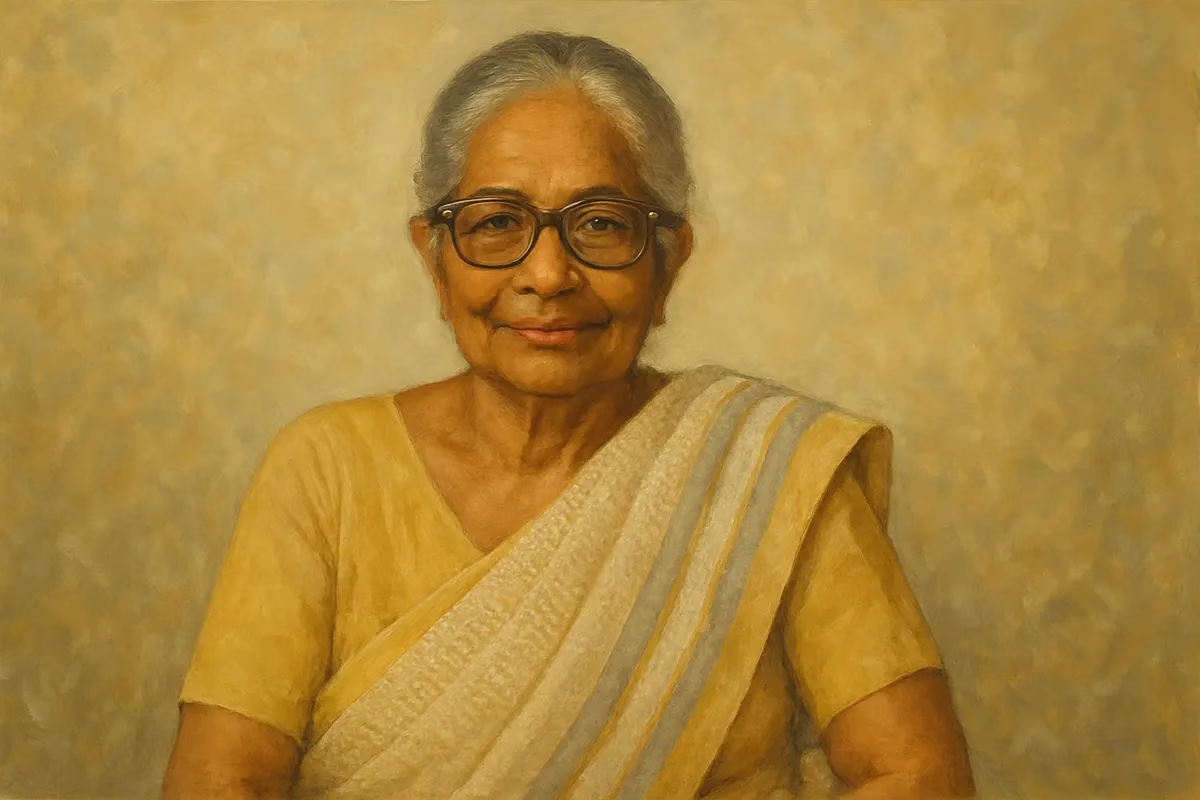
We often check the daily weather report when we plan a trip, look out to dry our clothes, find out how to prep our clothing, or even sometimes to build excuses to cancel some plans. But we rarely think about the people who made the precise forecasts possible. Behind India’s modern weather systems stands a quiet but powerful scientist. Known as the Weather Woman of India, Anna Mani built the foundation of meteorology in the country.
Through discipline, patience, and deep scientific thinking, she changed how India studied its skies. The Anna Mani story is a tale of resilience and ambition of a physicist and meteorologist in shaping India’s weather science at a time when very few women entered laboratories.
Early Life: Curiosity Begins at Home
Anna Mani was born on 23 August 1918 in Peermade, a hill station in present-day Kerala. Ever since a very young age, she followed nature with intricacy. She watched the movements of clouds across hills, observed changes in rain and wind, and was curious about the world around her.
These early observations slowly shaped her ambition and future as a meteorologist. Her parents supported education strongly. Her father encouraged logical thinking, while her mother believed deeply in learning. As a result, Anna Mani grew up valuing knowledge over tradition. At a time when many girls married young, she made a bold choice, which was to study science. This decision defined the rest of the Anna Mani story.
Education: Choosing Science Over Comfort
After schooling in Kerala and Tamil Nadu, Anna Mani studied physics at Presidency College in Madras. She displayed a great aptitude for experiments. Following that, she joined the Indian Institute of Science in Bangalore under Sir C.V. Rama,n where she published important research papers in physics.
Even though her research met high standards, she did not receive a PhD because of academic rules. But this did not stop her. Instead of capitulating, she moved forward towards her dream and ambition. This determination became a key part of the Anna Mani story and how she changed the world of weather in India forever.
Entering Meteorology: A New Path
In 1948, Anna Mani joined the India Meteorological Department (IMD). At that time, meteorology depended heavily on imported instruments. India relied on foreign tools for every weather report. Anna Mani saw a clear problem, which she then decided to solve.
She began designing and improving weather instruments that could be made in India. Over time, she led teams that built rain gauges, wind meters, thermometers, and solar radiation tools. Because of her work, India stopped importing many instruments. This achievement acknowledged that Anna Mani was no less than a true national asset.
As a meteorologist, her focus was not only on data but also on accuracy. Every reading mattered, and every instrument that India was to depend upon had to be extremely reliable.
Building India’s Weather Systems
During the 1950s and 1960s, Anna Mani expanded India’s weather networks. She set up solar radiation stations across the country. These stations helped scientists understand how sunlight affects climate, farming, and energy. As a senior meteorologist, she also worked with international scientific bodies. She represented India in global discussions and helped standardise data across countries. Her work ensured that Indian weather data matched international quality. Each accurate weather report during the monsoon season owed something to her systems.
Ozone and Climate Research
One of the most important parts of the Anna Mani story lies in her work on ozone. In the 1960s, she launched India’s first ozone-measuring balloon. This helped scientists study the upper atmosphere.
Later, Indian instruments contributed data that confirmed the ozone hole over Antarctica. These findings helped shape global environmental policies. Once again, Anna Mani, the Indian physicist, worked quietly while her data spoke loudly. As Anna Mani indian physicist, she believed science must serve people. Her research supported climate safety long before climate change became a global topic.
Life Beyond the Laboratory
People often wonder about Anna Mani husband, but the truth is simple. Anna Mani never married. She chose science as her lifelong commitment. She lived independently and focused on work, reading, music, and nature.
This choice made her different, but also free. She proved that success does not follow one path. Her personal life added strength to the Anna Mani story, showing that dedication and purpose matter most.
Later Years and Lasting Impact
Even after her official retirement, the research and ambition of Anna Mani did not stop. She continued working on wind energy research and helped map wind resources across India, supporting clean energy planning carefully and precisely.
She passed away in 2001, but her work remains alive. Every reliable weather report, every climate study, and every Indian-made weather instrument carries her influence.
Why Anna Mani Still Matters!
Today, climate challenges grow stronger. Accurate forecasts matter more than ever, and this is when the work and contributions of Anna Mani feel more relevant than before.
The Anna Mani story teaches us that progress comes from patience, discipline, and belief in knowledge. As a scientist, a meteorologist, and an anna mani indian physicist, she changed Indian science without seeking fame.
She listened to the sky carefully. And in doing so, she helped an entire nation understand its weather better. That is why Anna Mani remains India’s Weather Woman, not just in history, but in every forecast we trust today.