Karthigai Deepam - The Festival, The Case, and The Controversy!
Every year, around November and December, the hills of Tamil Nadu prepare for the Karthigai Deepam Festival. This is not just a festival for the Hindus of Tamil Nadu but an age-old tradition that has been passed down through dynasties, ages, and cultures.
Also celebrated at the Thirupparankundram Hill, one of the most sacred hills in the state of Tamil Nadu and associated with the Arulmigu Subramaniya Swamy Temple, this festival has now gripped in a legal, political, and cultural controversy.
But what exactly is the festival, case, and controversy is the question that now runs through many minds.
Karthigai Deepam Festival of Light and Memory
The origin of the Karthigai Deepam festival dates back over two millennia, with interesting stories, faith, and traditions often referred to in the Sangam age Tamil Literature. The faith finds its traces in Shaivism through two stories that the devotees believe.
The first story is about the Lord Shiva, Brahma, and Vishnu and a cosmic dispute. Lord Brahma and Vishnu had a disagreement over their superiority. In order to settle this disagreement, Lord Shiva manifested an infinite pillar of fire whose one end must be found by Lord Vishnu and the other by Lord Brahma. While Lord Vishnu chose honesty to declare that he was unable to find his end, Lord Brahma claimed a wrongful victory. Lord Shiva eventually declared Lord Vishnu victorious, declaring the importance of honesty over ego. Thus, to celebrate this, the devotees light diyas at the Deepathoon pillar.
The other story is associated with the birth of Lord Shiva’s son, Lord Kartikaye. It honours his association with the six Krittika stars, which happened to be the sparks of Lord Shiva. This is where the festival finds the origin of its name.
On this festival, multiple oil lamps or diyas are lit across Tamil Nadu. While at many places this festival is celebrated with vigour, community participation, and religious harmony, at Thirupparankundram, this tradition has taken the shape of a long controversy involving many faiths, politics, and legal battles.
Thirupparankundram: A Hill of Many Faiths
Located at about a height of 1,050 feet near Madurai, Thirupparankundram is a hill which is home to many faiths. While the rock-cut beds from the 1st century BCE trace their association to Jainism, there are also Tamil Brahmi inscriptions. Additionally, there is a Muslim dargah at the summit of the hill. And, with all, there is the ancient Arulmigu Subramaniya Swamy Temple at its base that states the sacredness of the hill in the Hindu traditions and cultures. There are also claims of Buddhist association with this hill, making it a hill of many cultures and religions.
In the Hindu religion, the Thirupparankundram hill is one of the Arupadai Veedu, the six abodes of Lord Murugan. As per the Kanda Puranam, this is the place where Lord Murugan married Deivanai after defeating Surapadman, and where he worshipped Shiva as Parangirinathar. The temple was carved directly into the rock by the Pandyas in the 6th century CE. Moreover, it is also a respected Lord Shiva worship site, recited in the Tevaram hymns.
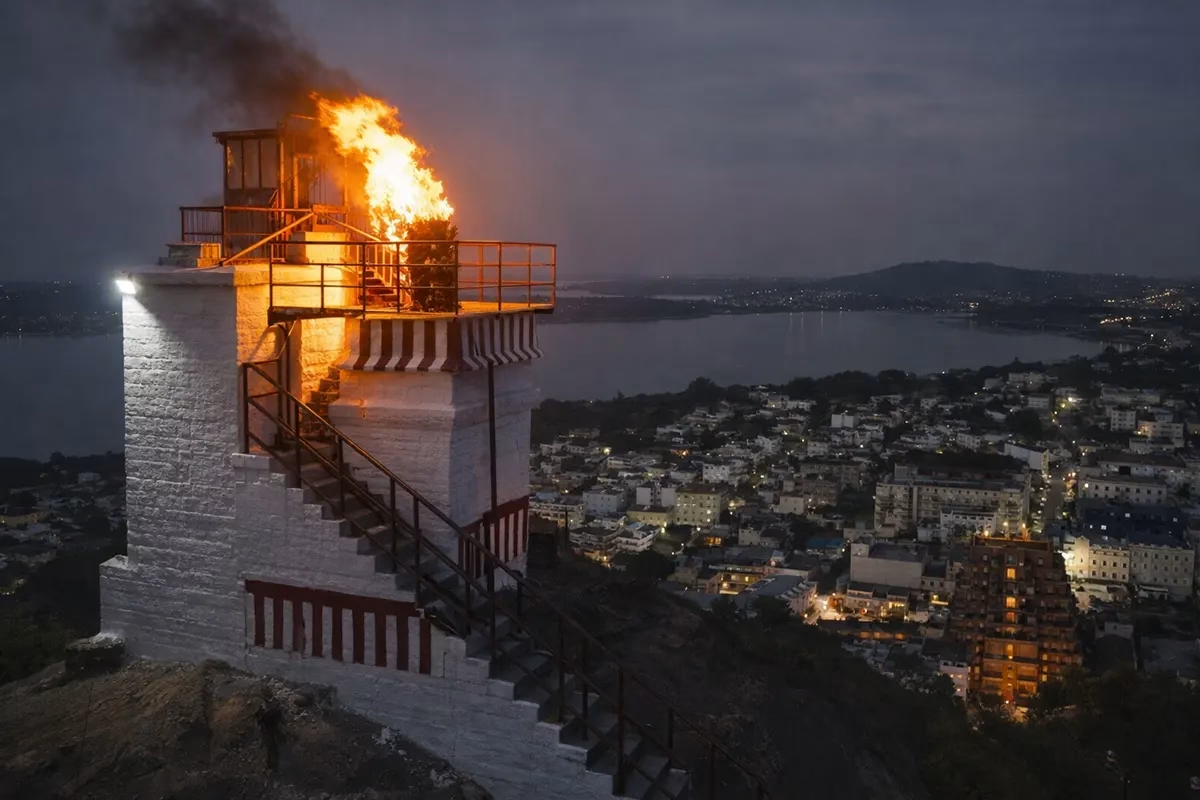
At the top of the hill is a Deepathoon pillar where the devotees lit lamps. This elevated pillar provided an opportunity to the devotees to witness the flame from a distance, making the celebration of the Karthigai Deepam more respected. And this was not a convenient incident but a ritual.
The Deepathoon and the Dispute
The Deepathoon pillar is the reason for the controversy. This lamp pillar holds a religious importance for the Hindus, but it is also claimed by the muslims as a part of the property that belongs to the durgah. Moreover, the archaeological survey of India suggests that this pillar is nothing but a colonial-era survey marker or an unrelated structure which has no relation to the Hindu traditions.
The present-day government supports the cause stated by the muslims, the Dargah authorities, and the Waqf board, while the Archaeological Survey of India tries to put forward their logic. Meanwhile, the court legally supports the Hindus on the basis of various evidence and legal history.
In December 2025, the Madras High Court judge GR Swaminathan allowed the lighting of lamps, denied by the administration. Thus followed a series of controversies, legal battles, and a string of politics.
Why the Madras High Court favours the Hindu cause
This matter reached the Madurai Bench of the HC Madras when a Hindu petitioned regarding the state’s denial of celebrating the Karthigai Deepam festival at the Thirupparankundram hill. Justice G.R. Swaminathan delivered a sharp verdict stating various reasons.
This case has a long history. In 1923, a trial court held that the land of Thirupparankundram Hill, including the Deepathoon pillar, belongs to the Arulmigu Subramaniya Swamy Temple. Only one specific portion falls under the dargah, and the pillar area is not included in that section. Additionally, under the Tamil Nadu Hindu Religious and Charitable Endowments (HR&CE) Act, 1959, this judgment remains valid. Not only that, Sangam-era texts such as Ahananuru and other Tamil literary works also describe this hill as sacred to Hinduism.
Further, a Government Order issued in 1909 granted Hindus the right to celebrate the Karthigai Festival on this hill. Along with this, in 2005, the dargah authorities themselves signed a peace committee resolution, in which they agreed that they had no objection to celebrations being held at the Deepathoon.
Thus, he held that the Deepathoon is temple property and devotees had a right under Article 25 of the Constitution to perform the ritual. He rejected arguments based on fear and speculation, stated by the DMK-led Government of Kerala, commenting that imagined threats could not override established rights.
From Ritual to National Debate
What could have just been a local religious dispute turned into a national debate when the ruling party, in collaboration with the I.N.D.I.A. bloc, started accusing GR Swaminathan of bias. They started an impeachment campaign against the judge, which sparked instant controversy on the vote politics, Hindu rights, and communalism.
In January 2026, the impeachment motion stood nowhere, and another bench at Madras High Court upheld GR Swaminathan’s ruling that favoured Hindu’s celebration of the festival. This decision was not welcomed by the DMK-led government, which has stated its will to challenge the ruling in the Supreme Court of India.
Light, Law, and the Question of Continuity
The Karthigai Deepam controversy at Thirupparankundram is not just a dispute over a lamp or land. It is much more than that. It reveals layers of politics, faith, and archaeological opportunity. It somehow triggers coexistence and questions the right to worship. It also unveils the Government’s understanding of judicial rulings, and takes an ugly turn where faiths of all communities suffer.
The question now stands if the Karthigai Festival will be peacefully marked by Deepathoon pillar lighting on 24 November 2026, or will a legal battle run throughout 2026 for the same!