
Alaknanda: How Indian Scientists Found a Mirror to the Milky Way
Recently, the world of astronomy revisited one of the most profound questions: When did the universal order and alignment originate from the chaos of the cosmos?
The answer to this question was the Astronomical Discovery of Alaknanda, a distant spiral galaxy whose beauty, complexity, and timing refuse to give in to the long-held astronomical theories.
Discovered by a team of Indian Scientists, this distant spiral is beautiful, structured, and shockingly mature. It suggests that the universe built an order in its cosmology and physics far earlier than humans anticipated.
A Galaxy or a River in the Sky
The discovery of the Alaknanda galaxy comes from the perceptive eyes of Indian Scientists, Rashi Jain and Yogesh Wadadekar, from the National Centre for Radio Astrophysics (NCRA) in Pune. Using data from NASA’s James Webb Space Telescope (JWST), they looked back 12 billion years into the past and discovered something that probably was not expected to be present in the universe at that time: Order.
The Indian scientists named the galaxy Alaknanda, after the Himalayan river that forms the headstream of the holy Ganga River in India. The name is completely apt, because just as the Ganga river flows from the high peaks to bring life to the Indian plains, this galaxy is expected to bring new light to the human understanding of cosmic history and the universe.
The "Impossible" Twin of the Milky Way
What makes Alaknanda extraordinary is not just its distance, but its maturity. This galaxy formed when the universe was only about 1.5 billion years old, roughly 10% of its current age. According to standard models of cosmology, galaxies that existed in that era were still chaotic, irregular, and unsettled. They lacked structure. They lacked rotation. They lacked symmetry. Yet Alaknanda defies that expectation.
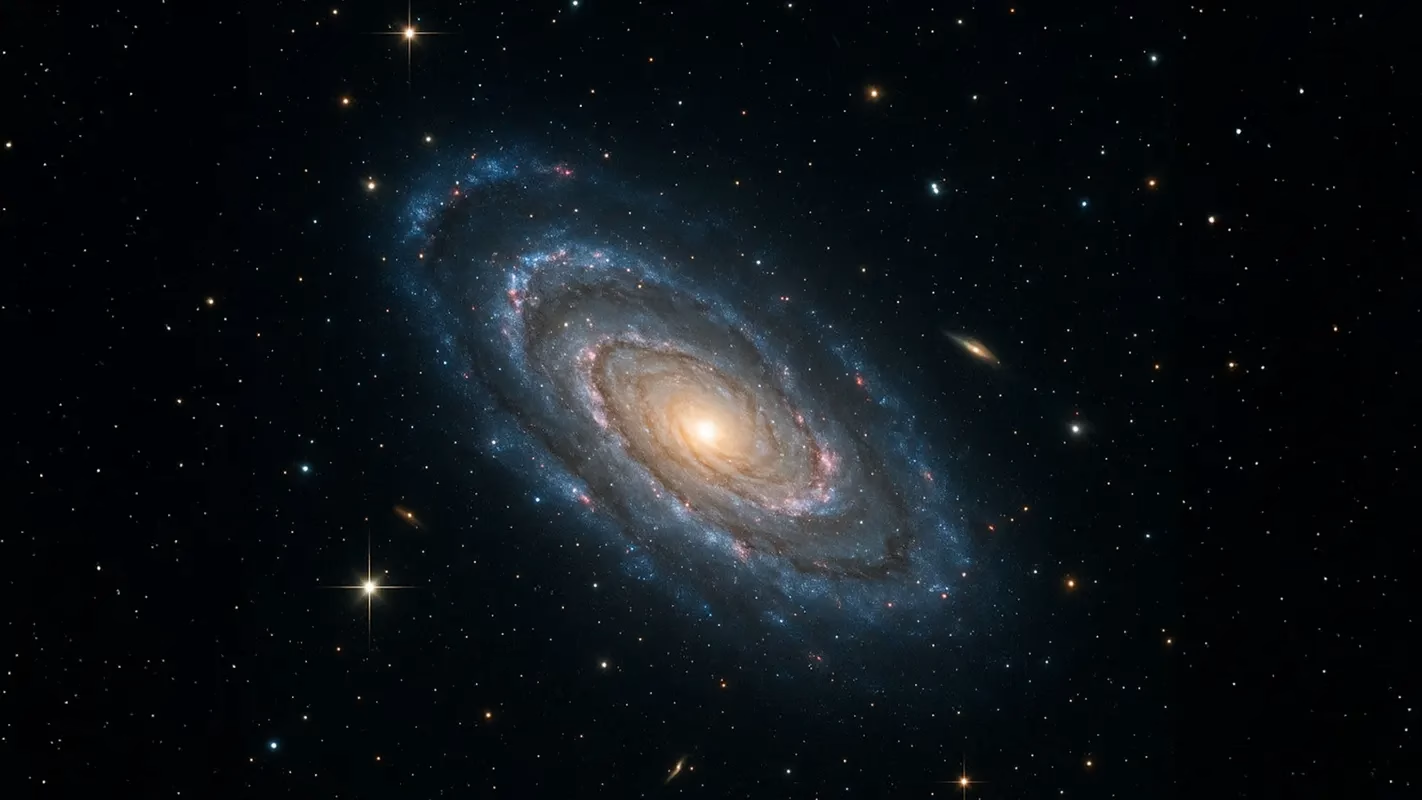
It holds a grand-design spiral structure with two clear arms and a well-formed rotating disk, hallmarks seen in mature galaxies like the Milky Way.
This resemblance raises an astonishing possibility that the universe may have developed structural order far earlier than humans predicted. As a result, the Astronomical Discovery of Alaknanda forces theorists to reconsider long-standing assumptions about how and when galaxies settle into form and how the universe used to function.
A Closer Look at the Structure of Alaknanda Galaxy
The details of the twin galaxy make this revelation even more compelling. Using high-resolution JWST data and lensing from the Abell 2744 galaxy cluster, the Indian researchers identified:
- A disk-dominated form with a low central bulge
- Symmetrical spiral arms are rare for such an early cosmic era
- Widespread star formation across the disk
- Nearly 16 billion solar masses of stars have already assembled
With a star-formation rate nearly thirty times higher than that of the Milky Way today, Alaknanda appears both active and orderly, an uncommon combination for its cosmic age.
These observations suggest that some galaxies in the early universe may have evolved quickly, quietly, and efficiently, not through violent mergers but through smooth accretion and rotational stabilisation.
How the Discovery of the Alaknanda Galaxy came to life
The identification of Alaknanda was not an accident; it was the result of meticulous analysis of astronomical data. As part of the UNCOVER survey program, the Indian scientists, Rashi Jain and Yogesh Wadadekar, meticulously reviewed high-redshift candidates. During this process, Alaknanda stood out as the only galaxy exhibiting unmistakable spiral arms.
This finding is now considered one of the most significant Astronomical Discoveries of the year, not only because of its rarity, but because of the new questions that it raises.
Why Alaknanda Galaxy Matters
The implications of this discovery extend far beyond one galaxy. If Alaknanda existed with such order at such an early time, there may be others. And if there are others, then the pace of cosmic evolution may have been dramatically faster than previously believed.
It forces a reconsideration of:
- Early gas dynamics
- Star-formation efficiencies
- The timeline of galactic evolution
- The assumed path from chaos to structure
In other words, Alaknanda is not just a galaxy, it is a revision to human understanding of the past of the universe.
A Discovery that marks the beginning, not the Conclusion
Further observations from JWST and ALMA will continue to uncover the internal dynamics of the Alaknanda Galaxy. These insights may reveal whether its ordered state emerged from companion interactions, rapid gas cooling, or processes still unknown.
For now, the world has paused to acknowledge what this moment represents. A galaxy named after a sacred river now serves as a cosmic reminder: science is not only about confirming what we know, it is about questioning what we believe. Through the work of determined Indian scientists, light that has travelled across 12 billion years now carries a message that the universe found structure earlier than we imagined. A message that is waiting to be explored into new possibilities of understanding the Universe.