
Arunachal Pradesh, Identity, and the India-China Border: A Story Reinforced by One Incident
In November 2025, a routine airport layover turned into a diplomatic flashpoint when Prema Wangjom Thongdok, a woman from Arunachal Pradesh travelling with a valid Indian passport, was detained at Shanghai airport for almost 18 hours. Chinese authorities refused to accept her passport because her birthplace was listed as Arunachal Pradesh in India, implying that the region belonged to China. She was questioned, isolated, and prevented from contacting Indian officials.
This new spread quickly online. And with it, a question resurfaced: How far will China go to assert its claim of Indian territories?
The news reached the Indian authorities, and they responded firmly. The Ministry of External Affairs detailed her detention as arbitrary and asserted that it violated international transit rules. MEA spokesperson Randhir Jaiswal stated clearly, “Arunachal Pradesh is an integral and inalienable part of India. No amount of denial will change this indisputable fact.”
This single event became symbolic, not just of a travel issue, but of the long and tense India and China border history.
The Roots of the India–China Border Tension
The India and China border stretches over 3,400 kilometres and remains one of the most disputed frontiers in Asia. While tensions flare in multiple sectors, the eastern region, especially Arunachal Pradesh, remains at the centre of global attention.
China claims the entire state and refers to it as “Zangnan” (South Tibet). India rejects this completely, maintaining that the region has been Indian territory both historically and legally.
Despite decades of agreements, military meetings, and confidence-building measures, the Indo-China border dispute remains unsettled. Incidents at the Line of Actual Control continue, and both sides maintain heavy troop deployment. The wider context, trade, geopolitics, and competing regional influence make the situation even more complex.
How Arunachal Pradesh Became Indian Territory
The foundation of India’s legal claim lies in the 1914 Shimla Convention, where the McMahon Line was negotiated between British India, Tibet, and China. The agreement placed the territory corresponding to today’s Arunachal Pradesh under Indian administration.
China, which participated in the talks but refused to sign the final treaty, later argued that the border was unfairly drawn. However, after India’s independence, the region, then known as NEFA (North East Frontier Agency), remained under Indian governance.
Key milestones include:
- 1972: NEFA became a Union Territory called Arunachal Pradesh.
- 1987: It became a full-fledged Indian state.
Throughout this period, the people living there, tribes such as the Monpa, Nyishi, Adi and Apatani, identified themselves as Indian. Their cultural, linguistic, administrative, and political ties aligned with India long before Beijing’s territorial claims intensified.
This is why the India China territorial disagreement is not only a matter of maps, it is also a matter of identity.
China's Renewed Assertiveness: Maps, Renaming, and Pressure
Over the last few years, China has repeatedly attempted to legitimise its claim. One example occurred earlier in 2025 when Beijing released a new official map showing Arunachal Pradesh as part of China. This version went viral and sparked global debate, often referenced online as the “China map Arunachal Pradesh” controversy. India rejected it immediately.
These map releases have become part of what analysts describe as “salami slicing”, small, cumulative steps that attempt to shift perception over time. In addition to maps, China has:
- Renamed towns, rivers, and mountains in Mandarin
- Issued stapled visas to residents of Arunachal Pradesh
- Objected to foreign leaders’ visits to the region
- Registered protests when India builds infrastructure near the Arunachal Pradesh and China border
Each move attempts to portray the region as disputed, or worse, Chinese.
The People of Arunachal Pradesh: “We Are Indian”
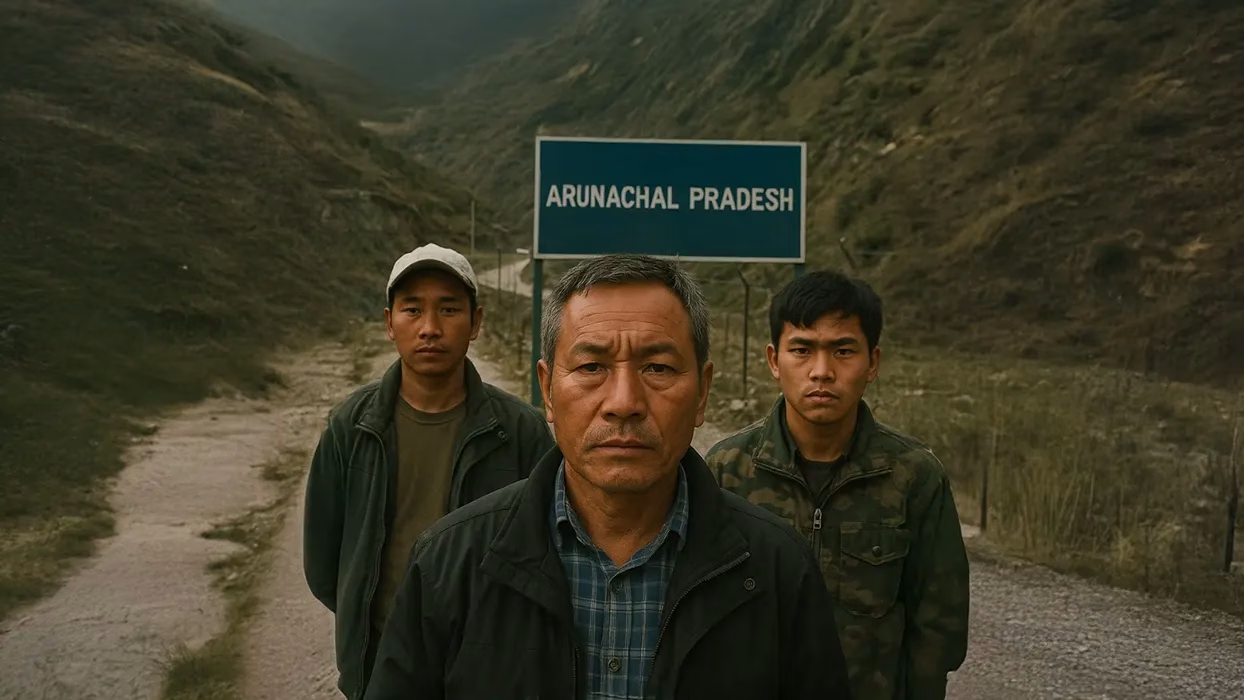
Residents of Arunachal Pradesh overwhelmingly identify as Indian. Their political leadership, cultural life, education systems, and democratic participation reflect this identity. Community responses to Chinese statements are often direct.
Locals have repeatedly said, “Arunachal was never part of China, and never will be.”
Many expressed anger and disbelief after the Shanghai airport incident. For them, it was not only an immigration matter, but it was also a denial of their dignity. Social media from the region echoed one repeated message: Being Arunachali means being Indian, not negotiable.
The Diplomatic Ripple Effect
This case arrived during a delicate period of Indo-China relations. While trade continues and diplomatic talks resume, mistrust remains high, especially after past clashes along sectors of the Indo-China border.
International reactions to the detention were notable. Media, strategic analysts, and rights groups questioned how travel documents could be rejected based on territorial claims rather than legal validity.
Some foreign governments informally expressed concern, viewing the incident as part of a broader attempt to shift global narrative about the India China border question.
A Story of Territory, But Also of Identity
The detention of Prema Wangjom Thongdok is not an isolated event; it is a reminder. It reflects how territorial disputes can extend beyond soldiers and maps into the personal lives of ordinary citizens. It shows that while officials negotiate, the people of Arunachal Pradesh continue to assert the truth every day through identity, culture, and lived reality.
And it reinforces India’s position that Arunachal Pradesh belongs to India, historically, emotionally, culturally, and legally, and no detention, renaming exercise, or map release can change that.