
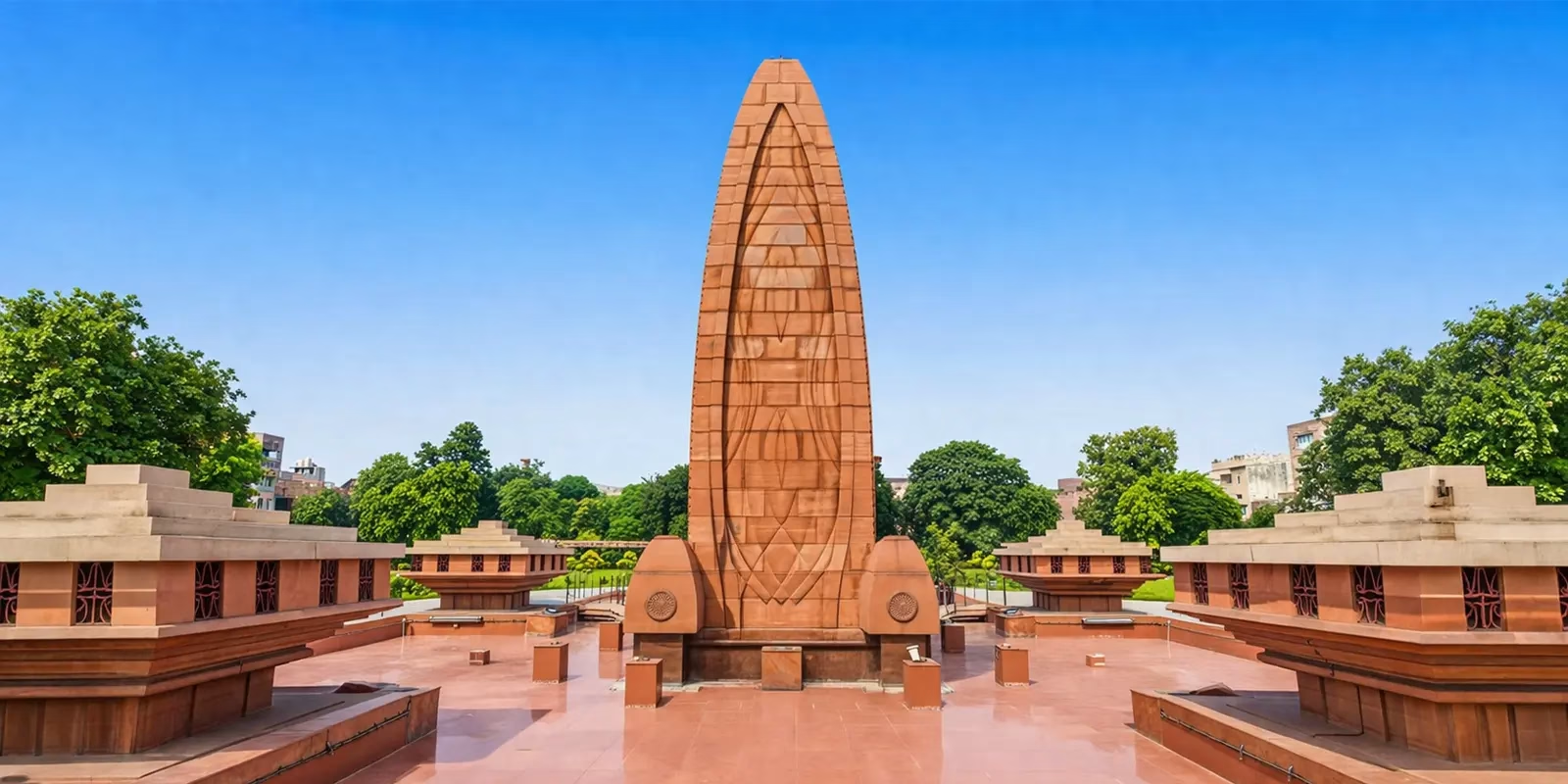
Jallianwala Bagh: Massacre, Denial, and a Century of Unanswered Accountability
It was the year 1919. The place was Jallianwala Bagh. And, more than 1,000 innocent, unarmed people were brutally killed in just ten minutes.
Their only fault: being Indian, daring to dream of freedom.
But in 2019, a woman stood smiling before the camera and called them “looters.”
And the man who ordered the firing on those innocents? An “honourable man.”
That woman was Caroline Dyer, the great-granddaughter of General Dyer, the very man who ordered firing on unarmed Indians on the day of Baisakhi and turned Jallianwala Bagh from a garden into a graveyard.
Today, 107 years have passed since the massacre, yet there is still no apology from the British side and no accountability. There are only carefully worded acknowledgements from the end of the perpetrators as an excuse dressed as acceptance. But today, we place the British narrative in the dock to understand their version of truth.
And to ask: does this version even deserve to be called the truth?
India in 1919
After World War I, the British Empire was celebrating victory. But across its colonies, from Egypt to Ireland, waves of unrest were rising. And one fear loomed large: losing India.
To suppress this fear, in 1919, the British introduced the Rowlatt Act – an act that stripped Indians of their rights even during peacetime. Arrest without a warrant, detention without trial, trial without a jury – this law was a direct attack on civil liberties. Protests were inevitable.
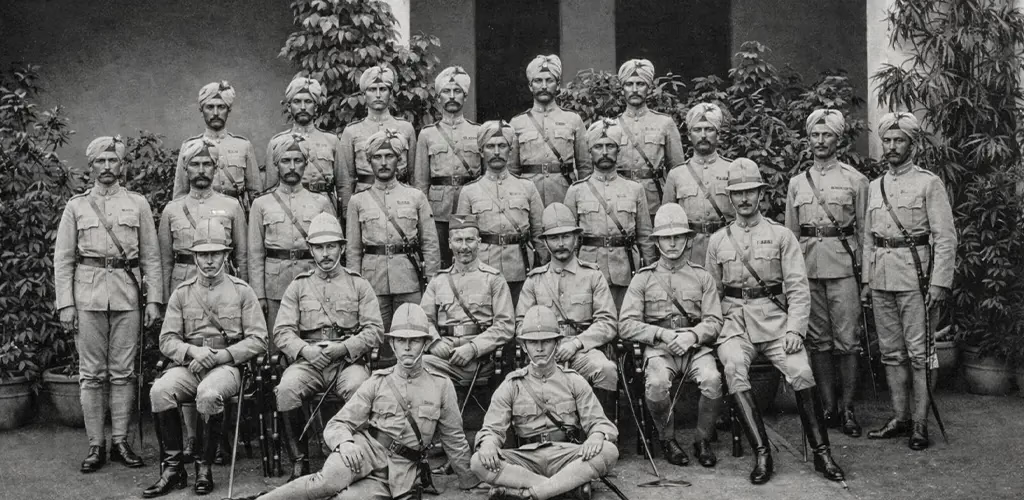
And, so were British crackdowns. In Amritsar, leaders Dr Satyapal and Saifuddin Kitchlew were arrested, angering the public. On 10 April 1919, riots broke out. A missionary was attacked, buildings were burned, and some Europeans lost their lives. This single incident became the trigger for the British administration. Brigadier General Reginald Edward Harry Dyer was sent to Punjab.
He had one mission – to crush the rising fire of freedom in India. His goal was clear – to ensure that 1919 did not become another 1857.
13 April 1919: The Bloody Baisakhi
On 13 April 1919, while Amritsar prepared to celebrate Baisakhi, General Dyer was preparing for something else. A proclamation was announced that there shall be no gathering of more than four people, and a strict curfew was imposed. Yet, a troubling fact remains: while parts of Amritsar received this order, areas like the Golden Temple and Jallianwala Bagh were never informed – a detail even acknowledged in the Hunter Commission report.
Was this a conspiracy? Perhaps.
What followed was inevitable.
On Baisakhi, between 10,000 and 20,000 people gathered at Jallianwala Bagh, near the Golden Temple – unarmed, celebrating the festival, carrying hope and prayers for freedom. To the British, this gathering was defiance and a growing threat of rebellion, terrorism, and unrest.
General Dyer arrived with armed troops. Why?
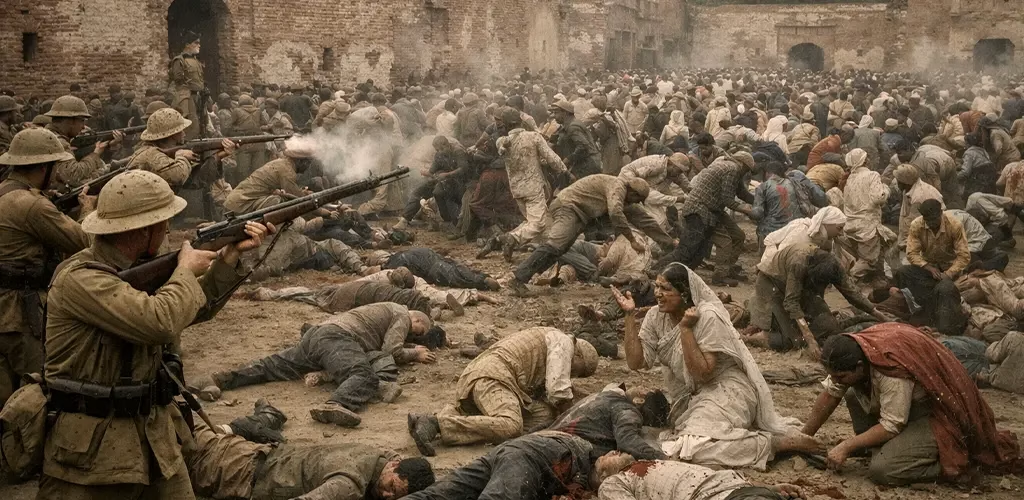
To prevent potential riots and to create a “moral effect”, a fear so deep that it would extinguish any spark of rebellion across Punjab. Within 30 seconds, Dyer made his decision. Without any warning or explanation, he ordered his troops to open fire on the unsuspecting crowd. The soldiers were Gorkhas, Pathans, Sikhs, Baluchis, not a single British soldier among them. It seemed as if Indians were being made to stand against Indians. When some soldiers paused or fired into the air, Dyer moved among them, ensuring that every bullet hit the crowd.
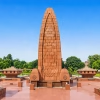
Jallianwala Bagh was enclosed on three sides, with only one narrow exit, blocked by Dyer himself. There was no escape. For the next ten minutes, 1,650 rounds were fired, and they continued until the ammunition ran out. What remained was blood-soaked ground, bodies piled in wells, and bullet marks etched into walls, marks that still exist today.
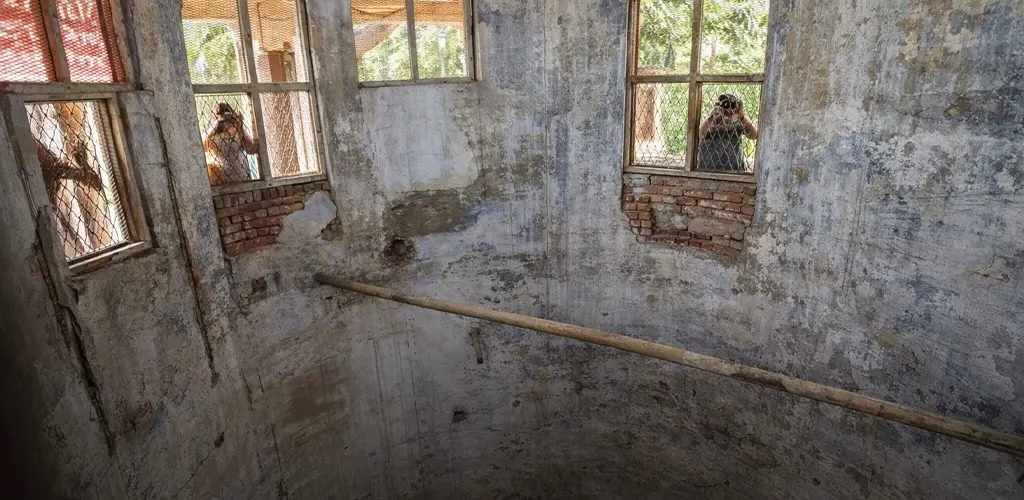
Even help was denied. Local leaders collecting funds for the injured were threatened. The wounded received no medical aid, no support. For Dyer, this was not a mistake; it was a “military necessity.”
The British Indian Government’s Version
The British Indian Government maintained a clear stance: Dyer made his decision in just 30 seconds. It was not planned. It was a “mistaken conception.”
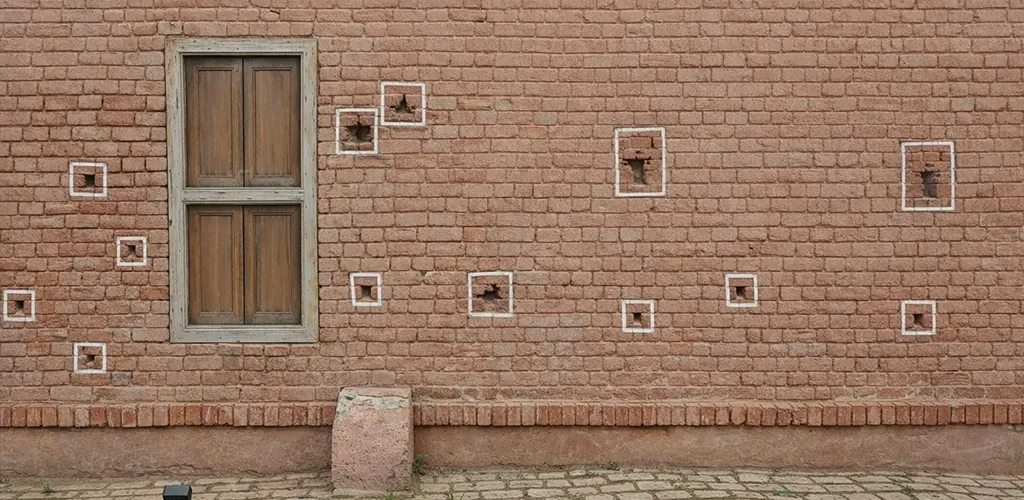
Officially, 379 people were declared dead, while eyewitnesses and records suggest over 1,000 bodies. News of the massacre was suppressed. Even Great Britain itself learned of it months later, in December. Excerpts such as Khooni Vaisakhi, a firsthand account by poet Nanak Singh, were destroyed.
And then came in the Hunter Commission. It concluded that Dyer had erred, but only out of fear of rebellion. There was no real punishment, and the only consequence Dyer ever faced was to simply be forced to retire. Some Indian accounts even mention a man named Hans Raj, who allegedly misled the crowd and supported Dyer. For the people of Punjab, this was not a military action; it was a conspiracy. But for the British Government, it was neither planned nor supported – just a momentary error in judgment.
Dyer: A Hero in Britain?
This story has two sides.
In 1920, debates were held in the British Parliament. Leaders like Edwin Montagu and Winston Churchill called Dyer’s actions “monstrous” and “terrorism.” Yet, when records were formalised, discussions about Amritsar were minimised, overshadowed by World War I narratives. Newspapers like The Times and Manchester Guardian described the firing as “excessive” – not wrong, just too much. The Morning Post even raised funds for Dyer.
Books over the years have reflected varying perspectives:
- Nigel Collett’s The Butcher of Amritsar highlights imperial arrogance as common among British officials.
- Alfred Draper’s Amritsar: The Massacre that Ended the Raj presents the massacre as a turning point that ultimately harmed British rule.
- Kim A. Wagner’s Amritsar 1919 describes it as a product of fear – the fear of losing an empire.
At the time, much of the British public saw Dyer as a hero, a man who “saved” Punjab. The House of Lords even honoured him with a sword. Honour, probably for the daylight genocide of thousands of unarmed civilians.
Sardar Udham Singh: A Terrorist in Britain?
General Dyer died in 1929.
But another key figure remained – Punjab’s Lieutenant Governor, Michael O’Dwyer, who had supported Dyer’s actions. Seeking justice, Sardar Udham Singh, one of the survivors of the Jallianwala Bagh Massacre, travelled to Britain.
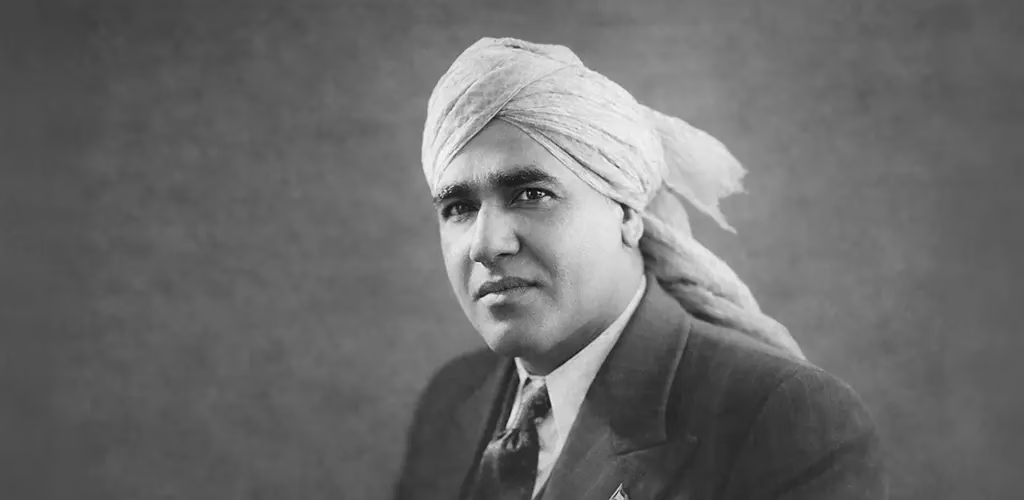
On 13 March 1940, in London, he assassinated O’Dwyer. Within four months, on 31 July 1940, Udham Singh was executed in Pentonville Prison. For Britain, he was a terrorist. But Udham Singh had been just 19 years old when he witnessed the horrors of Jallianwala Bagh. In the UK, however, there was no sympathy, only a label. The logic they were citing for Dyer paled in comparison to what they alluded to at the time of Sardar Udham Singh’s trial.
Singh never wanted to get acquitted – he dreamt of the label of “shaheed”. He wanted justice for his people – innocent, armless, innocuous – who were brutally murdered by a callous government and their sheer conspiracy to restrict the rebellion that was definitely the right of Indians.
And, the trail of Sardar Udham Singh was yet another evidence of the British brutality that continued to persist, and the striving freedom fighters of India implored the world to observe. The men that the British Government failed to even hold accountable led a life of honour, but the victims were treated like fodder to establish their colonial vainglory.
Britain Today
If one expects that, after 107 years, perspectives may have changed, disappointment is what stands ahead in the course.
- In 1997, Queen Elizabeth II visited India and called the massacre “deeply shameful” – but offered no apology.
- In 2013, Prime Minister David Cameron acknowledged it as regrettable but avoided apologising, saying he did not want to revisit the past.
- In 2019, Prime Minister Theresa May termed it a “shameful scar” on British-Indian history – yet again, no apology.
In 2025, after the release of the film Kesari 2, Caroline Dyer’s earlier remarks resurfaced, where she called the victims “looters” and Dyer an “honourable man.” Millions of Indians demanded an explanation. Social media was flooded with Indians calling out the insensitivity. The world was astonished at the temerity. There was an unbridled need for an action – an apology. And, none came.
Yet, there are voices within Britain that acknowledge the truth: Many of Dyer’s own relatives expressed shame over such statements. The British public today largely recognises the massacre as an atrocity. And, media outlets like the BBC and The Guardian, along with historians, have condemned it. In 2025, MP Bob Blackman once again demanded a formal apology in Parliament, citing the need for stronger India-UK relations. And, this is what continuously serves as optimism for Indians that one day, an apology will reach their doors. History cannot be reversed, but traumas can be put to rest with acknowledgement and closure. The apology shall imply that Britain has realised the extent of their grotesque regime just to build an empire onto which the sun could never set.
Is Acceptance Enough?
Today, the British stand in this court of history with the same argument: Jallianwala Bagh was a tragedy.
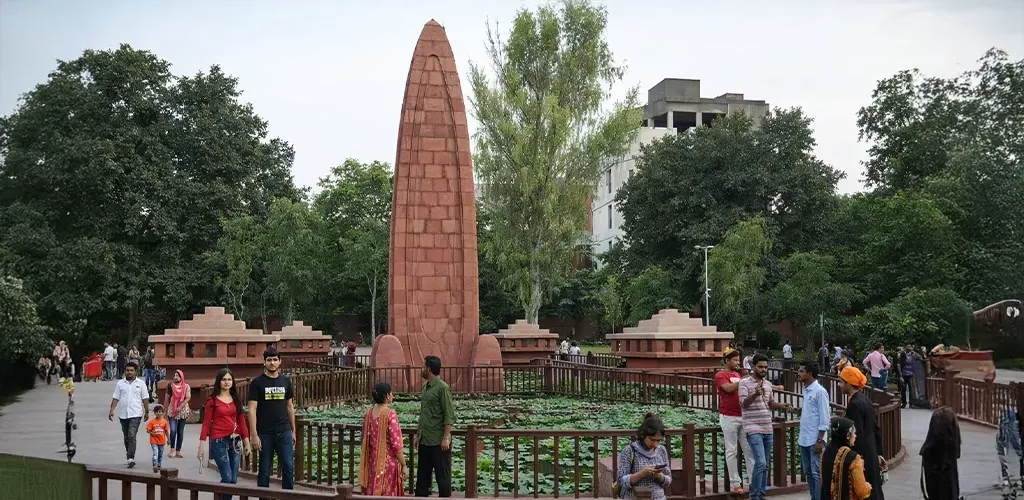
General Dyer was afraid and made a mistake, but it was neither a crime nor a conspiracy. While India still mourns, carrying the trauma of colonial brutality, standing before the bullet-scarred walls of Jallianwala Bagh in pain, the British position remains unchanged after 107 years.
No accountability. No responsibility.
Whether it is called acceptance or acknowledgement, the outcome remains the same: No apology.