
PC Vaidya: Indian Physicist Who Redefined Understanding of Radiating Stars
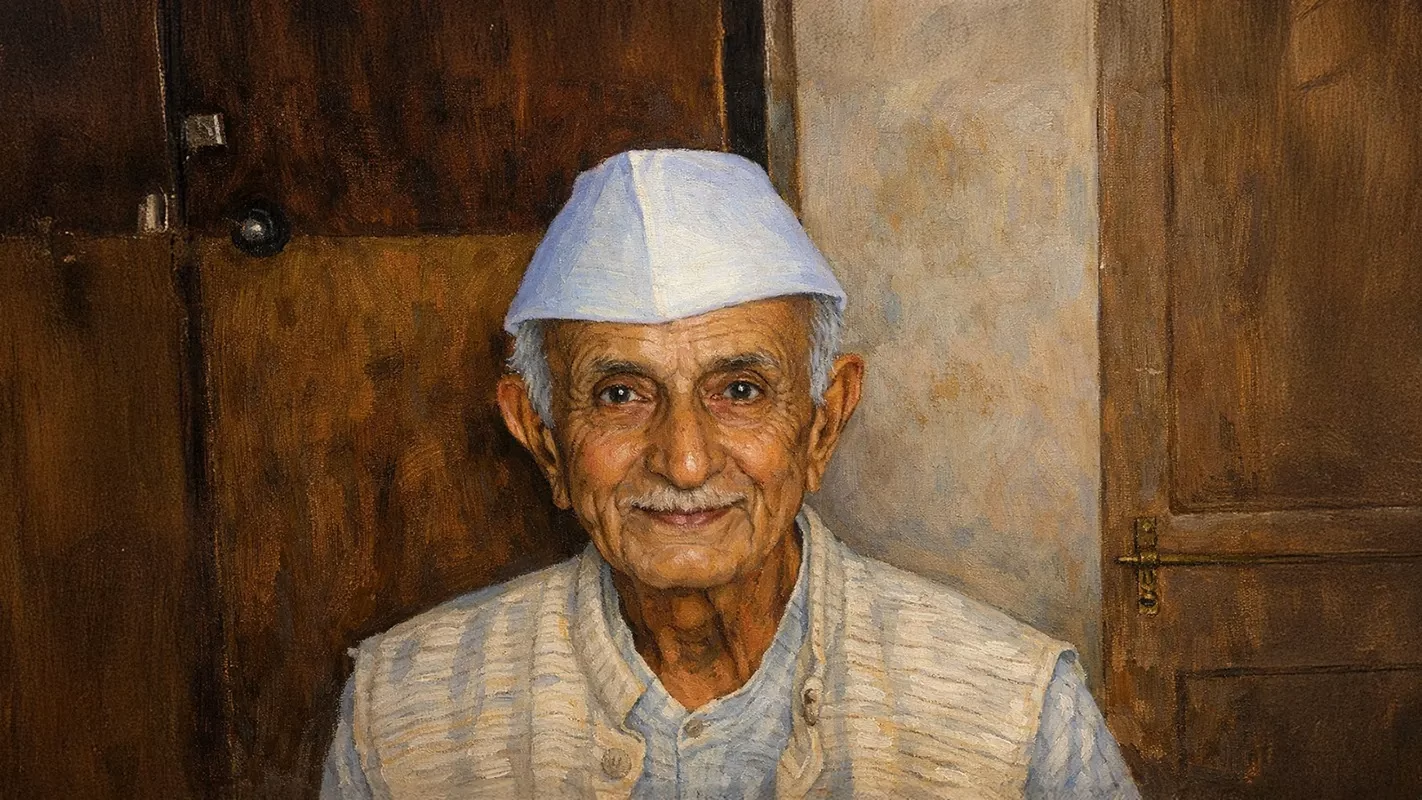
Prahlad Chunilal Vaidya, popularly known as PC Vaidya, was born in 1918 in a village in Gujarat. From a rural background, he went on to become an Indian physicist whose ideas permanently changed the way modern theoretical physics operated. While there are many physicists that the world celebrates for their loud and acknowledged achievements, PC Vaidya quietly changed the course of theoretical physics with his brilliance. He was always rooted in patients and had a lifelong dedication to the subject.
Education and Interest
PC Vaidya was interested in the field of mathematics and physics. He pursued both of the subjects at the Royal Institute of Science in Mumbai. Later, he earned his doctorate. In the early 1940s, he developed an interest in the field of general relativity. He was guided by the professor VV Narlikar at the Banaras Hindu University, who helped him shape his further journey in physics.
The Vaidya Metric
PC Vaidya changed the course of gravitational physics in the year 1943 when he published a paper where he introduced a solution to Einstein’s field equations describing a radiating star. This solution is now popularly known as the Vaidya metric. It talked about energy flow, radiation, and change. It certainly brought realism into the gravitational theory.
The Vaidya metric became a critical non-static extension of the Schwarzschild solution and is now central to research on black hole physics, stellar collapse, and astrophysical radiation. Till the present time, scientists who work on general relativity depend on the Vaidya metric to analyse and comprehend how mass and energy interact in dynamic cosmic environments.
Science with Simplicity and Purpose
PC Vaidya is influenced by other scientists are his personal values, which inspire his scientific excellence. He was not only an iconic physicist but also someone who participated in India’s struggle for freedom. An ardent follower of Gandhian principles, he practised simplicity, self-discipline, and service in research as well as administration.
Even as the Vice-Chancellor of Gujarat University, PC Vaidya commuted by bicycle. It was all reflective of the Gandhian principles that he followed, not as symbolic gestures, but as a philosophy on which he based his life. He kept reminding students and colleagues that intellectualism is not trammelled by luxuries and fame. It is reflective of living your life closely by your principles and values.
Building Scientific Temper in Society
As a physicist in the 1940s, the achievements of PC Vaidya are incomparable. But, beyond his theoretical contributions to general relativity, he also believed that science must have a larger outreach in society. Therefore, he established the Community Science Centre in Ahmedabad. His prime goal was to make science accessible to young minds. Moreover, he wanted to engage children in science in an interesting way. He was also involved in initiatives like Gujarat Ganit Mandal that strengthened mathematics education across the state.
He was committed to his belief and proved that an Indian physicist has responsibilities beyond science. He wanted to reinforce that a scientist should not only care about their own personal research, but also work towards society to enhance the curiosity and critical thinking of others in the field of science. The same Gandhian principles that guided his personal life shaped his approach to education and reform.
A Legacy That Continues to Radiate
Even though the Vaidya metric is internationally recognised, PC Vaidya still remains under-acknowledged in India. In the domain of general relativity, his work is highly appreciated and influences gravitational solutions to date. However, the life of PC Vaidya and his contributions to society and science are not very much talked about today. He had a lasting impact on. Science as well as society, and as an Indian physicist, freedom fighter, and educator, he continues to inspire anyone who believes in science, humility, and service.