
Rani Karnavati of Garhwal: The Himalayan Queen Who Defied the Mughals
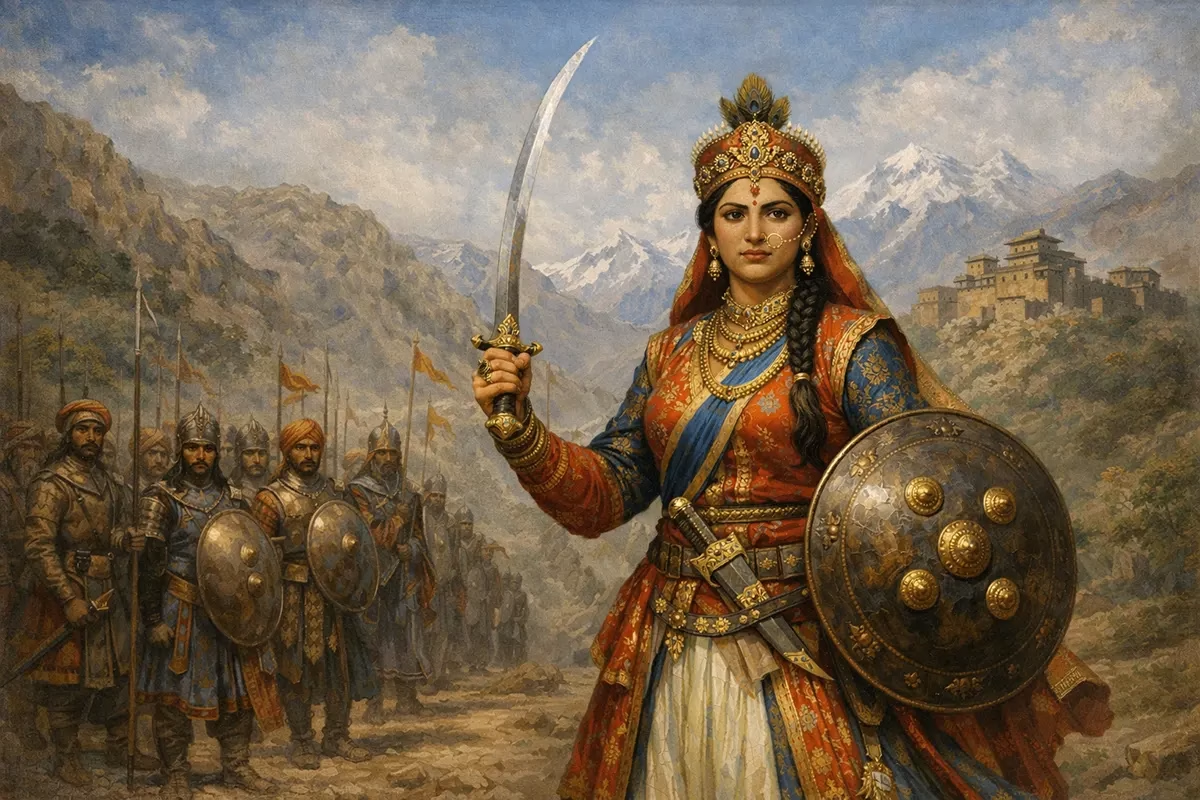
Indian Queens have always been underrepresented and hidden in the pages of history. From holding important positions and bringing in revolutionary reforms to shielding the dignity during adversity and fighting the enemies on the fields, the Queens of India have done it all. However, not many people know about them, but their accomplishments and achievements are in no way less than those of any king or warrior. One such Queen in India belongs to the Himalayan region. She defied the Mughals and was not just a figure of brutality or folklore, but a strategic leader, military tactician, and administrator, who defended her kingdom against one of the most brutal and powerful Mughal empires. This is the story of Rani Karnavati of Garhwal.
Rani Karnavati was also known as Nak Kati Rani, the nose-cutter queen in the court of the Mughals. In the 17th century, she stands as one of the most formidable female rulers in India. Her courage is widely known in the mountains of Garhwal but rarely known to the people across the nation. But Mughal’s struggle against her is an evidence of Himalayan resistance.
Early life of Rani Karnavati and her Rise to power
Not much is known about the early life of Rani Karnavati, and the remainder is shrouded in the ambiguity of history. This is not very unusual because most of the women rulers in the pre-modern historiography of India have met a similar fate. Some dependable sources suggest that she was the princess of the Kangra kingdom, which is in Himachal Pradesh in the present day. She was married to Raja Mahipat Shah of Garhwal due to a political strategic alliance. Meanwhile, other accounts stated that she was the princess of the Champawat region. Nevertheless, the idea remains the same that her marriage was a strategic move to strengthen political ties across the hill regions.
Her husband, Mahipat Shah, ascended to the throne in 1622 and was a competent leader. As a ruler, he expanded trade routes, shifted capital, launched military campaigns, conducted repeated raids, and ensured better ruling policy for the people. However, he fell to fatal injuries during a conflict with the Kumaon kingdom, which led to his passing away in 1631.
He was outlived by his seven-year-old son, Prithvipat Shah and at that moment of crisis, Rani Karnavati ascended the throne. As the female ruler of a dangerously exposed kingdom, she had to face multiple challenges. Her kingdom was threatened by Kumaon in the east, Simraur in the West, Tibet in the north, and the Mughals from all directions, who were seeking to extend their empire in India. Thus, Garhwal demanded a strong leadership that was not symbolic, but strategic and competent.
Governance of Rani Karnavati
Rani Karnavati ascended the throne due to unfortunate circumstances and during unstable governance conditions. Thus, she had to rule with diplomacy and firmness. While building trust among the people, she relied on trustworthy generals and administrators, like Lodi Rikhola, Madho Singh Bhandari, Banvaru Das Tunwar, and Dost Beg. This ensured military readiness and internal stability in the kingdom. She hardly isolated herself within the palace walls and actively engaged with the statecraft to ensure strengthened alliances with neighbouring Hill chiefs.
She had a deep understanding of the geography of the Garhwal region. Thus, she ensured that the military uses the natural defences strategically, and the steep terrain, narrow valleys, and dense forests of the region were perceived as assets for the kingdom and not obstacles. This intelligence leader became one of the major strategic reasons for her military victory.
The Mughal invasion of 1640
The Mughals were looking forward to expanding their kingdom throughout all regions, and thus, Shahjahan had his eyes on the region of Garhwal. Thus, he sent out nearly 30,000 horsemen under the leadership of General Najabat Khan to invade the Himalayan Kingdom and bring it under Mughal control.
While the Mughal Army advanced through the plains, Rani Karnavati’s forces employed sharp guerrilla tactics in order to lure the invaders into unfamiliar grounds. This included ambushes in narrow passes, supply line disruptions, strategic retreats, and much more. The Mughal Army was trapped in the mountains and constantly exhausted by the skirmishes, and suffered heavy losses. This is where Rani Ganapathy’s forces won against the Mughal invaders. She did not execute the captured soldiers, but ordered the severing of their noses and sent them back to the Mughal courts. This earned her the title Nak Kati Rani.
This act was delivered symbolically, and her move echoes through history. She intended to imply that Garhwal wasn’t ready to be conquered and was being ruled by a fierce and strategic leader.
Her move resulted in a peace treaty and the retreat of Mughal forces and dreams of penetrating the region of Garhwal.
A visionary administrator beyond the battlefield
Rani Karnavati’s strategy and victories were not limited to the field. She focused on economic stability and infrastructure, and one of her most significant contributions to the Garhwal kingdom was the Rajpur Canal, also known as Karnavati Nala. It ensured irrigation to the fertile lands of Doon Valley. This infrastructural development not only improved the productivity in the domain of agriculture but also strengthened the food security of the region.
At the foundation of various settlements like Karnaprayag, they constructed various temples and forts. These temples were crucial for cultural identity and defence. During her rule, Garhwal not only successfully resisted Mughal invasion but also repelled Kumaon, Simraur, and Tibetan forces, maintaining its territorial integrity.
Legacy of Rani Karnavati
While Rani Karnavati hold many remarkable achievements, the mainstream Indian history, accounts and textbooks hardly talk about her. She is only known through Mughal records and Garhwali folklore or oral traditions. While many places, their names, canals, temples, and stories still talk about her and keep her legacy alive, Uttarakhand hardly remembers the story of Rani Karnavati.