

The Dhurandhar Who No One Remembers
From Instagram reel trends to the silver screen, one cinematic experience that is making everyone talk is Dhurandhar. The fever for the first part was in its full glory when the second part of the movie got released and built on a story that the Indian cinema would remember for years. But this story, as real as it feels, is nowhere close to reality – because at the end of the day, it is a fiction even though inspired by real-life events.
However, ever since the movie was released, the public has been striving hard to find who inspired the exceptional character of Jaskirat Singh Rangi, alias Hamza Ali Mazari. But this groundbreaking story finds no inspiration in real-life spies of India, but it definitely traces some similarities that intensify the curiosity of the Dhurandhar fans.
One such spy whose duality and sacrifice put us all to bewilderment is none other than the Black Tiger of India – Ravindra Kaushik. While most people will emotionally recount the story of a fictional Jaskirat, Kaushik’s story haunts, amuses, and grounds them even further.
The Making of a Spy
Born on 11 April 1952, in Sri Ganganagar, Rajasthan, a border town where patriotism was not an abstract idea, but a lived reality, Ravindra Kaushik’s father served in the Indian Air Force. Discipline, duty, and nationhood were part of his upbringing. But Kaushik was not just dutiful; he was expressive. In college, he thrived in theatre, debates, and public speaking. He understood performance. He could become someone else on stage in just the blink of an eye, so believably that you would even doubt the reality. From fluency in Urdu, alongside Punjabi and Bagri, he is the epitome of both intellect and instinct.
And it was this one trait that attracted eyes from RAW in the 1970s – a moment that changed his life forever. Perhaps they did not just see an actor but someone who could live a role.
Nabi Ahmed Shakir: The real-life Hamza who did things differently
At the age when most are still discovering and striving to build themselves, Kaushik was asked to erase his every essence. From his religious identity to cultural nuances, everything about Ravindra was erased just to make way for Nabi – a life that was waiting for him in a nation that he could only imagine as an abomination.
For the next two years, he was trained in Delhi’s espionage agency. But that was not all he trained for. He was made to learn how to live as a Muslim, especially a Pakistani one. He underwent circumcision, mastered cultural nuances, and built an identity so complete that it could withstand scrutiny.
And then, in 1975, he crossed the border, moving away from his homeland but only for it. What was left of India was Ravindra Kaushik, but who entered Pakistan was Nabi Ahmed Shakir.
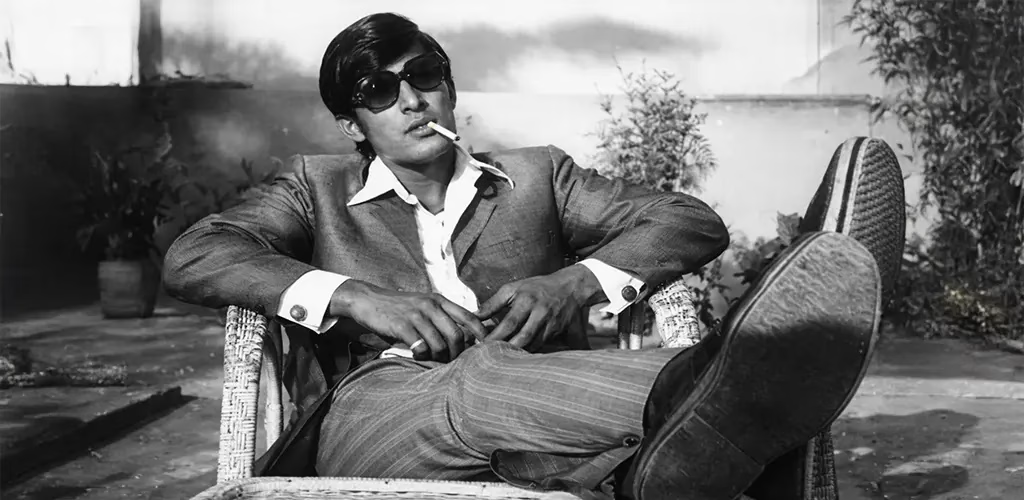
His first step was to enrol himself at Karachi University, earn a law degree, and slowly, meticulously, find his way to the Pakistan Army’s Military Accounts Department. This was the master move and an imposter growth that remains unparalleled. He made the highly intelligent parties of the Pakistani public believe that he was one of them – an art that, in reality, is much more complex than just any movie plot. This was not infiltration but a skilful reinvention that changed the course of a lot of Indian Defence decisions.
A Life Lived in Layers
From 1979 to 1983, Ravindra Kaushik transmitted critical intelligence back to India. This included information on troop movements, military strategies, and sensitive operations. With his information, India averted threats and navigated the volatile phase in Indo-Pak relations with clarity. This was not just any information. This was something that India’s national integrity depended upon.
What Ranvidra Kaushik did was so exceptional that Prime Minister Indira Gandhi gave him a codename that defines his legacy today. He was called “The Black Tiger” by her.
But a Pakistani officer with no personal life was something that wouldn’t have sat right with anyone, and this was the depth that made his cover more profoundly believable. In 1976, Kaushik married a Pakistani woman, Amanat.
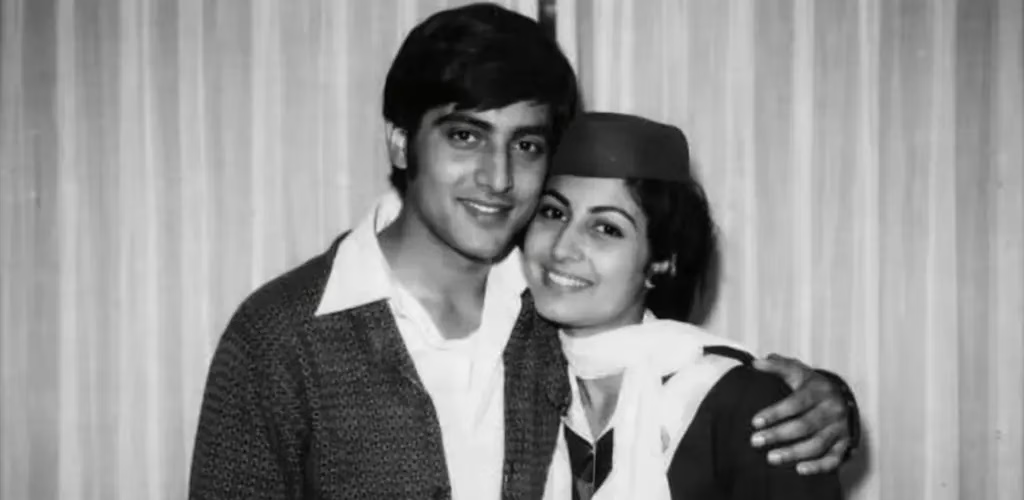
It was not a conventional love story with background music and some attraction, but a calculated necessity, an extension of his identity. Amanat never knew the truth. To her, he was Nabi Ahmed Shakir, a husband, a father, a man rooted in the same land. The two had a son together, and this quiet domesticity was carefully hidden from a haunting truth of espionage. Sometimes, the lie becomes the only life you are allowed to live.
The Fragility of Secrets
Every spy story, no matter how meticulous, rests on one fragile truth: secrets do not always remain hidden. In September 1983, that truth collapsed. Another operative, Inayat Masih, was captured and under interrogation, and details were revealed. This threatened Kaushik’s identity, the one he so carefully constructed over the years. And soon the truth was out to the world. He was arrested in Lahore.

But like most spy movies that we have seen, this culmination was not cinematic. It was brutal, full of the horrors of espionage. For nearly two years, he endured torture in Sialkot interrogation centres. Yet, he did not break. He did not reveal what was not already known. In 1985, he was sentenced to death. Later, the sentence was commuted to life imprisonment. And with that, the Black Tiger vanished into prison walls.
A Silence That Lasted Years
Kaushik spent the next 16 to 18 years in prisons, from Sialkot, Kot Lakhpat, and finally to Mianwali Jail. There were no rescue missions, no diplomatic breakthroughs, no dramatic exchanges, and only silence that demanded endless patience from him.
In letters smuggled to his family in India, he wrote not just of pain, but of abandonment. There was pride, but also a quiet anguish. The kind that does not accuse, but asks: Was it worth it?

His health started deteriorating, with malnutrition, isolation, and disease taking their toll. And on 21 November 2001, Ravindra Kaushik died in prison at the age of 49, from pulmonary tuberculosis and heart disease. He was buried in an unmarked grave. There was no ceremony, no flag, and no final salute.
The Unwritten Parallel: Cinema and Reality
Traces from the stories like Ravindra Kaushik’s often find echoes in cinema: the lone operative, double life, and the quiet sacrifice. As cinema enthusiasts and nationalists, it moves us, but the reality is unimaginable. One thing we cannot move past is how, in Dhurandhar, neither Jaskirat nor Hamza finds his family – there is no personal life, just an unending duty that refuses to dissolve or end. It carries the weight of secrecy and disappointment. The fictional world of Dhurandhar carries emotional arcs of love, betrayal, and conflict. But here lies the difference: in films, characters return, they are remembered, celebrated and even mourned.
But in reality, men like Ravindra Kaushik remain suspended between identities, claimed fully by none. He was Ravindra Kaushik in India and Nabi Ahmed Shakir in Pakistan.
And perhaps, in the end, a stranger to both.