
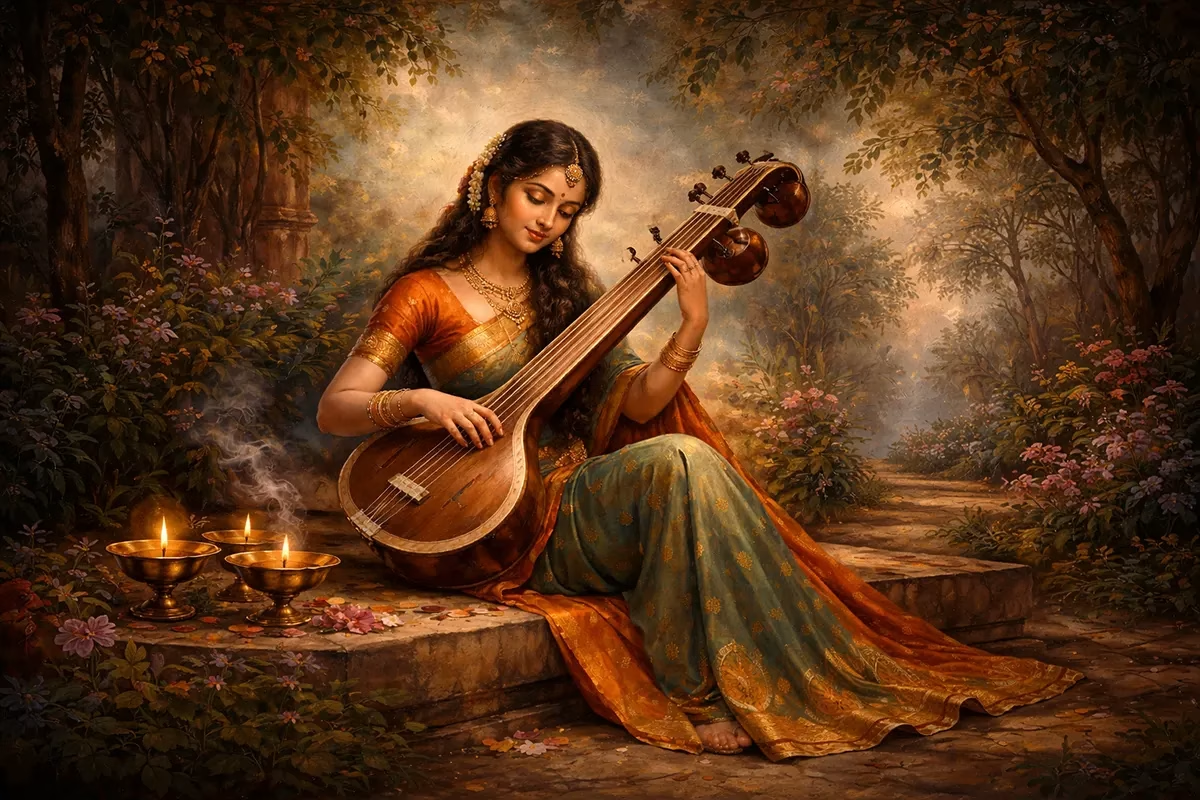
Saraswati Devi: The Forgotten Daughter of Tansen
History only remembers the voices that were allowed to be heard. All the others rest in margins, footnotes, and unscrapped memories. Saraswati Devi, the daughter of Tansen, belongs to that lineage in the history of Hindustani Classical music.
We can trace her back to the 16th century, when the musical industry was focused more on ragas, courts, and patronage. Her musical expertise lay in singing the dhrupads. Set in some fixed taals like Chautaal, Sooltaal, and others, this gayaki was mastered by her, making her stand very closely in the list of the legendary names of Indian classical music. Another musical expertise that can be tied to her is the musical instrument veena. However, she is still unknown, not because she was not acknowledged. But, because the history was not much kinder to female artists.
Growing Up in Tansen's World
Born in Tansen’s household, Saraswati Devi was never unknown to musical expertise. Her father, Tansen,was on the Navaratnas of the Mughal ruler, Akbar’s court. His musical accomplishments, knowledge, mastery, discipline, imagination, and contributions are still largely discussed throughout the musical communities and beyond. For him, music was not a profession but a lifestyle, a way of living deeply rooted in his veins.
Surrounded by such a musical idol, Saraswati Devi grew up practising with devotion, carrying forward the musical expertise and intellect in her genes. She was trained by the best, none other than Tansen. Ever since a young age, she was schooled to play the Veena. Associated with wisdom and learning, this musical instrument complemented her name as well as the profession she was being trained for.
While she was learning Veena, she also absorbed the learning of Dhrupad, one of the most demanding and difficult vocal forms of Hindustani classical music back then. Sung differently from the khyal bandishes, this singing brought her immense recognition within her family. But the world outside her familial tramlines was unknown.
The Daughter of Tansen, Seen and Unseen
The documented records from the court of Akbar, the books, and all the mentions of performances of Tansen very precisely mention him, his sons, and his musical skill. The only mentions of Saraswati Devi are limited to general references that do not complement her craft but only limit her identity to the daughter of Tansen.
The reason for this anonymity is that back at that time, there were hardly any female singers who performed in the Mughal courts, and if they did, they were forced to remain behind screens and were mostly unnamed and uncredited.
However, certain stories and tales do mention that Saraswati Devi accompanied Tansen during certain Dhrupad performances while also playing the Veena. The accounts of such stories also include an appreciation of her craft. They mention that the Veena accompanies her in a way that it used to seem as if the instrument was responding to her voice rather than accompanying it. But these accounts mention her expertise casually and not with exception, because when often compared with her father, her achievements were mostly undermined.
Music Without Ownership
Tansen trained his daughter under the Gwalior gharana of Indian classical music. He schooled her to be familiar with the raga structure, disciplined, and cautious of the nuances. She was trained to preserve certain discipline at a time when the musical vocal forms were rapidly transforming.
The sad part about the story of Saraswati Devi is that, just like many other female artists in the world of Hindustani music, she also never received the recognition for her exceptional work and contributions to the field. Her innovations and expertise were absorbed into generations of music through gharanas. With time, these changes and innovations found their credits elsewhere but were not traced back to her.
The Story of Fire and Rain
One of the most famous stories in the Indian classical music associated with Tansen is the one with Raga Megh Malhar. At one instance, Tansen was forced to sing Raga Deepak, a raga believed to generate heat enough to light up the lamps and warm the atmosphere. However, as the singing intensified, Tansen succumbed to the tough conditions. It is then that, behind the screens, a voice emerged which calmed down the atmosphere with rain. The raga that led to such a change was none other than Megh Malha,r and the singer was unnamed.
However, certain stories believe that the singer was Sarawati Devi. Since the formation of the raga, the story, and the singer are not accounted for, the story cannot trace its existence and craft to her. Just as many stories continue to claim credit for many other female artists of Hindustani music, but are hardly believed due to a lack of evidence.
Marriage and Disappearance
Saraswati Devi was married to Misri Singh, a veena player. The marriage linked two musical families of that time. However, after Tansen’s death, Saraswati Devi slowly disappeared from recorded history. By the time later historians wrote about Indian classical music, Saraswati Devi had already become a shadow.
Remembered Through Folklore, Not Texts
Today, Saraswati Devi survives through stories, mentions in family genealogies, passing references in musical lore, and performances where her name is spoken before a raga begins. Many practitioners of Hindustani music still invoke her quietly, especially the ones who play the veena instrument, not as a goddess, but as someone who was an expert in this domain.
Even though she is erased from the records, her true inheritance still lives on.