
Silent Architect of the Constitution of India: Sir Benegal Narsing Rau
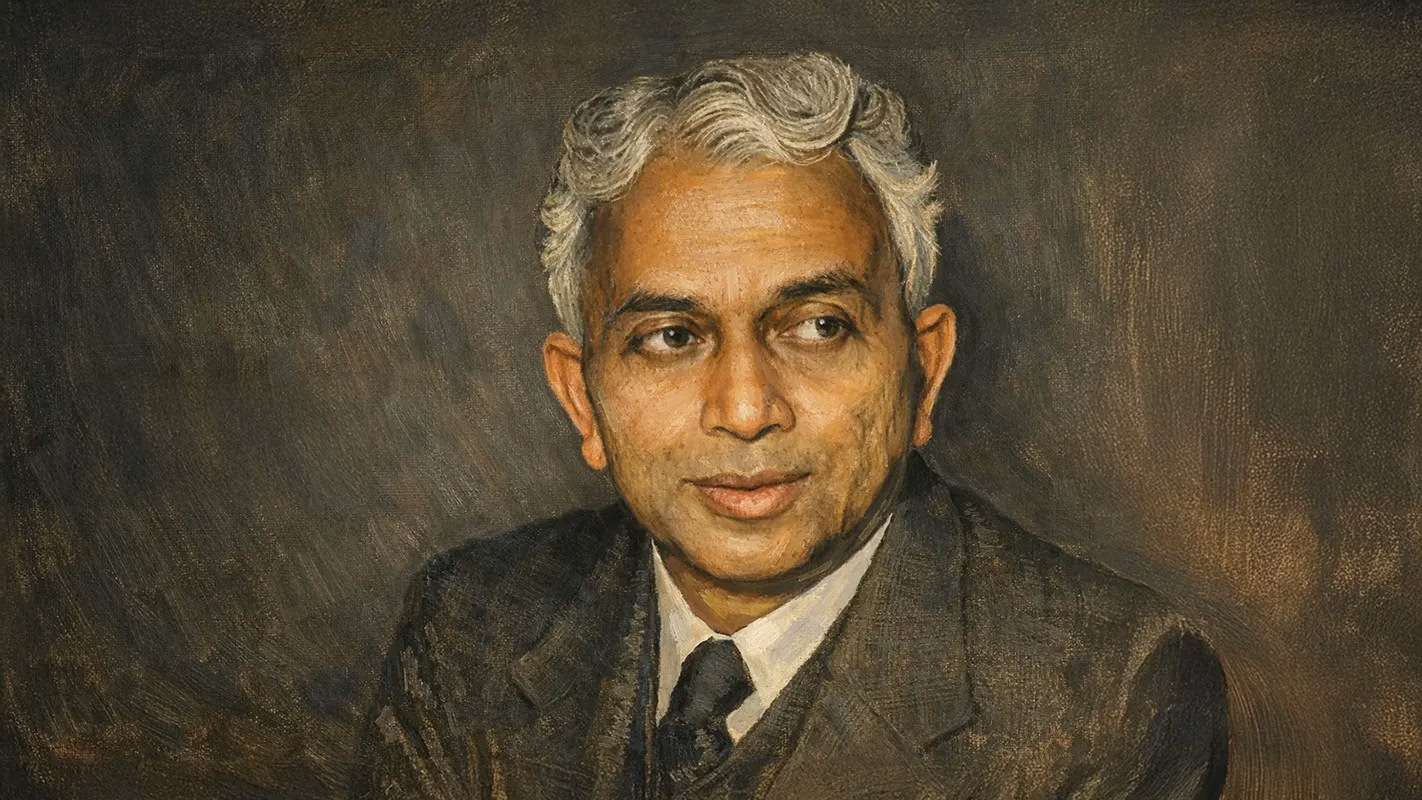
Whenever people talk about the Constitution of India, one person they never forget to mention is Dr BR Ambedkar. His role in shaping the Indian Constitution has inspired generations with an invaluable vision. But there was a man who worked behind the scenes. He was not a speechmaker in the constituent assembly, but his role was decisive in the construction of the constitution of India. This was Sir Benegal Narsing Rau, the constitutional consultant.
A Scholar of Law
Born in the city of Mangalore in the year 1887, Sir Bengal Narsing Rau was a brilliant student who went ahead to hold first division degrees in subjects such as English, physics, Sanskrit, and mathematics. Later, he continued his academic journey at the University of Cambridge, where he developed an international understanding along with academic precision. He was not only analytically sound but also had a sense of humanistic realisation, which defined his constitutional approach in the future, making it more balanced, comparative, and deeply logical.
Civil Servant to Constitutional Thinker
Sir Bengal Narsing Rau started his career in India by joining the Indian civil services. He also worked in the judiciary, where he understood the realities of governance. Throughout his life, he served as a district judge, a legal remembrance, and a High Court judge. He was also involved with the Simon Commission, the Round Table Conferences, and the Government of India Act 1935. He developed an understanding of the law through practical experience and not just theoretical study.
Rau's Role in Constitution Making
In 1946, Sir Bengal Narsing Rau was approached to become the constitutional advisor to the constituent assembly. He never sought credit for whatever he did and decided to travel across the world. In order to shape the Constitution of India as a consultant, he started his journey of travelling across the world to draw inspiration for the Indian constitution, even before the assembly was convened.
While visiting countries like the United States, Canada, Ireland, and the United Kingdom, he went through over 60 constitutions and consulted many leading jurists. He aimed to develop an understanding of world politics and the constitution through practical learning and sought a genuine understanding of people’s experiences to realise what can work, what can fail, and what India should avoid.
Blueprint Before the Building
The backbone of the Constitution of India was prepared by Sir Benegal Narsing Rau in September 1946. He created a detailed memorandum where he talked about the clear difference between the fundamental rights and non-justiciable directive principles, which was inspired by the Irish Constitution. He submitted this draft in 1947, which became the working document for the drafting committee. Dr BR Ambedkar also acknowledged that this draft turned into the foundation of the final draft of the constitution. Rau’s patience, language, refinement, structural architecture, and intent became the key factor in the smooth transition during multiple revisions that the Constitution of India went through.
Constitutional Services Beyond India
Sur Benegal Narsing Rau has not just contributed towards the formation of the Constitution of India, but also extended his services beyond national borders. He assisted in the drafting of the Burma Constitution in 1947 and has also represented India at the United Nations. At the UN, he presided over the Security Council during critical moments of the Korean War. He was also elected as the judge of international Court of Justice, which thoroughly reflects how closely he lived life by the law and international order.
A Legacy of Quiet Impact
The impact that Sir Bengal Narsing Rau left in the world was quiet. He passed away in 1953, away from the public eye and recognition, but his influence lives on through every page of the Constitution of India. He shaped the constitution while bringing global visit on the table, and at the same time, he respected the reality of India. His consultancy not only helped the constitution in becoming eclectic, but also inspired it to be extremely personal to the Indian soil and countrymen.