


World Consumer Rights Day: How Ancient India Protected Consumers 3,000 Years Ago
Every year on 15 March, the world observes World Consumer Rights Day. Governments speak about fair trade, safe products, and the consumer’s right to information. Campaigns such as Jago Grahak Jago remind people to question prices, check quality, and demand accountability.
However, there is a fascinating truth that rarely enters this conversation.
India’s concern for consumer rights did not begin in the modern era. In fact, the idea that buyers deserve protection goes back more than 3,000 years in Indian civilisation. Long before international charters and modern consumer courts existed, ancient Indian texts treated cheating a customer as a serious offence against society.

In those times, trade was not merely an economic activity. It was part of dharma, the moral order that governed life. Therefore, kings believed that protecting buyers was their sacred responsibility. The Arthashastra summarised this idea beautifully when it declared that the happiness of the king lies in the happiness of his subjects.
Because of this belief, early Indian society quietly created one of the world’s earliest systems of consumer protection.
When Trade Became a Moral Duty
The roots of this system can be traced to the Vedic era. The Vedas did not discourage wealth, but they insisted that wealth must be earned honestly. As a result, several commercial offences were already recognised as serious violations.
Adulterating food, charging excessive prices, fabricating weights and measures, or selling forbidden goods were considered crimes. What makes this particularly interesting is that these actions were not treated merely as business fraud. Instead, they were seen as acts that disturbed the moral balance of society.
In other words, cheating a customer was not simply illegal. It was unrighteous.
Manusmriti and the First Consumer Rules
As trade expanded, these moral expectations gradually turned into formal regulations. One of the earliest detailed examples appears in the Manusmriti, written between roughly 800 BCE and 200 CE.
The text laid down strict guidelines for merchants. Traders were forbidden from mixing inferior goods with superior ones or presenting poor products as high-quality items. Anyone who cheated customers through dishonest pricing faced fines.

Interestingly, the king was expected to review market prices regularly, sometimes every few days or weeks, to ensure fairness. Weights and measures were also inspected every six months to prevent manipulation.
Yet the Manusmriti introduced an even more remarkable concept. It described eighteen categories of legal disputes, many of which revolved around trade. These included selling goods without ownership, breach of sale agreements, and disputes over deposits. In effect, these rules created something very similar to an early consumer dispute system.
Kautilya’s Market Watchdog
While Manusmriti provided legal guidance, the most sophisticated system appeared later in Kautilya’s Arthashastra, written around 300 BCE during the Mauryan Empire.
The text introduced an official known as the Panyadhyaksha, or Superintendent of Trade. This officer functioned almost like a modern market regulator. Kautilya licensed traders, monitored supply and demand, and fixed profit margins to prevent exploitation. Merchants could earn reasonable profits, but they were not allowed to raise prices unfairly.
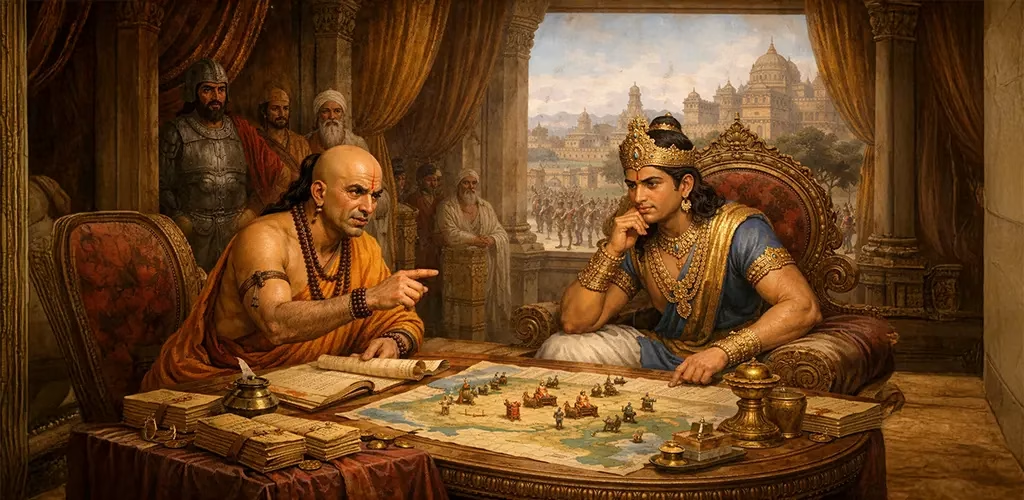
The Arthashastra also insisted that trade must happen in public marketplaces. This prevented secret deals and discouraged collusion among merchants. Standard weights and measures were produced in government workshops, and inspectors checked them regularly.
Adulteration of goods such as grains, oils, perfumes, or medicines attracted strict penalties. Moreover, buyers could return defective goods within a specified time limit, which closely resembles modern consumer protection practices.
A Tradition Behind Today’s Awareness
Ancient India even had guilds, known as sreni, that regulated their own members. These guilds enforced quality standards and punished traders who cheated buyers. At the same time, kings held courts where citizens could present complaints. Judges were expected to hear cases involving vulnerable groups such as women, minors, the sick, and the poor.
All of this reveals a remarkable truth. The principles celebrated on World Consumer Rights Day already existed in ancient Indian governance. The right to safe goods, honest information, fair prices, and legal redress were not modern discoveries in India. They were part of a long tradition that viewed fair trade as a duty towards society.
So, when we hear the slogan Jago Grahak Jago today, it is worth remembering something extraordinary.
India has been reminding its consumers to stay vigilant for thousands of years.