
The question of euthanasia — whether a person has the right to end life in cases of irreversible suffering — has troubled courts, doctors, and families for decades. While active euthanasia remains illegal, passive euthanasia in India is permitted under carefully defined conditions shaped by a series of landmark Supreme Court judgments.
On March 11, 2026, that framework was applied in practice for the very first time. The Supreme Court’s judgment in the Harish Rana case marks India’s first-ever court-ordered instance of passive euthanasia — a historic milestone that has reopened the country’s conversation about the right to die with dignity.
What Does the Law Allow? Active vs Passive Euthanasia in India
Indian law draws a clear line between two types of euthanasia.
Active euthanasia involves deliberately causing death — for example, through a lethal injection. This remains illegal in India and can be treated as culpable homicide.
Passive euthanasia involves withdrawing or withholding life-sustaining medical treatment — such as ventilators, feeding tubes, or clinically administered nutrition — in situations where recovery is medically impossible. This is permitted under strict legal safeguards established by the Supreme Court.
The idea is straightforward: medicine should not be used merely to prolong biological life when recovery is impossible and the patient cannot express a choice.
Why Is Court Permission Required for Passive Euthanasia in India?
Unlike some countries where end-of-life decisions are primarily medical matters, India requires judicial and institutional oversight before life support can be withdrawn. There are three core reasons for this.
- To prevent misuse- Ending life support is a grave, irreversible decision. Courts ensure the request is not driven by financial pressure, family conflicts, or inheritance disputes — and that it genuinely serves the patient’s best interest.
- To verify medical certainty- The patient must be confirmed to be in a permanent vegetative state or irreversible condition with no possibility of recovery — established by multiple independent medical boards, not a single doctor’s opinion.
- To protect doctors and hospitals- Without legal approval, doctors withdrawing life support could face criminal liability. Court approval ensures the decision is both legally protected and medically justified.
A Timeline of Passive Euthanasia in India
2011 — Aruna Shanbaug Case The Supreme Court rejects euthanasia for Aruna Shanbaug but, for the first time, legally recognises passive euthanasia in India. It lays down guidelines requiring High Court and medical board approval.
2018 — Common Cause vs Union of India A Constitution Bench rules that the right to die with dignity is a fundamental right under Article 21. The Court introduces the concept of a living will. Passive euthanasia is now constitutionally grounded — but has never been applied to any individual.
2023 — Procedural Reforms The Supreme Court simplifies the passive euthanasia process. Hospital-level medical boards are empowered to approve living wills. Bureaucratic hurdles are reduced to make the right practical, not just theoretical.
2026 — Harish Rana Case India’s first passive euthanasia is approved and implemented through a direct Supreme Court order. The court directs AIIMS Delhi to oversee the process and recommends Parliament enact comprehensive legislation on the subject.

The Case That Started the Debate: Aruna Shanbaug (2011)
India’s legal conversation about euthanasia began with the tragic case of Aruna Shanbaug, a nurse at Mumbai’s KEM Hospital. In 1973, she was assaulted by a hospital ward attendant, leaving her in a permanent vegetative state. She remained bedridden for over four decades.
When journalist Pinki Virani filed a petition seeking permission for euthanasia, the Supreme Court in 2011 rejected the request — but made a historic observation. It acknowledged passive euthanasia under exceptional circumstances for the first time and laid down guidelines requiring High Court and medical board approval before life support could be withdrawn. Aruna Shanbaug remained in care until her death from pneumonia in 2015.
This judgment opened the first legal door to the right to die with dignity in India.
Expanding the Right: Common Cause vs Union of India (2018)
The next major development was the Supreme Court’s landmark judgment in Common Cause vs Union of India in 2018. A Constitution Bench ruled that the right to die with dignity is a fundamental right under Article 21 of the Constitution.
The Court also introduced the concept of a living will — a legal document allowing a person to state in advance that they do not want artificial life-sustaining treatment if they ever enter an irreversible medical condition. This significantly expanded individual autonomy in end-of-life decisions.
However, while the 2018 judgment legalised passive euthanasia, it had never been applied to any individual — until 2026.
Simplifying the Process (2023)
Despite the 2018 ruling, the procedure for implementing passive euthanasia remained heavily bureaucratic and, in practice, largely unusable. In 2023, the Supreme Court revisited and simplified the guidelines — allowing hospital-level medical boards to approve living wills, reducing procedural hurdles, and clarifying the process for withdrawing life support when no living will exists.
These reforms were designed to make the right to die with dignity a practical reality rather than a theoretical one.

India's First Passive Euthanasia: The Harish Rana Case (2026)
The Harish Rana case is the moment India’s passive euthanasia framework moved from law on paper to law in practice.
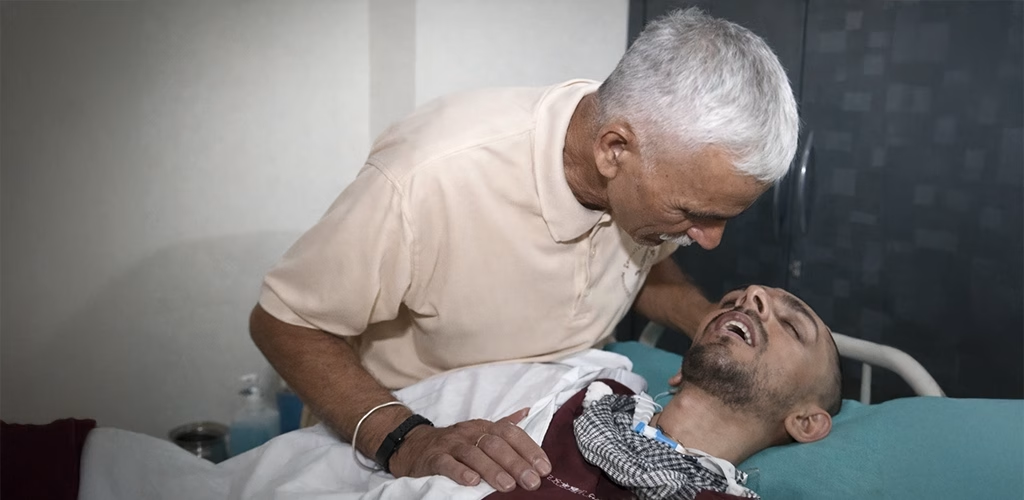
Harish Rana was a 20-year-old civil engineering student at Chandigarh University when, on Raksha Bandhan — August 20, 2013 — he fell from the fourth floor of his paying guest accommodation. The fall caused catastrophic brain injuries, leaving him with 100% disability and in a permanent vegetative state. For 13 years, he survived on a tracheostomy tube for breathing and a PEG (gastrostomy) tube for nutrition, with no signs of improvement.
His parents fought a long legal battle seeking permission to withdraw life-sustaining treatment. Lower courts had blocked the request, with one ruling that removing his feeding tubes would amount to active euthanasia. His family eventually approached the Supreme Court directly.
On March 11, 2026, a bench of Justices JB Pardiwala and KV Viswanathan allowed the withdrawal of life support — making this India’s first passive euthanasia approved through a direct court order. The court directed AIIMS Delhi’s palliative care department to oversee the process, ensuring Harish’s dignity was maintained throughout.
The judgment made two significant legal clarifications:
- Clinically administered nutrition (CAN) is medical treatment, not basic care — meaning it can lawfully be withdrawn when medical boards certify no hope of recovery.
- The key question in such cases is not whether death is in the patient’s best interest, but whether continuing life-sustaining treatment is in the patient’s best interest.
The bench also recommended that Parliament enact comprehensive legislation governing passive euthanasia in India.
What Makes the Harish Rana Case Different?
The Aruna Shanbaug case in 2011 led to the legal recognition of passive euthanasia — but permission was denied in her case. The 2018 Common Cause judgment created the legal framework — but was never applied to any individual.
The Harish Rana case is the first time the Supreme Court actually granted passive euthanasia to a specific person. It is not just another judgment on the subject — it is the judgment that finally put the law into practice.

When Bollywood Asked the Same Question: Guzaarish (2010)
Long before the Harish Rana case made headlines, Bollywood had already put the euthanasia debate on screen.
Guzaarish, directed by Sanjay Leela Bhansali and released in November 2010, tells the story of a paralysed magician-turned-radio jockey who files a petition in court seeking permission to end his life. Ethan Mascarenhas, played by Hrithik Roshan, is quadriplegic — paralysed from the neck down — and has been dependent on his nurse Sofia, played by Aishwarya Rai Bachchan, for over a decade. On the fourteenth anniversary of his accident, he decides to approach the courts for the legal right to die.
What makes the film particularly relevant today is its timing. When Bhansali made Guzaarish, the subject sparked considerable hue and cry. After the Supreme Court’s 2018 ruling on the right to die with dignity, Bhansali reflected that he had faced an outpouring of criticism for even raising the plea that the irreversibly ill should be allowed to end their lives. The film arrived a year before the Aruna Shanbaug judgment — at a time when India had no legal framework for euthanasia at all.
Guzaarish is widely considered mainstream Hindi cinema’s first film about mercy killing. It is also, in hindsight, a film that was ahead of its moment — asking questions that Indian courts would spend the next fifteen years trying to answer.
The fictional Ethan Mascarenhas was denied his petition. But in 2026, a real family from Ghaziabad finally received a different answer.
What Is a Living Will and How Do You Make One?
A living will is a legal document that allows any adult in India to record, in advance, their wishes about medical treatment in case they are ever unable to communicate those wishes themselves.
In plain terms: if you were to fall into a permanent vegetative state or an irreversible medical condition, a living will let you state that you do not want to be kept alive artificially.
Who can make one? Any adult who is of sound mind.
What should it include? Your full name and details, a clear statement that you do not wish to be put on life-sustaining treatment in the event of an irreversible condition, the name of a guardian or family member authorised to give consent on your behalf, and signatures of two witnesses.
How is it executed? It must be signed before a notary or a Judicial Magistrate First Class.
Where is it kept? A copy is given to the local government hospital, your treating doctor, and the Guardian (the person you nominate). The original should be in a place your family can access.
Can it be revoked? Yes, at any time, as long as you are of sound mind.
The 2023 Supreme Court reforms significantly simplified this process — hospitals are now required to maintain a register of living wills and act on them without requiring families to approach a High Court.
Can a family member request passive euthanasia for a patient?
Yes, but not unilaterally. A family member can approach the courts or the hospital medical board on behalf of a patient who cannot express consent. The request must be assessed by medical boards confirming the irreversible nature of the condition, and in many cases requires court approval. The courts will examine whether the request is genuinely in the patient’s best interest.
Has Parliament passed any law on euthanasia in India?
No. As of 2026, there is no standalone legislation. The entire framework is based on Supreme Court judgments. The bench in the Harish Rana case specifically recommended that Parliament enact a comprehensive law on the subject.
A Question India Will Keep Asking
Even with a clear legal framework now, euthanasia remains a deeply emotional issue. For some, allowing withdrawal of life support is an act of compassion. For others, it raises questions about the sanctity of life and the limits of medicine.
India’s courts have tried to hold both concerns together — permitting passive euthanasia only in exceptional, medically verified circumstances, with layered safeguards to prevent misuse. The Harish Rana Supreme Court judgment does not end the debate. If anything, by making passive euthanasia a lived reality rather than a legal abstraction, it ensures the conversation will continue with far greater urgency.