
Mount Abu Summer Festival: Celebration Or Commemoration?
The scorching heat invites every Rajasthani uphill to Mount Abu, but what could the purpose be?
One would naturally point out how the only hill station in the deserted state of Rajasthan would offer a cooling escape. But what if the purpose was something much different and unthinkable?
Every year, around Buddha Purnima during the Vaishakh full moon, the Mount Abu Summer Festival begins with an essence of celebration of folk traditions, tribal culture, spirituality, and community life, but it also carries something deeper and different through its rituals – something that simply surprises!
The Garasia Tribe And The Festival’s Spiritual Heart
Music, dance, games, and performances are common across festivals in India. What truly distinguishes the Mount Abu Summer Festival is its connection to the Garasia tribe – one of the indigenous communities of the Aravalli region. Known for their vibrant attire, silver jewellery, oral storytelling traditions, and close relationship with forests and mountains, the Garasia community carries a cultural identity deeply rooted in the landscape of southern Rajasthan.
During the festival, Garasia performers represent tribal life, harvest traditions, ancestral beliefs, and folklore through songs and dances passed down across generations. But for many Garasia families, the journey to Mount Abu is not only celebratory.
It is spiritual.
The Unthinkable Ritual of the Garasia Tribe
While the tourists gather around Nakki Lake for boat races, folk performances, and fireworks during the Mount Abu Summer Festival, some families participate for a much different reason. They walk toward the lake only to immerse the ashes of their loved ones in the lake.

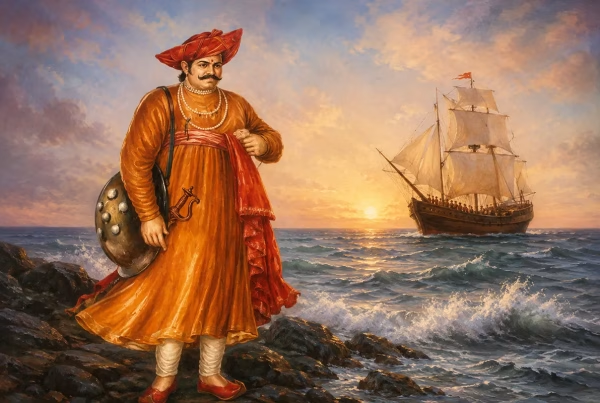
Image 2: The Garasia Tribe Ritual at Mount Abu Summer Festival
For the Garasia tribe, the Mount Abu Summer Festival is beyond just a carnival. While the other communities celebrate the breezy weather at the hilltop, the ancient observance of the tribe connects to death, memory, and spiritual release. During the sacred full moon period, families immerse ashes in Nakki Lake, believing its waters hold divine, purifying power.
This is a duality – a festival where songs of celebration and songs of mourning rise together into the mountain air.
The Ancient Legends Of Nakki Lake
The Nakki Lake, one of Mount Abu’s oldest and most sacred landmarks, is the focus of the entire Mount Abu Summer Festival. There are stories that link the lake to the rituals of the Garasia Tribe.
One story begins at the origin of its name – the name Nakki comes from the word nakh, which means nails. According to mythology, the gods dug the lake using only their fingernails while escaping from a demon named Bashkali. The lake became both a divine refuge and a hidden water source within the hills.

Another popular legend tied to the lake is the tragic love story of Rasiya Balam. According to local folklore, a sculptor named Rasiya Balam was challenged to dig the entire lake in a single night if he wished to marry the king’s daughter. Against all odds, he succeeded in completing the impossible task. However, the queen later refused to honour the promise, turning the story into one of heartbreak and betrayal.
For the Garasia tribe, these are not merely stories.
Some tribal rituals connected to ancestors and creation myths involve symbolic nail offerings into the lake, directly echoing the belief that Nakki Lake itself was formed through divine fingernails. The lake is also associated with purification and spiritual cleansing. Many locals believe its waters possess sacred qualities similar to the Ganga. Even Mahatma Gandhi shares a connection with Nakki Lake. Part of his ashes were immersed here after his death in 1948, and Gandhi Ghat was later built in his memory.
A Hill Station That Turns Into A Cultural Carnival
Every summer, an intense heat grips Rajasthan. The scorching temperatures, hot desert winds, and burning sands affect cities across the state, from Jaipur to Udaipur. It is during this season that people begin escaping toward Rajasthan’s only hill station – Mount Abu.

Traditional dances like Ghoomar, Gair, and Daph happen across the festival, and folk singers perform regional ballads. Puppet shows, horse races, skating competitions, tug-of-war matches, CRPF band performances, and fireworks are just a few more activities that one can easily spot across the Mount Abu Summer Festival.

Another major attraction is the Nakki Lake, where boat racing and sports happen. In the evenings, the lake becomes even more magical as the Deep Dan ceremony happens, during which floating lamps drift across the water.
A Festival Of Contrasts
What makes the Mount Abu Summer Festival unforgettable is how naturally it brings together different worlds. Loud celebrations coexist with the solemn tribal rituals and modern tourism in reach of cool weather, and entertainment also finds its place within rituals of ancestry, spirituality, and remembrance. Another duality lies in how a place in a deserted state offers a chilling escape while the cities and towns all around fume in the heightened temperatures.
The truth is that while being the festival of contrasts, at the same time, the Mount Abu Summer Festival constantly stands as a carnival – a celebration of life, before and beyond existence.