Rabindranath Tagore: Reimagining Villages, Nature, and the Meaning of a Complete Life
Rabindranath Tagore is often remembered through the lens of literature, as the Nobel laureate behind Gitanjali and the composer of Jana Gana Mana. Yet, beyond his poetry and songs lies a lesser-explored dimension of his life: his deep engagement with rural India and his philosophical belief that human life, nature, and community must exist in harmony. For Tagore, this was not an abstract idea. It was something he actively tried to build.
When Rural India Changed Tagore

His understanding of rural life began to take shape in the 1890s, when he started managing his family’s estates in places like Shilaidaha and Patisar. Living amidst rivers, fields, and villages, often on a houseboat along the Padma, Tagore encountered a reality that reshaped his thinking. What he saw was not just poverty, but a deeper erosion of social and cultural vitality. Villages, once self-sustaining and vibrant, had become dependent, fragmented, and stripped of dignity.
Beyond Charity: A Philosophy of Self-Reliance
This experience marked a shift in his life. He moved from being a landlord observing rural distress to someone committed to rebuilding village life from within. Unlike many reformers of his time, Tagore did not believe in charity or top-down intervention. He argued that real change must come from within the community itself, through self-reliance, cooperation, and renewed cultural confidence. For him, development was not limited to economics; it had to include joy, creativity, education, and a sense of belonging.
Sriniketan: A Living Experiment

This philosophy found its most concrete expression in Sriniketan, established in 1922 near Santiniketan. Sriniketan was not designed as a model village to be replicated mechanically. Instead, it functioned as a living experiment – an evolving space where rural communities could rediscover their strength while adapting to modern knowledge.
Agriculture was improved through scientific methods, but without dismissing traditional wisdom. Cooperative systems were encouraged to reduce dependence on exploitative structures. Education extended beyond classrooms through initiatives like mobile libraries, while youth groups worked to strengthen community life.
Villagers and students engaged in crafts, agriculture, or cooperative activities within Sriniketan, reflecting Tagore’s model of rural reconstruction
“Life in Its Completeness”
What distinguished Tagore’s approach was his insistence on what he called “life in its completeness.” He believed that a village could not truly thrive if it only addressed survival. It needed space for art, music, festivals, and emotional well-being. In his view, the absence of joy was as damaging as economic hardship. His efforts at Sriniketan were therefore as much about restoring cultural life as they were about improving material conditions.
Nature a Teacher, Not Backdrop

Parallel to his rural work was his deeply personal relationship with nature. Tagore did not treat nature as a backdrop or resource; he experienced it as a living presence. He often spoke of an intimate companionship with trees, rivers, and the sky. This perspective shaped not only his writing but also his educational philosophy.
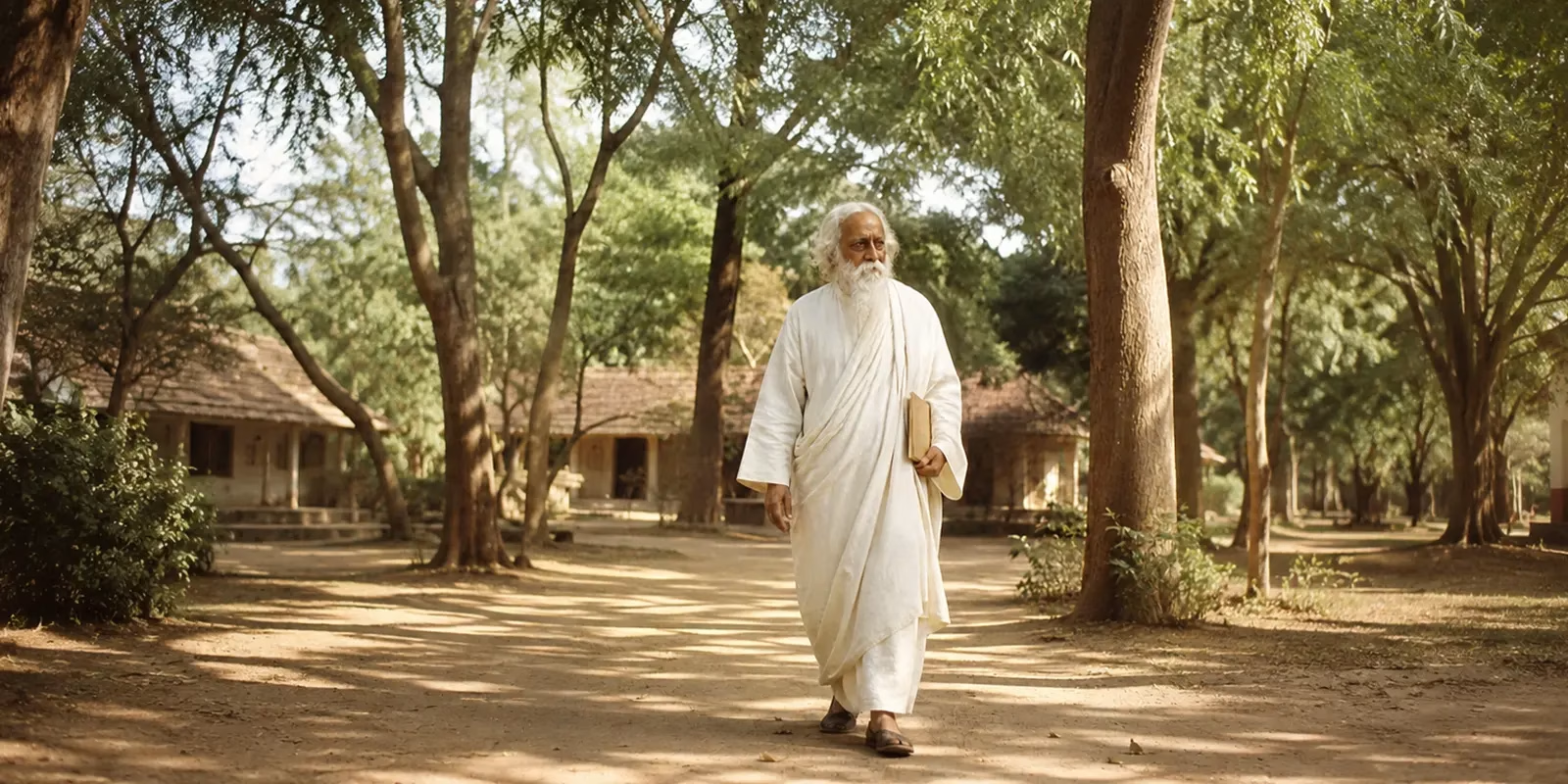
At Santiniketan, learning often took place outdoors, under open skies, because he believed that nature itself was the greatest teacher – capable of nurturing curiosity, sensitivity, and freedom in ways formal structures could not. Students are seated under large trees in an open-air classroom setting, reflecting Tagore’s belief in nature-based education
Seasons as the Language of Emotion

Nature also became the language through which Tagore expressed human emotion and spiritual experience. In his works, particularly in collections like Stray Birds and Gitanjali, the changing seasons mirror the inner life of individuals.
Spring evokes renewal and awakening, the monsoon carries longing and intensity, autumn reflects quiet fulfilment, and summer suggests fullness and fleeting beauty. These were not merely aesthetic choices; they reflected his belief that human life is deeply intertwined with the rhythms of the natural world.
A Quiet but Lasting Vision
In many ways, Tagore’s ideas feel strikingly contemporary. Long before sustainability became a global concern, he was already advocating for development rooted in ecological balance, community participation, and cultural continuity. He resisted both colonial models of extraction and narrow forms of nationalism, arguing instead for a vision of progress that began at the grassroots.
His legacy extends far beyond literature. It lies in a way of thinking that refuses to separate growth from well-being, or progress from harmony. Tagore’s work reminds us that villages are not relics of the past but living ecosystems, that nature is not external to human life but central to it, and that true development must address the fullness of human experience.
For Tagore, a nation could never be truly modern if its villages were left behind.