7 Mathematical Concepts That Were Discovered in India — But Are Rarely Credited to Indian Mathematicians
Every morning, you wake up and use a number system invented in India. You check the date using a calendar built on arithmetic refined in India. If you studied mathematics in school, you worked with concepts — zero, decimals, algebra’s foundations, early calculus — that were developed in India, often centuries before European mathematicians are credited with the same discoveries.
You probably weren’t taught any of that.
The history of mathematics, as it is taught in most of the world, follows a largely Eurocentric path: from Greece to Rome to Renaissance Europe to the Enlightenment. India appears, if at all, as a footnote. The reality, as historians of mathematics have been slowly and painstakingly establishing, is considerably more complicated — and considerably more Indian.
Here are 7 mathematical concepts that were discovered by Indian mathematicians — but are commonly attributed to, or named after, someone else entirely.
1. Aryabhata & Brahmagupta's Number System: The Decimal System Europe Called Arabic
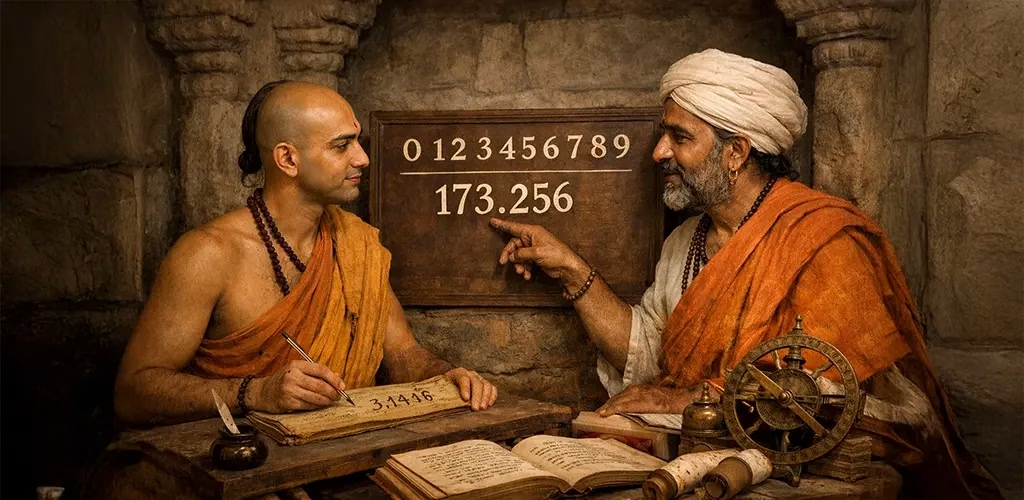
The decimal system you use every day — where the position of a digit determines its value — was built in India, by specific people, over a traceable period of history.
It began with the Brahmi numerals — the decimal digits 1 through 9, appearing in Ashoka’s edicts as far back as 250 BCE. These are the direct ancestors of the digits you are reading right now.
The positional value — where the same decimal digit means something different depending on where it sits — was formalised by Aryabhata in 499 CE in his Aryabhatiya. The final piece, zero as a number with its own arithmetic, was defined by Brahmagupta in 628 CE in his Brahmasphutasiddhanta. His word for it: shunya — void.
2. The Fibonacci Sequence: Pingala Described It 1,500 Years Before Fibonacci Was Born
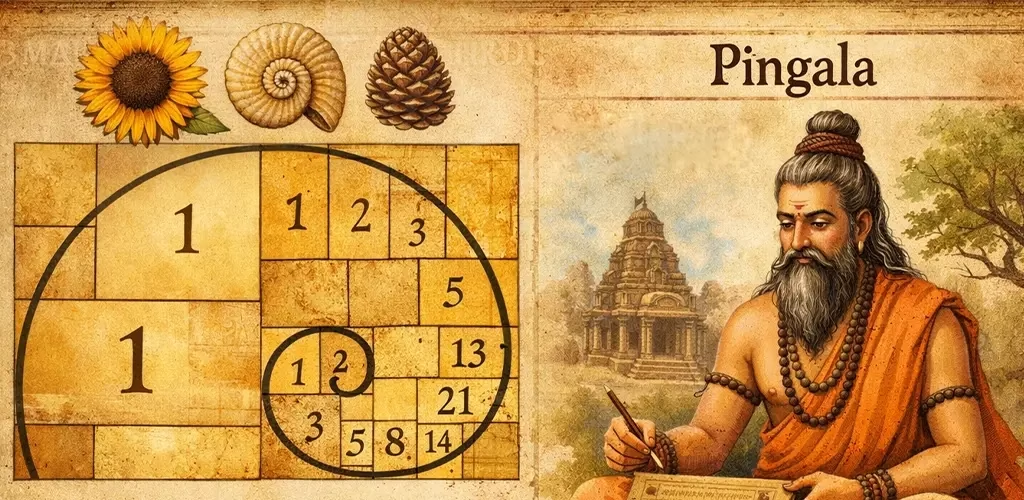
The sequence 1, 1, 2, 3, 5, 8, 13, 21 — where each number is the sum of the two before it — is one of the most famous patterns in mathematics. It appears in sunflower spirals, nautilus shells, and the branching of trees. It is called the Fibonacci sequence, named after Leonardo of Pisa, who introduced it to Europe in his 1202 book Liber Abaci.
But long before this, the sequence was described in India around 300–200 BCE by the mathematician and musicologist Pingala, in his work on Sanskrit poetry. Pingala was classifying the patterns of long and short syllables in Vedic metre — and in doing so, encountered this sequence as a natural consequence of the combinatorics involved.
Fibonacci himself was transparent about his sources. In Liber Abaci, he explicitly noted that these mathematical ideas came to him through Arab scholars who had brought them from India. His successors chose to name the sequence after him anyway.
The gap between Pingala and Fibonacci: approximately 1,500 years.
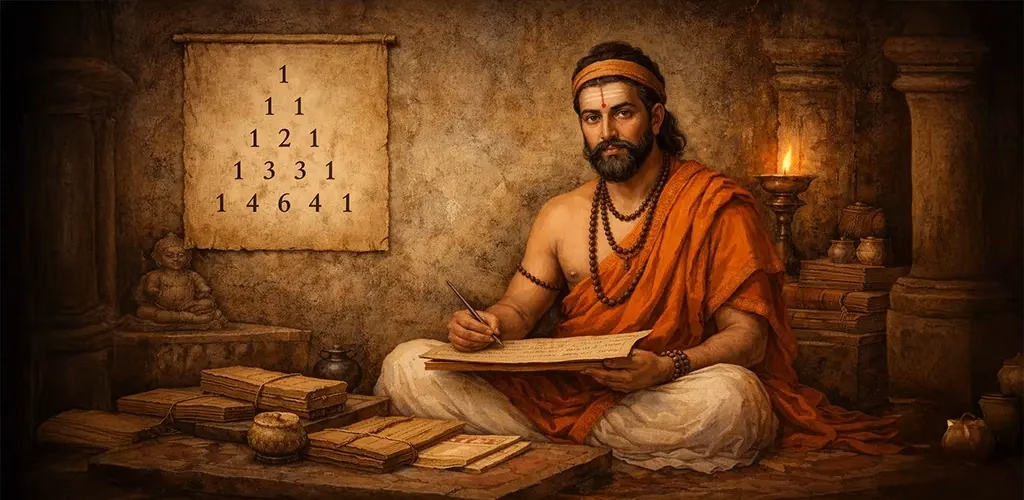
3. Pingala & Halayudha's Triangle: The Structure Blaise Pascal Made Famous - But India Knew 2,000 Years Earlier
Blaise Pascal described his famous triangle of numbers in 1653. The same structure — rows of numbers where each entry is the sum of the two above it — had been described in India by Pingala around 300 BCE and elaborated upon by the mathematician Halayudha in the 10th century CE, more than 600 years before Pascal.
In academic mathematical history, it is sometimes acknowledged as the Halayudha triangle, or the Pingala-Pascal triangle. In most school textbooks around the world, it remains simply Pascal’s triangle.
The structure appears in Halayudha’s commentary on the Chandas Shastra — a work on Sanskrit prosody — where it was used to calculate the number of possible patterns in metres of varying syllable lengths. The mathematics was there. The naming came from elsewhere.

4. Pingala's Binary System: The Logic of 0s and 1s That Leibniz Formalised — 2,000 Years Later
The binary number system — representing all values using only 0 and 1 — is the foundation of every computer, smartphone, and digital system on earth. It is attributed to Gottfried Wilhelm Leibniz, who formalised it in 1679.
Pingala, working in India around 300 BCE, described a binary-like system in the same work on Sanskrit metre. He used laghu (light, short syllable) and guru (heavy, long syllable) as his two states — directly analogous to 0 and 1. To analyse all possible combinations of syllables in a line of poetry, he needed a system that could represent every possible pattern. What he built, to do that, was structurally binary.
The context was poetic. The mathematics was not. Pingala arrived at the conceptual architecture of binary logic for the same reason most mathematical discoveries happen — he needed a tool to solve a real problem.
Leibniz arrived at the same system roughly 2,000 years later.
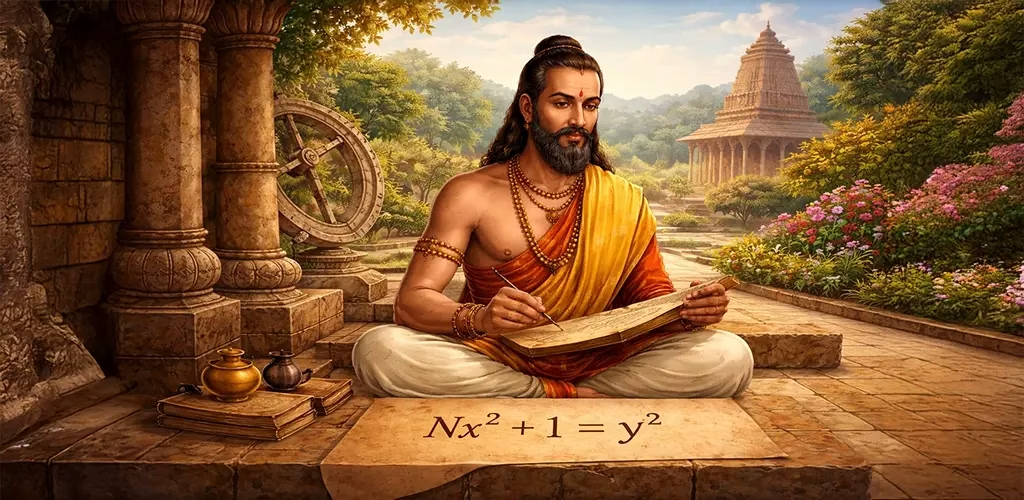
5. Pell's Equation: Brahmagupta Solved It in 628 CE. Europe Worked On It 1,000 Years Later — and Named It After the Wrong Person.
Pell’s equation — a class of mathematical problem involving whole-number solutions to equations of the form x² − Dy² = 1 — is named after John Pell, a 17th-century English mathematician. There is a well-documented historical irony in that name: John Pell did not solve it.
The equation was misattributed to Pell by Leonhard Euler — one of history’s greatest mathematicians — who made an error in attribution. The person who actually solved it was the Swiss mathematician William Brouncker. But the name stuck.
What is less discussed is that the equation itself had been studied and solved by the Indian mathematician Brahmagupta in 628 CE — in his landmark work Brahmasphutasiddhanta — and extended to a full general solution by Bhaskara II in 1150 CE. That is over 1,000 years before European mathematicians seriously engaged with the same problem.
Brahmagupta’s method, called chakravala or the cyclic method, was described by the 19th-century mathematician Hermann Hankel as one of the finest achievements of ancient mathematics. It remains, by any measure, one of the most sophisticated pieces of number theory from the ancient world.
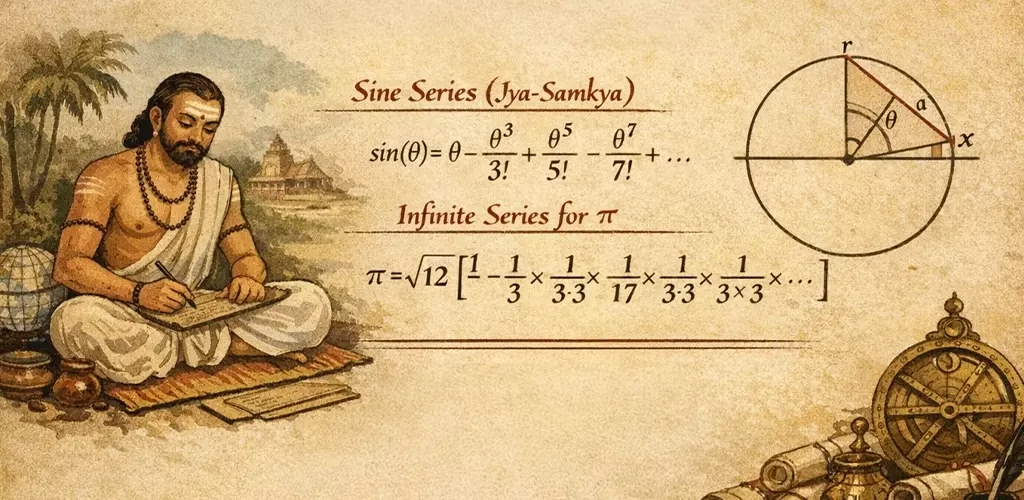
6. Madhava's Calculus: The Kerala School Built Its Foundations 250 Years Before Newton and Leibniz
Calculus — the mathematics of change and accumulation — is credited to Isaac Newton and Gottfried Wilhelm Leibniz, who developed it independently in the 1660s and 1670s. What is far less widely known is that the Kerala School of Mathematics, founded by Madhava of Sangamagrama in the 14th century, had already developed the core conceptual architecture of calculus approximately 250 years earlier.
Madhava derived infinite series expansions for sine, cosine, and the arctangent — results that Newton, Gregory, Taylor, and Maclaurin would independently rediscover in Europe between the 1660s and 1740s. He used these series to calculate π to 13 decimal places, a world record that stood for well over a century.
Bhaskara II, working in the 12th century, had earlier demonstrated an early understanding of differential calculus concepts — including what is now called Rolle’s theorem — more than 500 years before Leibniz was born.
Some historians have suggested that Jesuit missionaries active on the Malabar coast in the 16th century may have encountered Kerala School manuscripts and carried their contents to Europe. The evidence is suggestive but not conclusive. What is not in dispute is the timeline: the Kerala School was there first.
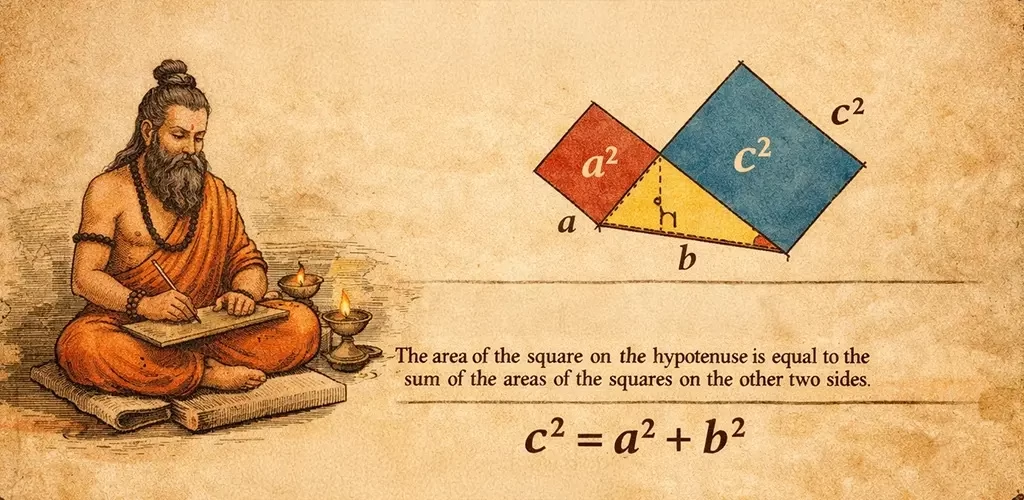
7. Baudhayana's Theorem: The Geometric Truth India Knew 300 Years Before Pythagoras
The Pythagorean theorem — that in a right-angled triangle, the square of the hypotenuse equals the sum of the squares of the other two sides — is one of the most famous results in all of mathematics. It is named after the Greek mathematician Pythagoras (c. 570–495 BCE). The Indian texts known as the Sulba Sutras state and apply the same relationship — and they predate Pythagoras.
The Baudhayana Sulba Sutra, composed around 800 BCE, contains an explicit statement of the theorem and uses it to construct altars of specific shapes and sizes. The Apastamba Sulba Sutra, from around 600 BCE, lists Pythagorean triples — sets of three numbers that satisfy the theorem — with remarkable precision.
Indian scholars were using this mathematical relationship for practical geometric construction centuries before Pythagoras is recorded as having proved it. The theorem’s proof is Greek. Its knowledge, and its practical application, predates Greece.
In a nod to this history, it is sometimes called the Baudhayana theorem in academic literature. In school classrooms worldwide, it remains Pythagoras.
Why Did the West Get the Credit? The Story of How India's Mathematics Got Lost in Translation
It was transmission — and transmission has always had a politics of its own.
Between the 7th and 12th centuries, Arab scholars were the most active translators and carriers of scientific knowledge in the world. They encountered Indian mathematics through trade on the Malabar coast and through texts carried to Baghdad. They translated, refined, and transmitted it westward — honestly crediting India in their own writings. Al-Khwarizmi titled his work On the Calculation with Hindu Numerals. Al-Kindi called his On the Use of the Indian Numerals. The attribution was explicit.
The problem came one step further down the chain. When European scholars received this knowledge through Arabic translations in the 11th and 12th centuries, they cited their immediate source — Arabic scholars — without necessarily tracing the knowledge back to its Indian origin. By the time the printing press standardised these names into textbooks, the Indian layer had been papered over.
A similar story played out with the Kerala School. Madhava’s infinite series work was done in Sanskrit, in a South Indian village, at a time when Europe had no systematic mechanism for accessing or translating regional Indian scholarship. Jesuit missionaries on the Malabar coast in the 16th century may have encountered some of it — but even if they did, it entered no formal European record. Newton and Leibniz, working a century later, had no documented access to these manuscripts. They arrived at the same results independently — and were credited for it, because in the world’s record, they were first.
The pattern repeats: Indian knowledge was oral or Sanskrit-recorded. European knowledge was Latin-recorded, printed, and institutionalised. The printing press did not just spread knowledge — it froze attribution.
What Does It Mean That We Don't Know This?
None of this is secret. The evidence sits in manuscripts, in academic journals, in careful translations of ancient Sanskrit texts. Historians like George Gheverghese Joseph, Kim Plofker, and A.K. Bag have spent careers documenting it.
The gap between what the historical record shows and what most people are taught reflects a longer story — about which knowledge systems were written up, translated, transmitted, and institutionalised during the centuries when the modern world’s educational frameworks were being built. India’s mathematical tradition was documented in Sanskrit, a language that was not systematically translated into European languages until the 18th and 19th centuries. By then, the textbooks had already been written, the names already assigned.
Changing a name that has been embedded in education for generations is genuinely difficult — and names are not, ultimately, the most important thing. What matters more is the question of how we understand the history of human knowledge: as a story with one centre, or as a far wider, more distributed, and more extraordinary record of what people across every civilisation have been able to figure out.
India’s contribution to that record is not a footnote. It is, in several crucial areas, a foundation.