Indian Fashion: Worn By The World, Credited To None
What is fashion about: originality, or reinvention?
Because when it comes to Indian fashion, the answer is rarely simple. What the world often celebrates as modern, vintage, boho, aesthetic, or global has, more often than not, existed in India for centuries, rooted in culture, climate, and craft.
And yet, today, these very elements walk international runways with new names, new narratives, and no memory of where they came from. But this is not a new story, it is a pattern – a pattern that concerns the Indian audience watching this from far.
The Red Carpet That Forgot Its Roots

In March 2026, the Vanity Fair Oscars After-Party became an unexpected stage for Indian fashion. Bella Hadid walked in wearing a custom Prada ensemble, an ivory silk satin two-piece with a halter-neck blouse, a fitted skirt, and a trailing scarf. The global media described it as everything from a “modern 90s look” to a “bridal two-piece”.
But what many noticed, especially in India, was something far more familiar: a lehenga choli silhouette. And that scarf? A dupatta.
The resemblance was not subtle. The structure, the drape, and the styling all echoed a form deeply embedded in Indian fashion, popularised through generations and amplified by cinema. Yet, the narrative never once acknowledged that lineage. The 2026 Oscars circuit carried visible imprints of Indian silhouettes. But in mainstream coverage, Indian fashion remained unnamed.
When Craft Becomes Luxury
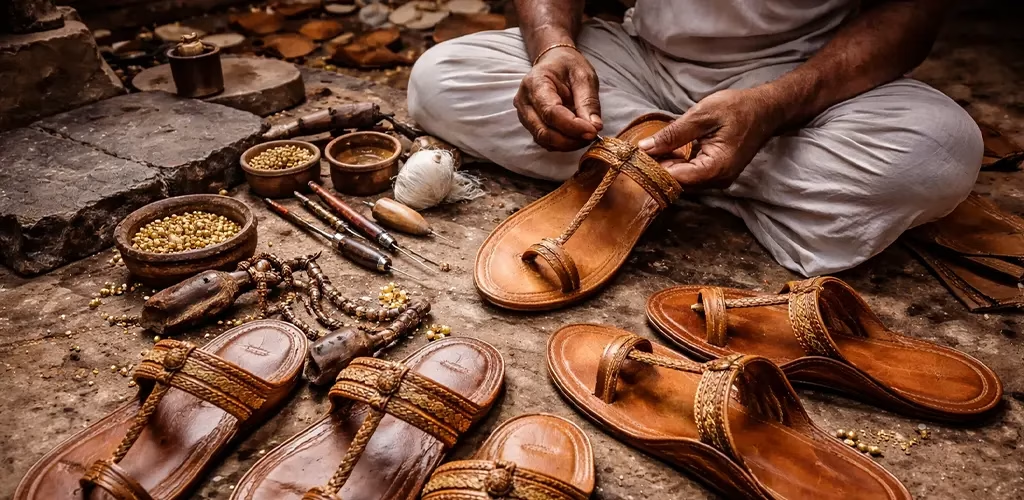
A year earlier, in June 2025, Prada presented a pair of flat leather sandals at Milan Fashion Week. They were minimal, open-toed, and braided. They were also unmistakably the Kolhapuri chappals.
For centuries, Kolhapuri chappals have been handcrafted in Maharashtra and Karnataka, worn daily, shaped by local artisans, and recognised with a Geographical Indication tag. But on the runway, they were introduced simply as leather sandals. And to add to that, no mention of India or the local artisans who handcraft it every single day, for generations.
The backlash was immediate and genuinely invitational. Artisans, designers, and the public called out what they saw as a direct replication without credit. Months later, Prada acknowledged the inspiration and moved towards collaboration.
But the question remained: why does recognition come only after resistance?
The Jewellery That Lost Its Name
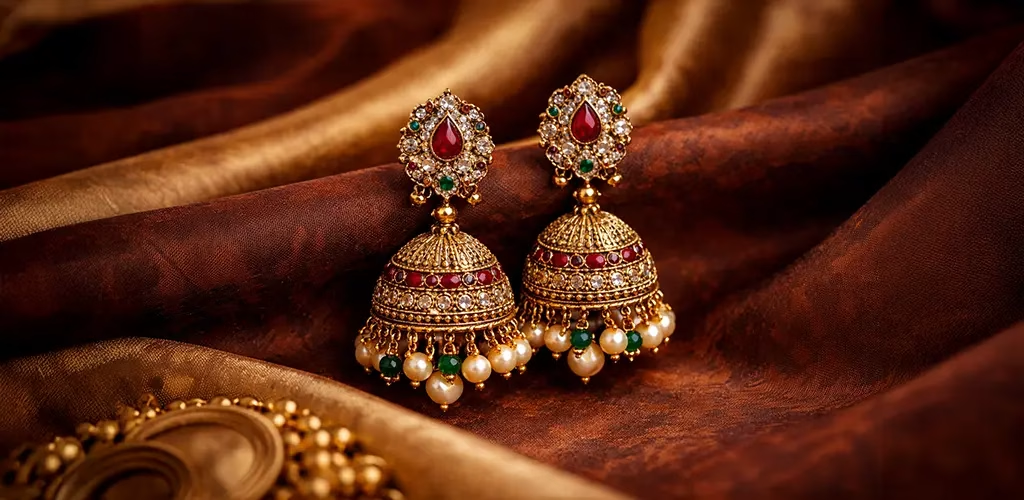
In March 2026, at Paris Fashion Week, Ralph Lauren showcased large bell-shaped earrings as part of its Fall collection and described them as vintage accessories.
But in India, they have always had a name: jhumkas.
With a history spanning over two thousand years, jhumkas are not just ornaments. They are part of rituals, celebrations, and everyday identity. Their design is instantly recognisable across the subcontinent. And yet, on one of the world’s biggest fashion platforms, that identity was replaced with a generic label: vintage.
This is Not the Beginning
The modern runway is only the latest chapter. But the story of Indian fashion being adapted, renamed, and absorbed into Western narratives goes back centuries.
And one example is the cummerbund: a staple of Western formal wear, its origin lies in the Indian kamarbandh, a cloth tied around the waist during the Mughal period. It was practical, elegant, and widely used. British officers adopted it for comfort in the heat, and over time, it became a symbol of Western formal dressing. But its Indian origin quietly faded.
And another, the flowing robes: garments like the jama, angarakha, and choga defined royal dressing in India. Loose, layered, and climate-responsive, they influenced global silhouettes that are now seen as robes or kaftans. While these forms travelled through cultural exchange, their Indian context is rarely acknowledged.
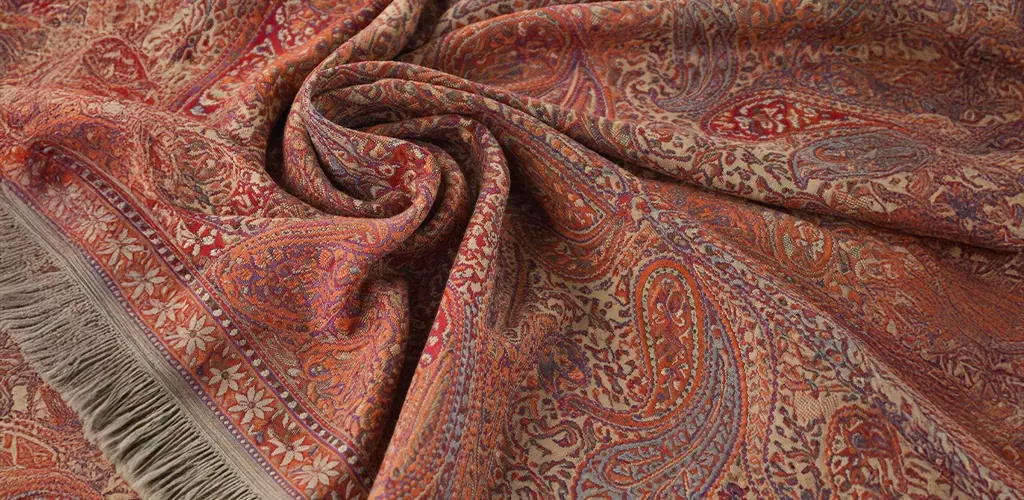
And then another, paisley: what the world recognises as a Scottish print began as the buta motif in Kashmir. Over time, it was reproduced in Europe and renamed, losing its original identity in the process.
From Culture to Category
There is a pattern in how Indian fashion is absorbed into global spaces.
Lehenga becomes a “two-piece set”.
Dupatta becomes a “scarf”.
Kolhapuri becomes “leather sandals”.
Jhumka becomes “vintage jewellery”.
What is removed is not just the name. It is the context.
Because once a cultural element is stripped of its identity, it becomes easier to reposition it as something new, something marketable without history. What has changed, however, is the response. With social media, designers and policymakers in India are increasingly calling out these omissions. The conversations are shifting from just fashion to ownership, credit, and cultural memory. In some cases, this pushback has led to acknowledgement and collaboration. In others, it has simply exposed the gap between inspiration and attribution.
Indian fashion has never been confined to trends. It has always been an extension of identity, geography, and history. And, the world is clearly inspired by it. But inspiration without acknowledgement raises a simple question. Is it appreciation, or is it appropriation?