
Mayong: India’s Village Where Myth, Memory, and Medicine Still Blur
There are places in India that feel like unresolved questions.
Mayong is one of them.
Barely 40 kilometres from Guwahati, on the floodplains of the Brahmaputra in Assam, sits a village whispered about for centuries with equal measures of fear, fascination, and disbelief. Locals call it ordinary. Folklore calls it dangerous. Colonial accounts approached it cautiously. Internet headlines dramatically christened it India’s Black Magic Capital.
Yet Mayong is stranger than sensationalism allows.
This is a village where palm-leaf manuscripts preserve cryptic mantras, where healers still claim to cure illness through chants and herbs, where stories circulate of armies vanishing into forests and bullets dissolving into water. It is also a place where anthropology, medicine, religion, folklore, memory, and performance intersect so tightly that separating myth from reality becomes unexpectedly difficult.
The real mystery of Mayong may not be whether magic existed here.
It may be why generations kept believing it did.
A Village That Hides in Plain Sight
Arriving in Mayong can feel oddly anticlimactic.
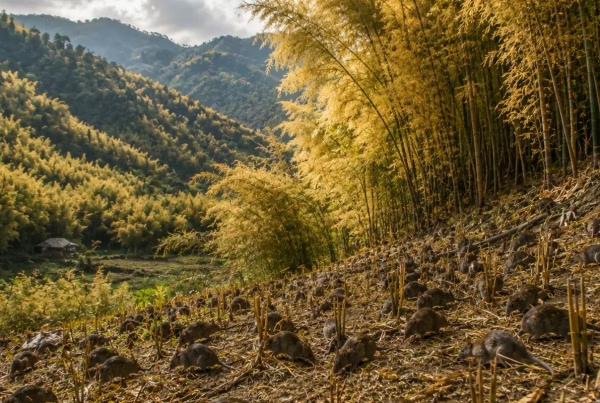
The Brahmaputra moves quietly nearby. Narrow roads cut through fields and greenery. Children play in courtyards. Elderly men sit outside homes, sorting herbs or talking beneath trees. Small markets hum with familiar rhythms.
Nothing about it announces danger or immediately feels supernatural. And yet, conversations in Mayong tend to bend toward hesitation.
Ask older residents about its reputation, and one often hears some version of the same carefully phrased response: “Yes, things happened once. Not anymore.”
The sentence itself feels haunted – not by certainty, but by ambiguity.
The Museum of Black Magic: Archive or Evidence?
The name Museum of Black Magic sounds theatrical, but the objects inside complicate easy dismissal.
Glass cases hold puthi manuscripts written by hand on palm leaves and agarwood bark – texts containing ritual diagrams, medicinal instructions, invocations, and cryptic formulas. Nearby sit copper diagnostic plates believed to identify pain points in the body, necklaces fashioned from bones and shells, preserved animal remains, ritual tools, and objects associated with folk healing traditions.

Among the museum’s most discussed artefacts are two imposing Dakhors – ceremonial swords linked in local memory and some historical accounts to sacrificial practices and ritual worship.
At first glance, these objects seem to belong to the domain of superstition.
Look again, however, and another possibility emerges: what if much of what outsiders called “black magic” was once an elaborate, locally encoded knowledge system – part medicine, part ritual psychology, part cosmology?
The museum raises an uncomfortable question modernity rarely enjoys asking:
How much traditional knowledge becomes “occult” merely because we stop understanding its language?
The Name Mayong: A Village Born of Ambiguity
Even the name Mayong resists certainty.
Some scholars and local traditions trace it to “Maya” – illusion, enchantment, deception. Others connect it to the Dimasa word “Miyong,” meaning elephant. Another interpretation links it to Moirang, an ancient Manipuri clan. Yet another derives it from “Maa-R-Ongo,” suggesting a sacred geography associated with the Goddess herself.
Each explanation feels plausible.
None fully settles the mystery.
The village, in typical Mayong fashion, remains suspended between meanings.
Between Kamakhya and the Mahabharata
Mayong’s mythology cannot be understood without its proximity to Kamakhya Temple, one of Hindu tantra’s most significant sacred centres, located scarcely 40 kilometres away.
According to local narratives, practitioners of tantric traditions migrated toward Mayong after restrictions associated with the legend of Narakasura, the demon king and devotee of Goddess Kamakhya. In one popular retelling, Narakasura attempted to marry the goddess, only to be outwitted by divine intervention. Some traditions suggest disruptions to tantric practices later drove practitioners into surrounding forests, where Mayong evolved into an informal sanctuary of hidden knowledge.
If Kamakhya represented tantra’s sacred nucleus, Mayong became, metaphorically speaking, its underground classroom.
Then comes another startling claim: local lore and regional narratives link Mayong to Ghatotkacha, son of Bhima from the Mahabharata, who is said to have acquired supernatural powers here before the Kurukshetra war.
History, unsurprisingly, becomes difficult to verify.
But folklore rarely waits for proof.
The Darkest Rumours: Human Sacrifice and Fear
No account of Mayong can avoid its darkest chapter: narabali, or human sacrifice.
Excavations, oral histories, shrine traditions, and museum artefacts have long fuelled speculation that ritual sacrifice may once have existed in the region, especially during periods associated with Ahom rule. Local accounts frequently connect the preserved Dakhors with such rituals.
For believers, sacrifice represented exchange – blood offered in pursuit of supernatural favour or power.

For historians, evidence remains partial and contested.
What is clearer is that these practices, if they existed in organised form, ended long ago. Some accounts place their decline centuries earlier, while colonial-era interventions in the 19th century attempted to suppress harmful ritual systems across Assam.
Still, Mayong’s reputation survived.
Fear, after all, often outlives evidence.
The Bez and Ojhas: Healers, Magicians, or Psychologists?
To reduce Mayong merely to dark ritual would miss its most fascinating dimension.

Its real protagonists may have been the Bez and Ojhas – traditional healers, ritual specialists, and custodians of oral knowledge.
Locals distinguish between:
- Su Mantra: healing, protection, restoration
- Ku Mantra: harm, manipulation, affliction
Bez healers reportedly treated illness through chants, herbs, touch, ritual timing, and psychological suggestion. Some local stories even describe temporary paralysis or immobilisation induced through mantra – phenomena modern observers alternatively explain as fear, trance states, suggestion, hypnosis, or psychosomatic influence.
And here the line between mysticism and medicine becomes unexpectedly porous.
Contemporary neuroscience increasingly studies repetitive chanting, rhythm, and sound-based practices for their measurable impact on stress regulation, cognition, and emotional states.

Could Mayong’s “magic” partly have been ritual psychology?
Could chants function as therapeutic technologies long before laboratories gave them vocabulary?
Recent academic work examining Mayong’s healing traditions suggests the village’s practices cannot simply be dismissed as superstition. Instead, they form a layered cultural system shaped by ecology, oral transmission, memory, and inherited medicinal knowledge.
Mayong begins to resemble not merely a site of occultism, but a repository of forgotten epistemologies.
Mayong Today: Between Wonder and Regulation
Modern Mayong no longer thrives on fear.
It survives on curiosity.
Tourists visit museums. Scholars document manuscripts. Festivals such as the Mayong-Pobitora Festival celebrate folklore, performance, and regional identity. Local healers still attract visitors seeking relief for ailments, both physical and emotional.

Yet contemporary Assam has also moved toward regulation, attempting to curb exploitative or harmful occult practices while preserving cultural memory.
This contradiction feels strangely fitting.
Mayong has always lived between worlds – between belief and scepticism, healing and manipulation, history and invention, and fear and fascination.
The Village That Refuses Explanation
Standing in Mayong today, one realisation slowly settles in: the village itself may not be mysterious, but human beings are.
We inherit stories because they explain what certainty cannot. We ritualise fear. We transform healing into myth and ignorance into reverence. Sometimes we dismiss what we cannot understand. Sometimes we romanticise it.
Mayong asks an unsettling question modern life rarely pauses to consider: When knowledge becomes forgotten, does it become superstition, or does it simply become a mystery? Perhaps that is Mayong’s true enchantment. Not that it proves magic exists.
But it reminds us how fragile certainty really is.