
Kohinoor: Who Does the World’s Most Controversial Diamond Really Belong To?
The moment people hear the words “British Crown,” another name almost instantly comes to mind – the Koh-i-Noor.
A diamond born in the Indian subcontinent, shaped by centuries of conquest and bloodshed, and today resting among the British Crown Jewels. For Britain, it is a symbol of monarchy and royal heritage – a crown jewel. But for much of the world, especially South Asia, the Kohinoor represents something far more complicated: colonialism, betrayal, violence, and loss.
Every few years, the same demand resurfaces: “Return the Kohinoor.” Recently, even Zohran Mamdani publicly stated that the United Kingdom should return the diamond. But that immediately raises a bigger question: return it to whom?
India claims it because the diamond originated there. Pakistan points toward Lahore, where the British acquired it. Afghanistan traces its connection through Afghan rulers, while Iran links the diamond to Persian history and Nader Shah. One diamond, multiple nations, and centuries of competing claims.
So who does the Kohinoor actually belong to? And why has this single jewel gained such a dark reputation that many still believe it carries a curse?
Why Is the Kohinoor So Important?
At first glance, the obsession with the Kohinoor can feel strange. After all, it is “just a diamond.” It cannot solve poverty, strengthen an economy, or change a nation’s future. Yet for centuries, rulers treated it as something priceless.
The Kohinoor, meaning “Mountain of Light,” is no ordinary gem. Today it weighs around 105.6 carats, though historians believe it was once nearly 186 carats before being recut by the British. Its extraordinary clarity and rare composition make it one of the world’s most remarkable diamonds. But its true value has never really been about money.
For centuries, the Kohinoor symbolised ultimate power. Whoever possessed it was seen as a ruler of immense authority. Perhaps that is why empires fought wars, betrayed allies, and destroyed kingdoms just to claim it.
India and the Origins of the Diamond
Most historians agree that the Kohinoor originated in the famous Golconda mines in present-day Telangana, a region once known for producing some of the world’s rarest diamonds.

The diamond’s connection to India goes beyond recorded history and enters mythology itself. Some legends even link it to the Syamantaka Mani from the Mahabharata – a mythical jewel associated with immense power and prosperity. According to folklore, the gem passed through the hands of figures like Satrajit, Jambavan, Lord Krishna, and eventually ancient kings.
There is no historical evidence proving that the Syamantaka Mani was the Kohinoor, and many historians dismiss the connection entirely. But one detail keeps the legend alive: almost everyone associated with the jewel eventually faced destruction or tragedy. Coincidence, perhaps.
The Diamond of Empires
The Kohinoor’s documented history becomes clearer during the medieval period. Historians believe Alauddin Khilji acquired the diamond after his invasions of South India in the 14th century. From there, it eventually passed into Mughal hands.
Babur mentioned an extraordinary diamond in his memoirs that many historians believe was the Kohinoor. Later, Shah Jahan reportedly embedded it into the legendary Peacock Throne – perhaps the greatest display of royal wealth in Mughal history.

But power around the diamond never lasted peacefully. Aurangzeb imprisoned his own father, Shah Jahan, and seized control of the empire along with its treasures.
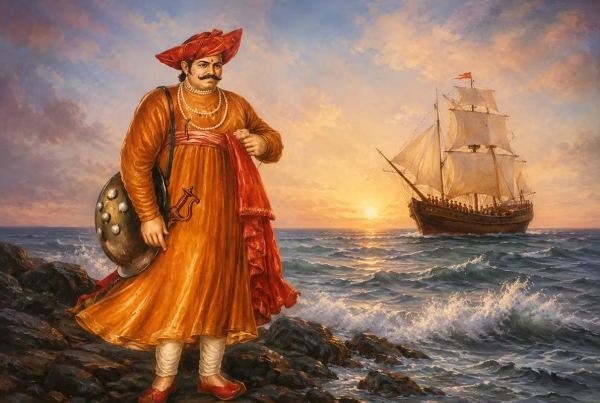
Then came 1739. Nader Shah invaded Delhi in one of the bloodiest attacks in Indian history. The massacre and looting devastated the Mughal Empire, and among the treasures taken back to Persia was the Peacock Throne and the famous diamond within it. According to legend, when Nader Shah first saw the gem, he exclaimed, “Koh-i-Noor!” – “Mountain of Light.” The name stayed forever.
But soon after acquiring the diamond, Nader Shah was assassinated by his own guards, and his empire rapidly collapsed. Once again, the Kohinoor passed to another ruler through violence.
Afghanistan, Punjab, and the Sikh Empire
After Persia, the diamond eventually reached Afghanistan before coming into the possession of Maharaja Ranjit Singh, the legendary Sher-e-Punjab. Ranjit Singh treated the Kohinoor as a symbol of authority and pride.
But after his death, the Sikh Empire quickly descended into internal conflict, assassinations, betrayals, and political instability. And then began the chapter that remains the most controversial even today.
How the British Acquired the Kohinoor
In 1849, the East India Company annexed Punjab after the Anglo-Sikh wars. At the centre of this political takeover stood a ten-year-old boy – Maharaja Duleep Singh. The British forced him to sign the Treaty of Lahore, which included a clause surrendering the Kohinoor to the British Crown.

Legally, Britain still argues that the diamond was obtained through an official treaty. But critics across the world question whether a treaty signed by a child ruler under colonial pressure can ever be considered legitimate.
For Britain, the Kohinoor became a symbol of imperial glory. For India, it became a lasting reminder of colonial exploitation.
Who Owns the Kohinoor Today?
India claims the diamond because it originated there and was taken during colonial rule. Pakistan points to Lahore, where the British acquired it. Afghanistan connects it to Afghan rulers, while Iran traces it back to Persian history.
Legally, the diamond belongs to the British Crown. Morally and historically, however, the debate remains unresolved. And perhaps that unresolved ownership is exactly why the Kohinoor still feels politically explosive even centuries later.
The Curse of the Kohinoor
A strange pattern follows the diamond throughout history: destruction.
Many rulers who possessed the Kohinoor eventually faced betrayal, political collapse, imprisonment, assassination, or violent deaths. Over time, this pattern evolved into one of history’s most famous royal superstitions – the curse of the Kohinoor.
According to legend, the diamond brings misfortune to any man who wears it. When the Kohinoor arrived in Britain in 1850, stories of the curse travelled with it. During the ship journey, a cholera outbreak occurred, and British newspapers quickly linked the tragedy to the supposedly cursed diamond.

Whether superstition or coincidence, the British monarchy appeared cautious. Over time, a tradition emerged where male monarchs avoided wearing the Kohinoor entirely. Instead, the diamond was worn only by queens, including Queen Victoria, Queen Alexandra, Queen Mary, and Queen Elizabeth.
Even during the coronation of King Charles III, the Kohinoor was absent. Officially, this was largely due to political controversy surrounding demands for its return. But the centuries-old superstition surrounding the diamond once again became part of public conversation.
Britain’s Recutting of the Diamond
One of the most controversial moments in the Kohinoor’s history came in 1852, when British jewellers recut the diamond to increase its brilliance. The result made the diamond visually brighter but significantly smaller.
For many historians and critics, this act symbolised more than gemstone refinement. It represented the reshaping of a cultural treasure according to British imperial tastes.
The World’s Most Disputed Diamond
Today, the Kohinoor remains locked inside the Tower of London as part of the British Crown Jewels, protected behind bulletproof glass and heavy security. Yet despite all that protection, its ownership remains deeply contested.
And perhaps that is the Kohinoor’s real curse.
For centuries, rulers fought wars, manipulated children, destroyed kingdoms, and betrayed one another to possess it. Yet despite all the violence attached to its history, the diamond never truly became anyone’s.
Maybe that is the final irony of the Kohinoor: everyone wanted to own it, but in the end, it only left behind conflict, controversy, and loss.