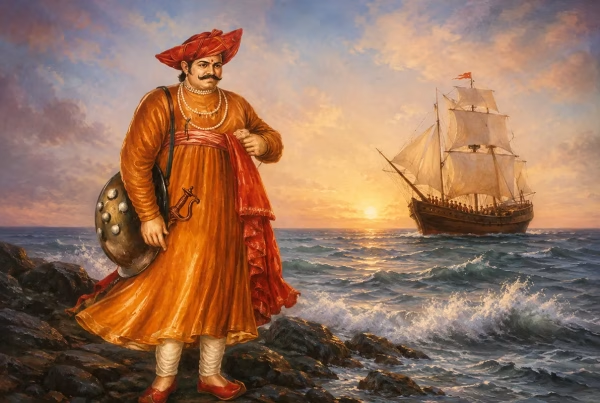

23 June 1757: The Day India Wasn’t Conquered by Force, But by Betrayal
How would an empire capture another?
Probably through vast armies, decisive military victories, and a gradual conquest achieved through superior force.
This usually happens, but in case of India and the British Raj, the story was much more different. India was not colonised by the British Empire on the foundations of prolonged war, but, it emerged from a battle that only lasted a few hours and caused casualties in much different forms.
The story begins, 23 June 1757, with the Battle of Plassey – a day that opened the door to nearly two centuries of colonial rule.
Before the British Ruled India, They Wanted to Trade

In the middle of the eighteenth century, the British East India Company was not a government. It was a commercial enterprise driven by profit, trade, and access to lucrative markets. Its ships arrived on Indian shores carrying goods, while its representatives negotiated with local rulers for trading privileges and commercial concessions.
Few regions were more valuable than Bengal.
At the time, Bengal ranked among the richest and most prosperous regions in the world. Its fertile agricultural lands, thriving textile industry, bustling ports, and extensive trade networks generated extraordinary wealth. For merchants and investors in London, Bengal represented immense opportunity.
The province was ruled by Siraj-ud-Daulah, a young Nawab who ascended the throne in 1756. Barely in his early twenties, Siraj possessed a reputation for ambition, energy, and unpredictability. More importantly, he viewed the growing influence of European trading companies with deep suspicion.
His concerns were not unfounded.
The East India Company had begun strengthening its fortifications, expanding its military presence, and increasingly interfering in regional politics. What had started as a trading relationship was slowly evolving into something far more dangerous.
Conflict was becoming inevitable.
The Young Nawab Who Challenged the Company

In June 1756, Siraj-ud-Daulah decided to act.
Determined to curb British influence, he marched against Fort William in Calcutta, the Company’s principal stronghold in Bengal. The attack succeeded, and the fort fell into his hands.
For the East India Company, the loss was humiliating.
For Siraj, it was a declaration that Bengal would not submit to foreign merchants who increasingly behaved like sovereign rulers.
The British, however, had no intention of accepting defeat.
From Madras arrived Robert Clive, a man who would become one of the most consequential figures in British imperial history. Unlike many military commanders, Clive had not begun his career as a soldier. He had arrived in India as a clerk employed by the Company.
Yet ambition, political instinct, and calculated risk-taking had transformed him into a formidable military leader.
Now he had a clear objective – retake Calcutta, punish the Nawab, and secure British dominance in Bengal.
A Conspiracy Takes Shape

While Clive prepared his troops, another battle unfolded behind closed doors.
Siraj-ud-Daulah’s position was far less secure than it appeared. Although he ruled one of India’s wealthiest provinces, he had accumulated powerful enemies within his own administration. Influential bankers distrusted him. Courtiers resented him. Senior officials questioned his leadership.
Among them stood Mir Jafar, one of the Nawab’s most senior military commanders.
Officially, he remained loyal. Privately, he was negotiating with the British.
Over weeks of secret discussions, promises were exchanged and alliances forged. The arrangement was simple but transformative: if the British emerged victorious, Mir Jafar would become the next Nawab of Bengal.
Before a single cannon fired, the future of Bengal was already being negotiated.
The battlefield would merely formalise a decision made in secret.
The Day of the Battle

On the morning of 23 June 1757, the opposing forces assembled near the village of Plassey.
On paper, the contest seemed overwhelmingly one-sided. Siraj-ud-Daulah commanded an army of roughly 50,000 soldiers, supported by cavalry, artillery, infantry, and war elephants. The British force numbered only around 3,000 men. The Nawab possessed every numerical advantage.
Yet numbers alone rarely determine history.
Unknown to Siraj, a significant portion of his army had already decided not to fight. As the battle began, Mir Jafar and several other commanders deliberately held back their forces. Instead of joining the conflict, they watched from a distance.
The Nawab expected their support. It never came.
With every passing hour, the gap between appearance and reality became impossible to ignore.
When the Rain Changed Everything

Then nature intervened.
A heavy monsoon shower swept across the battlefield, drenching soldiers, weapons, and artillery positions. The Nawab’s forces assumed that the rain would disable British gunpowder and render enemy cannons ineffective.
But the British had prepared for precisely such conditions.
Their ammunition remained protected. Their artillery remained operational.
Much of the Nawab’s artillery did not.
Believing British firepower had been neutralised, sections of Siraj’s army advanced. Instead, they encountered devastating cannon fire from guns that remained fully functional.
The consequences were immediate. Confusion spread through the ranks. Communication faltered. Confidence evaporated. A battle that should have favoured Bengal began slipping rapidly out of the Nawab’s control.
The Moment It Was Lost

The tragedy of Plassey lies in the fact that it was not truly lost through combat.
It was lost through betrayal.
Throughout the battle, Siraj-ud-Daulah continued to expect support from commanders who had already abandoned him. As reports arrived and the situation deteriorated, the truth gradually became impossible to ignore.
The men he trusted most had chosen another future.
By the time he understood the scale of the conspiracy, the battle was effectively over.
As evening approached, Siraj fled the battlefield. The British claimed victory.
Not because they had defeated a vastly larger army through military brilliance alone, but because the army opposing them had fractured from within.
The Empire Begins
The immediate outcome appeared straightforward. Mir Jafar became the new Nawab of Bengal.
The East India Company became the power behind the throne. Yet the long-term consequences proved enormous.
Control over Bengal’s immense wealth provided the Company with resources unlike anything it had previously possessed. Revenues from the province financed future military campaigns, strengthened political influence, and expanded British ambitions throughout the subcontinent.
What had begun as a trading enterprise gradually transformed into a territorial power. With each successive victory, the Company’s authority grew. Within a few decades, merchants had become rulers. And the road to British India had begun.
Why Plassey Still Matters
The Battle of Plassey occupies a unique place in Indian history.
It was not the largest battle ever fought on Indian soil. It was not the bloodiest. Nor was it the most impressive military achievement.
Yet few events have produced consequences as far-reaching.
A single day in a mango grove in Bengal altered the fate of millions. It weakened one of India’s richest provinces, empowered a foreign corporation, and created the conditions for nearly two centuries of colonial domination.
That is why 23 June 1757 is remembered as far more than the date of a battle. It marks the moment when the balance of power in India shifted decisively. And perhaps the enduring lesson of Plassey remains as relevant today as it was in 1757.