
From Refugees to Heroes
What does it mean to lose a home but refuse to lose your identity?
For millions of refugees around the world, displacement is more than crossing a border, it means leaving behind generations of memories, familiar landscapes, and a way of life, often with no certainty of return.
Every year on June 20, World Refugee Day shines a light on these stories of loss, honoring the millions of people who have been forced to flee their homes while carrying their culture and identity with them.
And many of these uprooted identities found a home on Indian soil. But their lives continue to be a question awaiting an answer that might never come.
India Being The Helping Hand
For centuries, people fleeing persecution, war, and uncertainty have looked to India, not just as a neighbouring country, but as a place where they could begin again.
When the Parsis escaped religious persecution in Persia over a thousand of years ago, they found a new home on India’s western coast. Decades later, millions fleeing the violence of the Bangladesh Liberation War crossed into India seeking safety. In 1959, thousands of Tibetans undertook a journey across the Himalayas, hoping to preserve not only their lives but also their culture.
Each of these journeys was different, but they shared the same beginning of people forced to leave everything behind in search of a homeland. And among them, the story of the Tibetan community stands apart as one of the world’s most remarkable examples of rebuilding an entire civilization in exile.
The Cold Escape
You’ve probably seen Tibetan prayer flags, but do you know the story they carry?
It goes back to March 1959, thousands of miles away in Lhasa, the historic capital of Tibet, a 23 year old named Tenzin Gyatso, known around the world as the 14th Dalai Lama, had only two choices – stay and risk his life, or leave behind everything he had ever known.

Disguised as an ordinary soldier, he quietly slipped out of his palace under the cover of darkness. Accompanied by only a small group of trusted followers, he began a long and dangerous journey across the Himalayas. With almost no food, no shelter, and no warm jackets, they trekked through freezing temperatures and crossed rugged mountain passes for weeks. Every step carried uncertainty, but turning back was no longer an option.
Eventually, they crossed into India and made their way to the peaceful hill town of Dharamshala in Himachal Pradesh.
Rather than closing its doors, India welcomed them.
Then Prime Minister Jawaharlal Nehru granted the Dalai Lama asylum, and Dharamshala soon earned the nickname Little Lhasa as it became the heart of the Tibetan community in exile.
What began as an escape soon became the story of an entire culture finding a new home in India.
Jungle Monks
What if, everything your body had adapted to since birth changed overnight, from icy mountain winds to the heavy heat of a tropical jungle?
This is exactly what happened next.
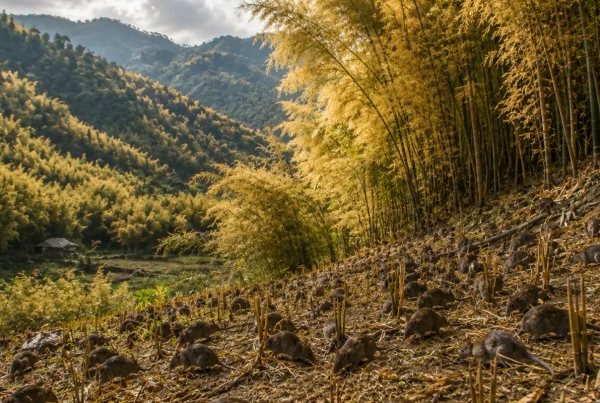
India wanted to give the refugees a permanent place to live, so the state of Karnataka in South India offered them land. But it wasn’t a ready-made town. It was a thick, wild jungle. Monks who had spent their lives reading holy books in cold stone monasteries suddenly had to clear trees under a blazing hot sun.
Even after this, they didn’t give up.

By working alongside local Indian farmers, they learned how to grow corn, and slowly built the breathtaking Namdroling Monastery, often called the Golden Temple of Bylakuppe. What started as a tiny bamboo temple put together by just a few monks today houses thousands of students and stands as one of the largest Tibetan Buddhist centers in the world.
The Green Book
How do you keep your culture alive when you don’t have a country anymore?
The Tibetans found a clever way.

Every Tibetan refugee in India carries a small green notebook called the Green Book. Even though they pay normal taxes to the Indian government, they also choose to pay a small voluntary tax into this green book every year.
This money travels from every corner of India straight up to Dharamshala, keeping their schools, clinics, and heritage alive. It is their way of proving that a nation isn’t defined by borders on a map, but by the shared heartbeat of its people.
The Tailors Of The Mountains
Over the last sixty years, something beautiful happened between the refugees and their Indian neighbors.
They started blending their worlds.

In towns like Dharamshala, local Indian tailors realized the refugees needed their traditional wrapped dresses, called Chupas. The Indian tailors sat down with the Tibetan elders, learned how to cut the specific silk blouses, and mastered the art. Today, those same Indian tailoring families make their entire living stitching traditional Tibetan clothes.
What They Gave Back?
The contributions to the land that sheltered the Tibetan community went far beyond food or culture.
It is written in blood and bravery.

During the Sino-Indian war, many soldiers struggled in the thin air and harsh terrain. In these conditions, the military often relied on the Tibetan community, whose life in high-altitude regions had naturally prepared them for survival in extreme altitude. Their strength, endurance, and familiarity with mountain landscapes made them crucial in some of the toughest frontier regions.
From the blood shed on frozen Himalayan peaks to the steam rising off a plate of momos, how did a people who lost everything manage to give their new home so much of their soul?