
Ambubachi Mela: Celebration of Blood at Kamakhya, Against Societal Taboos
What if the one thing human society spends centuries hiding in shame is the very thing the cosmos chooses to celebrate?
In a world where menstruation is often shrouded in silence, there is a place in India where it is celebrated. Every year in mid-June, a hill overlooking Guwahati fills with thousands of people celebrating a four-day festival dedicated to menstruation. The festival of Ambubachi Mela commemorates something that still exists as a taboo in Indian society.
During this time, something remarkable happens.
When Rituals Pause, and Traditions Begin
During the three days of Ambubachi Mela, the doors of the legendary Kamakhya Temple slam shut, which is known as Pravritti. It is then that daily prayers stop and the temple bells go silent.
For three days, the entire area falls into a heavy, profound silence as Goddess Kamakhya is believed to undergo her annual menstrual cycle. This period of temple lockdown is known as the Ambubachi Mela, often referred to as the Mahakumbh of the East.

During these four days, the ordinary world around the temple stops in its tracks, and the raw, unstoppable force of nature takes full control.
The Resurrection of Kamadeva
The story of the Kamakhya temple begins with a god who lost everything.
According to the ancient legend, Kamadeva, the God of love and desire, tried to break Lord Shiva’s deep meditation by shooting him with an arrow of passion. Furious at the interruption, Shiva opened his third eye and burned him into a pile of ash.
To regain his physical form, a grieving Kamadeva was told to find the spot where Sati’s womb had fallen on Earth and build a temple over it. He found the fissure on the hill, and there he began a long journey of penance and devotion. With the help of Vishwakarma, he built a magnificent temple over the sacred site and worshipped the Goddess with complete surrender.
Moved by his devotion, the Goddess blessed Kamadeva and restored his physical form.
It is believed that this miracle gave the temple its name – Kamakhya.
The Womb of the Earth
To step onto Nilachal Hill during the four days of this cosmic celebration is to step into an experience unlike any other. The air feels alive with prayers, chants, and the steady flow of thousands of devotees. But what makes the place even more unique is what lies inside the temple.
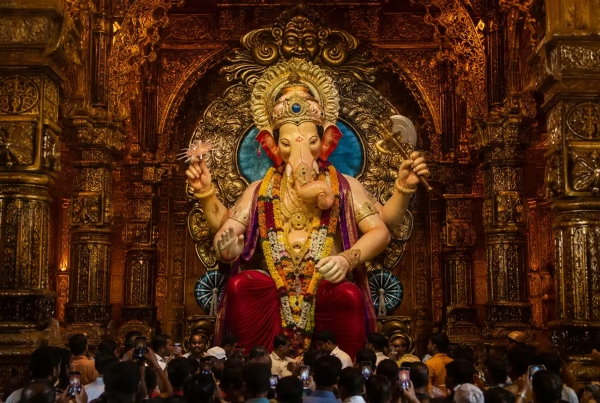
Unlike most Hindu temples filled with statues of gods and goddesses, the Kamakhya Temple has no idol. Instead, visitors walk down into a dark cave lit only by the soft glow of oil lamps.

As you move through the shadows, a quiet reverence fills the air. At the end of the narrow path is a natural spring that flows over a rock formation shaped like a yoni, believed to represent the Goddess’s womb. This sacred spot is the true heart of the temple and a powerful symbol of life and creation.
The Bleeding River
Imagine a river flowing, not with the fluidity of water but bleeding instead? Every year during the Ambubachi mela festival, the Brahmaputra River below Nilachal Hill appears to do just that.
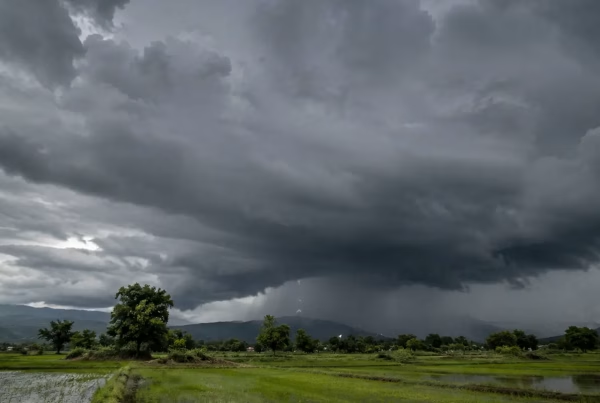
For many devotees, the crimson colour is seen as the menstrual blood of Mother Earth, making the river itself part of the sacred celebration. But science points to a natural explanation. As the monsoon arrives, heavy rains wash iron-rich red soil from the surrounding hills into the river, giving the water its reddish tint.

Whether viewed through faith or science, the sight of the Brahmaputra seemingly changing colour is one of the most unforgettable moments of Ambubachi Mela.
The Midnight Rituals
After three days of seclusion, the temple doors finally reopen on the fourth day, and devotees receive the Angabastra as prasaad, a highly coveted white cloth that had been draped over the sacred stone fissure during the temple’s closure and is believed to have turned red during those three days.

But when the celebrations fade and night falls, Kamakhya reveals a different face.
As the last of the crowds disappear, another world begins to stir. From the darkness emerge Aghoris and Vamacharis, drawn by the belief that Kamakhya’s hidden spiritual energies awaken after nightfall. In the nearby cremation grounds, this belief is closely associated with Shava Sadhana, one of the temple’s most mysterious and controversial tantric practices.

The ritual is believed to blur the line between death and existence, confronting the practitioner with the very truths most people spend their lives trying to avoid.
The Lasting Echo of Kamakhya Temple
Long after the four days end and the crowds return home, Kamakhya temple leaves behind a question that lingers: Is this the work of nature, an act of the divine, or a reminder that the two were never separate at all?
By placing a biological process at the center of worship rather than shame, Kamakhya temple preserves an ancient perspective that honors nature instead of treating it as taboo.
Perhaps that is the true legacy of Kamakhya Temple, not that it provides clear answers, but that it makes us rethink the way we view the natural world.