
Jarawa Tribe: How Identity and Survival Demands Effort
The Andaman and Nicobar Islands are almost always viewed through a tourist lens, a paradise of clear turquoise waters, vibrant coral reefs, and quiet coastlines.
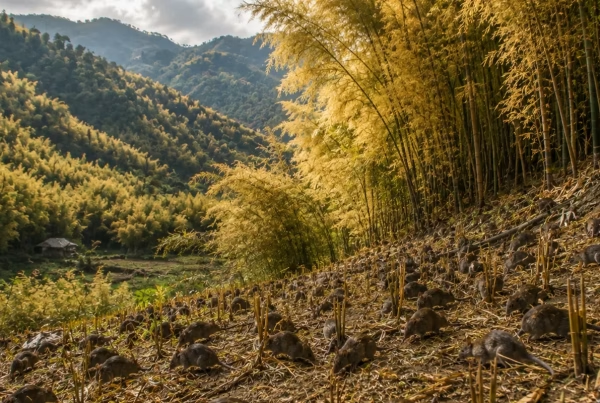
But deep within the dense tropical canopies lies an entirely different reality.
Long before modern maps gave these islands a name, and long before ships arrived on their shores, the ancestors of the Jarawa tribe were already here. Having inhabited the region for an estimated 50,000 years, this indigenous community carries a human identity and a story of survival that continues to challenge everything.
Here’s what Jarawa does differently.
The Story of Names
What would you do if your name were an entity that needed to be earned?
This is exactly what the people of the Jarawa tribe need to do.
For them, a name is never meant to last forever. It changes as life progresses.

A child is given a name at birth, but that is only the beginning. Years later, when a young boy returns after his first successful wild boar hunt, he leaves behind the name of his childhood and is given another, one that marks the person he has become. And when a woman becomes a mother, she may leave behind her old name and begin the next chapter of her life with a new one.
Among the Jarawa community, a name is not just something you are given but something you earn as life unfolds.
The Day Ocean Retreated, And Jarawa Just Knew
But identity isn’t the only thing that the Jarawa tribe needed to find in order to live a life.
For them, even survival demanded something beyond just existence. In December 2004, a massive earthquake struck the Indian Ocean, triggering one of the deadliest tsunamis ever recorded. This destroyed coastlines across Asia and took thousands of lives. Modern warning systems did not alert coastal cities in time.
But deep in the forests of South and Middle Andaman, the Jarawa tribe survived, without enduring much suffering.

So, the question persists – how did a community with no internet, radio, or modern science survive such a disaster?
When Jarawa Trive Survived Purely On Instincts
The Jarawa tribe live closely, connected with nature. After thousands of years in this ecosystem, they have learned to sense when something is not right. In 2004, this instinct saved their lives.
On that December morning, the Jarawa saw the sea pull far away from the shore, leaving the ocean floor exposed.
The forest grew strangely quiet, and animals began acting in unusual ways. The tribe recognised these signs right away. But they stayed calm.
The Jarawa tribe gathered their families, left the beaches, and walked up into the hills deep in the forest. By the time the huge waves hit the shore, they were already safe. While modern cities suffered, the Jarawa showed that paying attention to nature can be our best way to survive.
Is There More?
Their identity struggles and survival instincts give us a small glimpse into a completely alternative way of living. For fifty thousand years, the Jarawa tribe have walked these same paths and protected a way of life that modern researchers still struggle to understand.
Did this ancient tribe simply survive a tsunami and use a unique naming custom, or are there many more secrets of the Jarawa tribe hidden beneath the forest canopy?