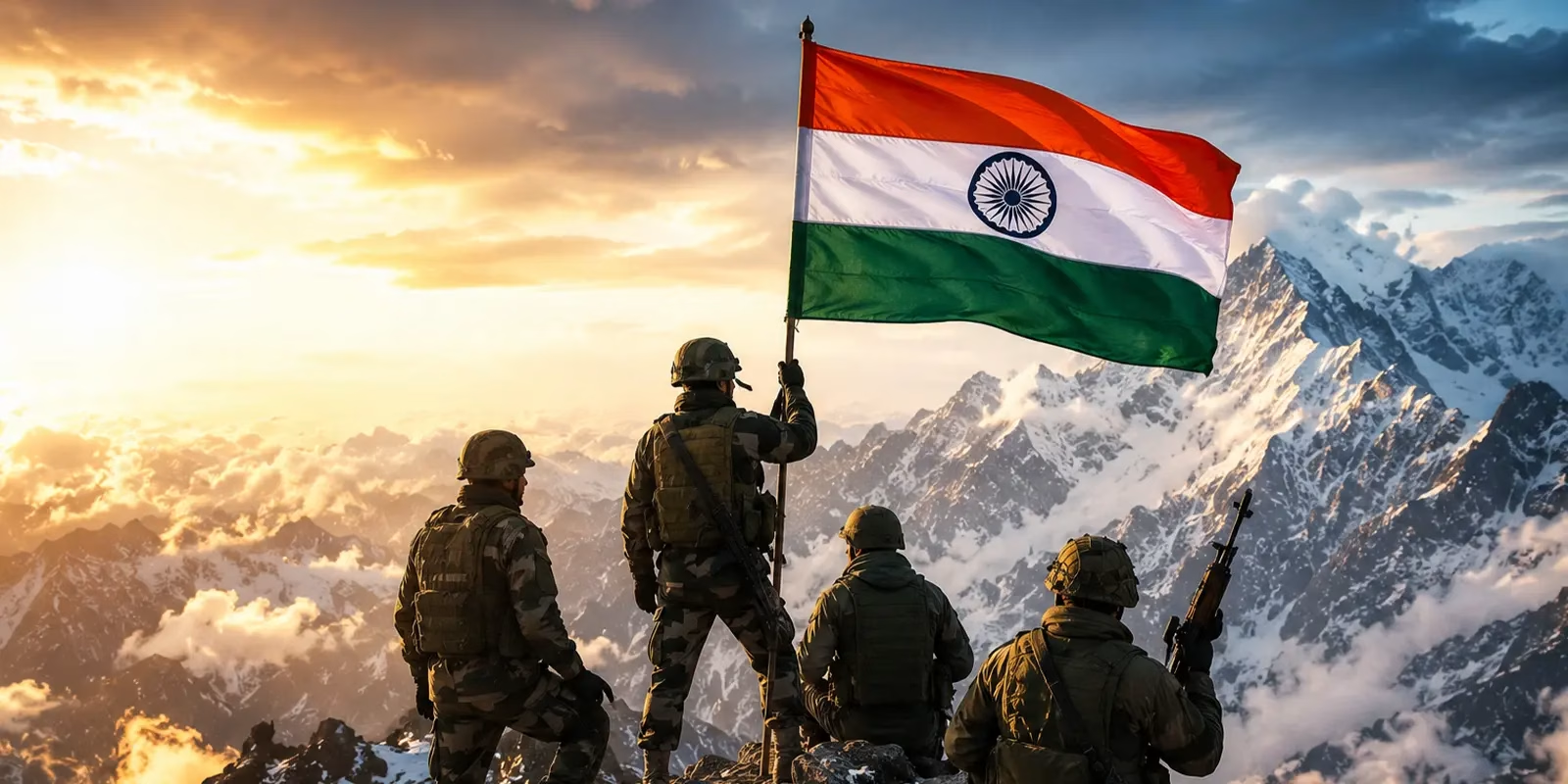
Kargil War: Beyond the Victory
When we remember the Kargil War, we often remember India’s victory. But how did a few snow-covered mountain peaks turn into one of the toughest wars the country has ever fought?
The answer lies in a story that began months before the first shots were fired. It is a story of trust that was broken, a routine patrol that never returned, soldiers who fought against both the enemy and the mountains, and courage that showed itself in the most unexpected ways.
Long before the celebrations of victory, these silent peaks had already witnessed sacrifices that would never be forgotten.
So, where did it all begin?
A Winter That Changed Kargil Forever
For years, the Indian and Pakistani armies followed an unwritten routine in the high mountains of Kargil. Every winter, when temperatures dropped far below freezing and heavy snow covered the mountaintops, many of the highest military posts became impossible to occupy. Soldiers from both sides would move down before winter became too harsh and return once the snow melted.
But the winter of 1998-99 was different.
While many of these posts stood empty, Pakistani forces quietly crossed the Line of Control and occupied several strategic peaks. Sitting more than 16,000 feet above sea level, they could closely watch the Srinagar-Leh highway and monitor the movement of Indian troops below.
For weeks, everything seemed normal. But soon the truth came out through a routine patrol that never returned.
Captain Saurabh Kalia and the Patrol That Led Kargil War
In early May 1999, local shepherds reported unusual movement in the Kaksar sector and informed the Indian Army. To verify this information, a young officer, Captain Saurabh Kalia, and five soldiers were sent on what seemed like a routine patrol.
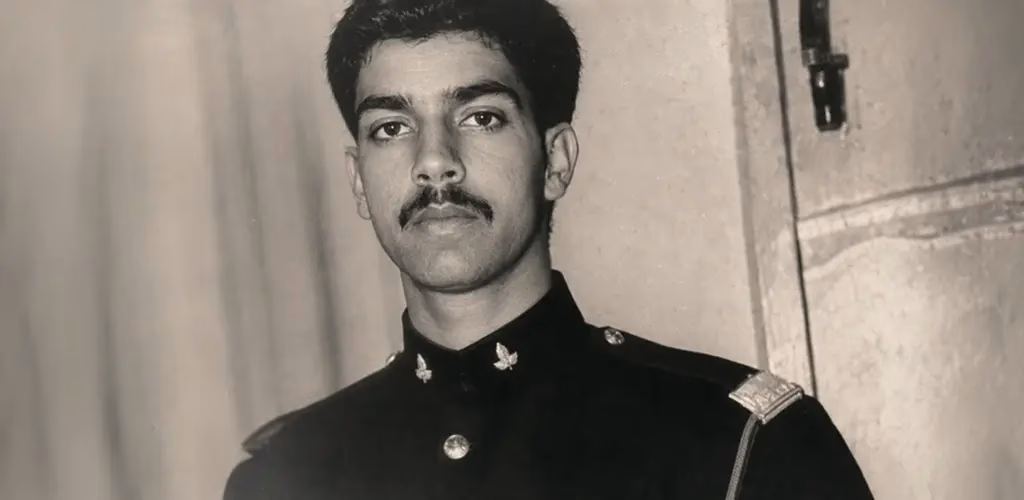
What was meant to be a routine check turned into one of the earliest and most painful chapters of the Kargil War.
Captain Kalia and his team walked straight into a large group of heavily armed Pakistani soldiers who had already occupied the area. They were surrounded, captured, and taken across the Line of Control for more than three weeks and were held in captivity.
When their bodies were finally returned to India, the entire nation was left stunned. Post-mortem reports revealed cigarette burn marks, broken bones, fractured teeth, and several other signs of severe torture. What had begun as a routine patrol had now exposed the true scale of the intrusion.
Captain Kalia and his men never returned home, but their sacrifice revealed the true scale of what India was facing. There was no longer any doubt that this was a planned military intrusion. Soon after, the Indian Army launched Operation Vijay to reclaim the occupied peaks.
But the battle wasn’t just against the enemy; the mountains themselves had become one of India’s biggest challenges.
A War Fought Against the Mountains
The Kargil War was unlike most battles India had fought before.
The enemy was already sitting on the highest peaks, while Indian soldiers had to climb with Pakistani forces firing down at them from above. The freezing cold, thin air, and heavy backpacks made every step harder.
Even reaching the battlefield was a battle in itself. Despite all the challenges, the soldiers kept climbing.
Slowly, one peak after another began to return to Indian hands. The victory at Tololing gave the army its first big breakthrough and lifted the spirits of soldiers across the front. Soon after came the battle for Tiger Hill, where Indian troops fought through steep cliffs and freezing nights to recapture one of the most important positions in Kargil.
With every peak that was recaptured, the course of the war began to change. Every peak had its own story. One of them belonged to a young officer who made an unbelievable decision halfway up an icy cliff.
Captain Neikezhakuo Kenguruse: The Soldier Who Climbed Barefoot
As Indian troops fought to reclaim one peak after another, every mission brought a new challenge. One of the toughest came in late June 1999, when Captain Neikezhakuo Kenguruse and his team were assigned to capture an enemy position known as Area Black Rock.
The only way to reach it was by climbing a steep, icy cliff in the middle of the night.
As the team climbed higher, Captain Kenguruse realised that his heavy combat boots were slipping on the frozen rocks. Every second mattered, and one wrong step could send him falling into the gorge below.
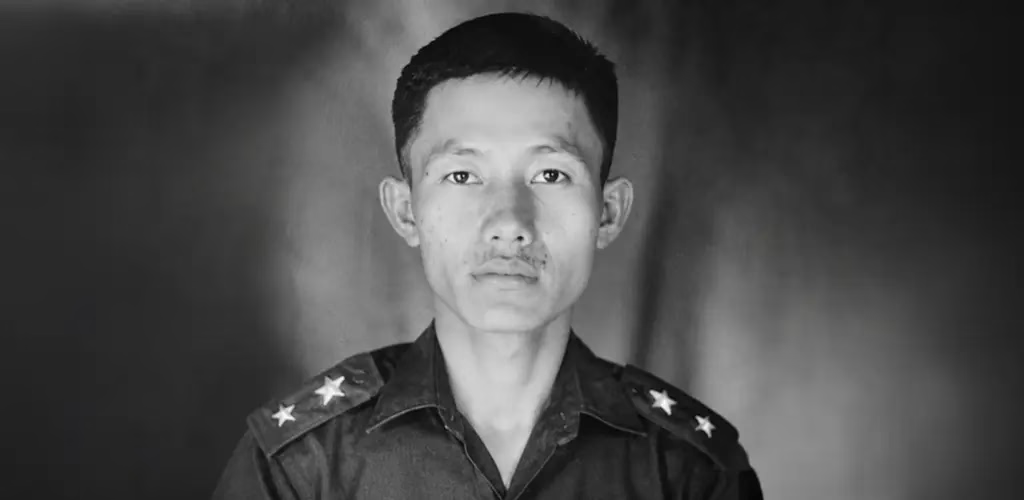
With bullets flying and time running out, he made a decision that no one could have imagined.
He kicked off his heavy boots and pulled off his socks, deciding to scale the icy rock barefoot.
Using his bare feet for grip, he climbed the icy cliff while carrying a rocket launcher on his back. Even after being shot during the climb, he refused to stop. He reached the top, destroyed the enemy bunker, and made it possible for his team to capture the position. The moment the mission was completed, Captain Kenguruse collapsed due to heavy injuries.
Later, he was posthumously awarded the Maha Vir Chakra for his courage and bravery.
The war was fought with guns and ammunition, but even in the middle of such a brutal conflict, one act showed that humanity had not disappeared from the battlefield.
When Humanity Survived the Battlefield
What do you think happens to the soldiers on the other side once a war is over?
As Indian troops recaptured one peak after another, they recovered the bodies of several Pakistani soldiers who had been left behind on the battlefield. Pakistan initially refused to accept many of them, as it would have meant admitting that its regular army had taken part in the conflict.
The Indian Army could have left the bodies where they were.
Instead, the soldiers were given full military burials with respect and according to their Islamic religious customs. Among these, one incident became a lasting symbol of that respect.
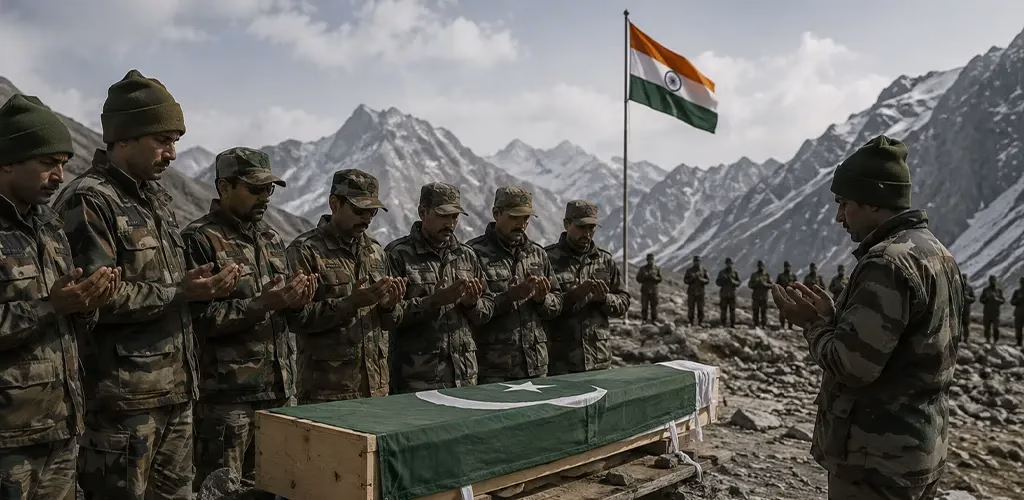
During the Battle of Tiger Hill, Captain Karnal Sher Khan of the Pakistan Army fought with remarkable courage before losing his life. His bravery left such an impression on Brigadier M. P. S. Bajwa of the Indian Army that he wrote a handwritten note praising the Pakistani officer before his body was returned.
That note later became one of the reasons Pakistan honoured Captain Sher Khan with the Nishan-e-Haider, its highest military award.
Every year on Kargil Vijay Diwas, India remembers the victory. But the mountains of Kargil hold far more than memories of battles. They remember the soldiers who climbed them, the sacrifices made on their slopes, and the moments of humanity that survived even in the middle of a war. More than two decades later, those stories remain just as important as the victory itself.