The Thalaikoothal Secret: When Elders Are "Helped" to Die
Imagine bringing death to the person you always bend down to seek blessings from.
Simply put, it’s about helping your elders die.
Sounds horrifying, right?
In some parts of Tamil Nadu, this is exactly what happens, and it also has a name: Thalaikoothal.
What It Actually Means
Thalaikoothal is a ritual where an elderly person, usually someone who is terminally ill or bedridden, is given an oil massage followed by a bath. The bath can last for hours, often using large amounts of cold water, usually at that time of day when it is coldest. Afterwards, they are given cold coconut water or buttermilk.
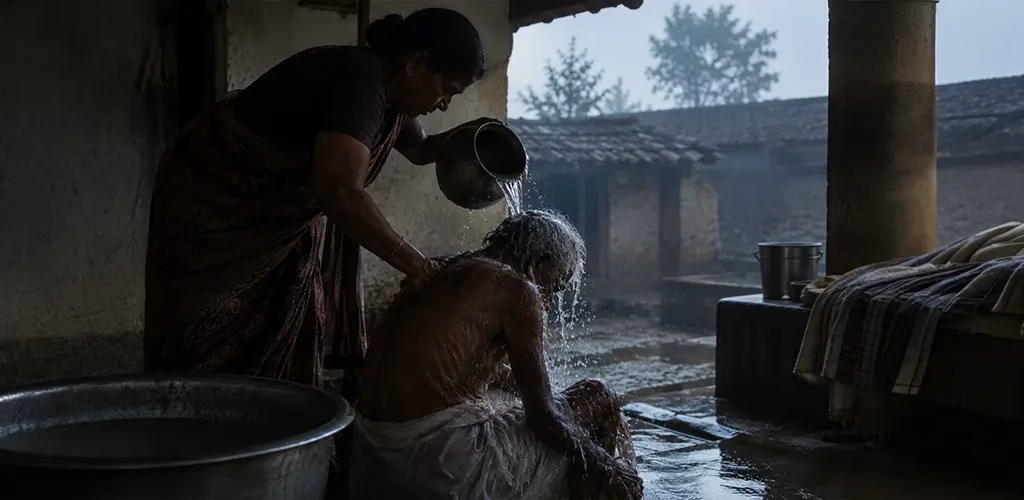
None of this sounds violent on its own, and that’s the whole idea behind the practice. It is dressed up as care, something that looks gentle from the outside. But when it’s done over and over, in the cold, to someone whose body is already weak, it’s not really about bathing anymore. It’s meant to bring on illness, pneumonia especially, and speed up a death the family has more or less already decided is coming.
Researchers call this a form of senicide, basically the deliberate killing of the elderly, and more specifically, involuntary euthanasia, since the person it’s happening to rarely gets an actual say.
Where It Comes From
Most documented cases of Thalaikoothal come from the southern districts of Tamil Nadu, particularly Virudhunagar, Madurai, and Theni.
Its exact origins, however, are difficult to pin down. One theory connects the practice with the Piramalai Kallar community, who once worked as village guards under old Tamil rulers. Another traces some of these communities to Reddy settlers who moved from the Nellore region of Andhra Pradesh generations ago.
Whatever its beginnings, the practice seems to have slowly become part of community life. It was passed down quietly, known to those around it, but rarely spoken about outside the community.
And perhaps that is how something deeply troubling can survive for generations: when a practice becomes familiar enough, people stop questioning where it came from or whether it should continue.
Why It Still Happens
It is easy to imagine Thalaikoothal as something from another time. But it hasn’t disappeared. Investigations suggest that it still occurs in parts of southern Tamil Nadu, with cases reported year after year.
And the reasons behind it are often painfully ordinary.
For some families, poverty is at the centre. Caring for a bedridden parent for years means paying for medicines, hospital visits and someone to stay home and provide constant care. In places where palliative care and nursing homes are difficult to access, that responsibility can become overwhelming.
But hardship is not always the whole story.
Some documented cases have involved relatives wanting to gain control of property, a pension or a government job sooner. And perhaps the saddest part is that, in some cases, the elderly person knows what is happening and asks for it themselves, believing they have become a burden on the people they love.
That is where the story becomes harder to look at. When someone asks to die because they feel they have no other way out, the question is no longer only about death. It is also about what made them feel so alone in the first place.
When Care Becomes Silence
There’s something about Thalaikoothal that is harder to see – it is illegal in India.
Deaths due to Thalaikoothal are often reported as natural. But the families and communities know the truth.
The real question is: is taking care so difficult that death becomes the easier choice?
And that is something one simply cannot understand from afar. You need to step into the shoes of the suffering family. Because we never know what they go through every minute of the day!