
Goa Wasn’t Freed in 1947: The Forgotten Freedom Struggle Most Indians Don’t Know About
When India awoke to freedom on August 15, 1947, the nation erupted in celebration. The British Empire had withdrawn, the tricolour flew across cities and villages, and a new chapter in Indian history had begun.
But there was one part of the country where independence was still a dream and the Portuguese flag still flew over – Goa.
While the rest of India stepped into freedom, Goa remained under colonial rule for another fourteen years. Today, the Goa India admires for its beaches, churches, seafood, music, and a vibrant cultural landscape struggled for freedom for much longer.
The Colony That Refused to End

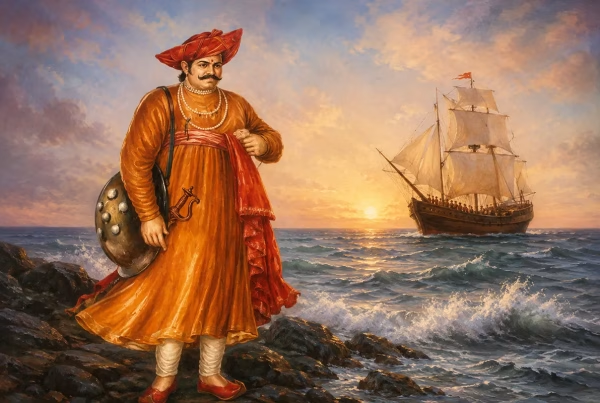
The story begins in 1510, when Portuguese commander Afonso de Albuquerque captured Goa and transformed it into the centre of Portugal’s eastern empire. What followed was more than four centuries of colonial rule, making Portuguese Goa one of the longest-lasting European colonial conquests in Asia.
Over time, Goa emerged as a major hub of trade, religion, and administration. Merchants sailed through its ports carrying goods between continents – Missionaries established churches and institutions, new architectural styles reshaped towns and villages, and cultural influences from Europe and India intertwined.
At the height of its prosperity, travellers referred to the territory as “Goa Dourada” or Golden Goa.
Yet beneath this prosperity was a more complicated reality. Colonial authorities exercised significant control over political and social life. During certain periods, forced religious conversions occurred, traditional practices faced restrictions, and the Portuguese Inquisition left a lasting mark on the region’s collective memory. While empires rose and fell elsewhere, Portuguese authority endured.
Most remarkably, it survived even after the British departed India.
The Day That Changed Everything

By the mid-twentieth century, frustration with colonial rule had been simmering for years. However, a single event transformed that frustration into a mass movement.
On June 18, 1946, thousands of people gathered in Margão despite strict Portuguese restrictions on public assemblies. The meeting was led by socialist leader Dr. Ram Manohar Lohia, who had arrived in Goa at the invitation of Goan physician and activist Dr. Julião Menezes.
At the time, fear and censorship had become deeply entrenched. Public criticism of colonial rule was dangerous. Open political gatherings were prohibited. Nevertheless, Lohia chose to challenge the restrictions directly.
As he addressed the crowd, he spoke openly against repression and demanded civil liberties. His words resonated immediately. What began as a public meeting quickly evolved into a powerful demonstration of collective dissent.
The Portuguese administration responded swiftly – Lohia was arrested.
Yet the authorities had miscalculated. Rather than silencing opposition, the arrest ignited it. Across Goa, people who had long remained silent found a renewed sense of purpose. For many historians, this gathering marked the beginning of the modern Goan liberation movement. Today, June 18 is commemorated as Goa Revolution Day, or Kranti Din, in recognition of its historic significance.
The Freedom Fighters History Forgot

Unlike many anti-colonial movements, Goa’s liberation struggle drew support from a remarkably diverse coalition. Socialists, nationalists, students, workers, religious leaders, and ordinary citizens united around a common goal despite differing political beliefs.
Among the most extraordinary figures was Mohan Ranade.
While many activists embraced non-violent resistance, Ranade joined the underground movement and became associated with the Azad Gomantak Dal, an organisation committed to direct action against Portuguese rule. He participated in operations targeting colonial infrastructure and authorities before eventually being captured.
The consequences were severe.
Portuguese authorities sentenced him to years of imprisonment, much of it served in Portugal itself. In total, Ranade spent nearly fourteen years behind bars. Although he later became a symbol of sacrifice and resilience, his story remains surprisingly absent from mainstream historical narratives.
Equally remarkable was the work of Libia Lobo Sardesai and Vaman Sardesai. At a time when information could shape public opinion as effectively as any weapon, they operated clandestine radio broadcasts that challenged Portuguese propaganda and supported the liberation cause.
These secret transmissions carried messages of resistance across borders, helping sustain morale among activists and keeping the movement alive during some of its most difficult years.
When Protest Was Met With Bullets

During the 1950s, resistance intensified.
Groups of satyagrahis crossed into Portuguese-controlled territory carrying the Indian tricolour and demanding an end to colonial rule. Many knew exactly what awaited them. Arrests were almost certain. Violence was a constant threat.
Nevertheless, they continued.
Portuguese authorities responded harshly. Protesters were detained, beaten, imprisoned, and, in some cases, shot. Many activists were deported to Portugal, while others spent years in colonial prisons.
Yet repression produced the opposite of its intended effect.
Each arrest attracted wider attention. Each act of violence generated greater sympathy for the movement. What had once been viewed as a regional issue gradually became a national cause.
Across India, public support for Goa’s liberation continued to grow.
The 36-Hour Operation That Ended 451 Years of Rule

By 1961, diplomatic efforts had reached a dead end. India repeatedly urged Portugal to negotiate, but the Portuguese government remained unwilling to relinquish control.
Eventually, New Delhi concluded that peaceful resolution was unlikely.
In December 1961, India launched Operation Vijay, a coordinated military campaign involving the Army, Navy, and Air Force. The objective was straightforward: end Portuguese rule and integrate Goa, Daman, and Diu into the Indian Union.
The operation unfolded with remarkable speed.
Within roughly thirty-six hours, Indian forces had secured key positions across the territory. Facing overwhelming military odds, Portuguese Governor-General Manuel António Vassalo e Silva surrendered.
On December 19, 1961, more than 451 years of Portuguese rule came to an end.
Goa was finally free.
The Legacy That Still Lives in Goa

Liberation, however, did not erase centuries of history.
Walk through Goa today and traces of the Portuguese era remain visible almost everywhere. Elegant churches rise above old settlements. Colourful villas line narrow streets. Architectural styles blend European influences with local traditions. Even beloved dishes such as vindaloo and bebinca tell stories of cultural exchange that unfolded over generations.
The legacy extends beyond architecture and cuisine.
Portuguese surnames remain common. Many Konkani words reveal Portuguese influences. Although relatively few Goans speak Portuguese today, interest in the language has experienced a revival among younger generations, scholars, and heritage enthusiasts.
This creates one of Goa’s most fascinating contradictions.
Goans celebrate liberation from colonial rule while simultaneously preserving elements of the culture that evolved during those centuries. Rather than erasing the past, modern Goa has woven it into a distinct identity found nowhere else in India.
More Than Beaches and Sunsets
For many visitors, Goa begins with beaches, cafés, and sunsets.
For historians, it begins with a different question.
How did a territory on India’s western coast remain under foreign rule for fourteen years after independence?
The answer lies in the courage of thousands of ordinary people whose stories rarely appear in textbooks. People who organised secret meetings despite the risk of imprisonment. People who broadcast forbidden messages from hidden locations. People who crossed borders carrying little more than a flag and an idea.
Some spent years behind bars, others sacrificed their futures, and many never received widespread recognition. Yet their efforts transformed history.
Every June 18, Goa Revolution Day serves as a reminder that freedom is rarely achieved in a single moment. More often, it emerges through countless acts of courage carried out by ordinary individuals who refuse to accept injustice as permanent.