
Nalanda University: The Fire That Burned More Than Books
We’ve all worried about losing files on a laptop, years of photos or notes gone in one crash, with no way to get them back.
Now imagine losing not a folder, but an entire library, one holding the collected knowledge of a civilisation, in a fire that did not stop burning for months.
That is exactly what happened to Nalanda, once the greatest university the ancient world had ever seen.
A University Built Centuries Before the Word Existed
Long before universities like Oxford or Cambridge existed, Nalanda was already teaching thousands of students in the heart of Bihar.
It was set up in the 5th century CE, most likely under the Gupta king Kumaragupta I, on a stretch of land that would soon become one of the busiest centres of learning in the world. The spread went far beyond India, and students began arriving from China, Korea, Tibet and Persia, walking for months just to sit in a single class.
At its peak, Nalanda had around ten thousand students and two thousand teachers, all living and studying within the same walls. Subjects ranged from medicine and mathematics to grammar and logic. Students came for a fixed number of years. They stayed as long as they needed to truly master what they had come to learn.
The Library That Held a World of Knowledge
What made Nalanda truly rare was not just its size, but what it was guarding inside.
The university’s library was spread across three tall buildings, one of them said to rise nine storeys high. Inside this were what many accounts have described as millions of handwritten manuscripts, copied and preserved by monks over hundreds of years, on subjects that took entire lifetimes to record.
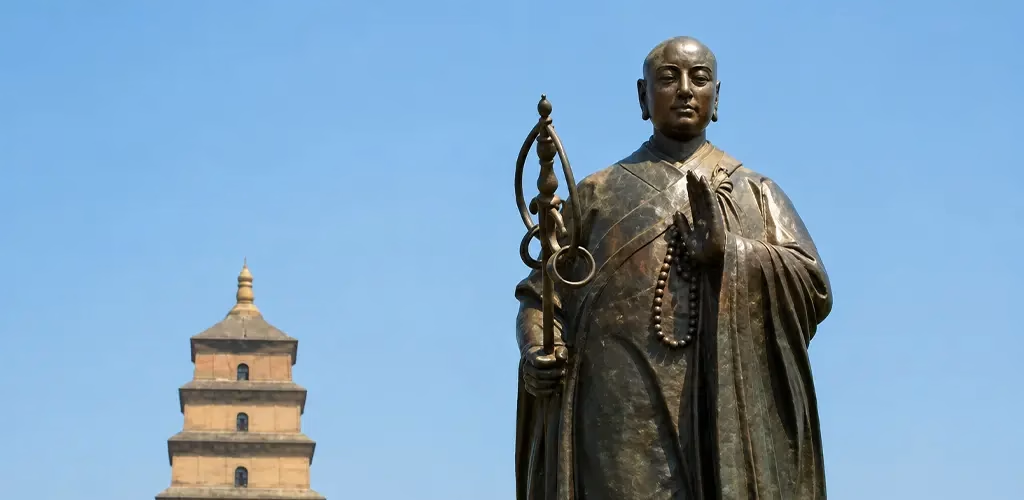
Chinese pilgrim monks who studied here, including the well-known traveller Xuanzang, spent years inside this library, copying texts to carry back home. For them, and for scholars across Asia, Nalanda was not just a school. It was the closest thing the ancient world had to a single home for all human knowledge.
When Nalanda Went Up in Flames
In 1193, an army led by the Turkic general Bakhtiyar Khilji arrived at Nalanda during a wider campaign across Bihar.
What followed was quick and brutal. Monks were killed, buildings were ransacked, and the great library was set on fire. Because the shelves were so densely packed with manuscripts, the fire did not simply burn out in a day.
According to several historical accounts, it kept burning for months, with smoke said to remain visible over the nearby hills long after the attack.
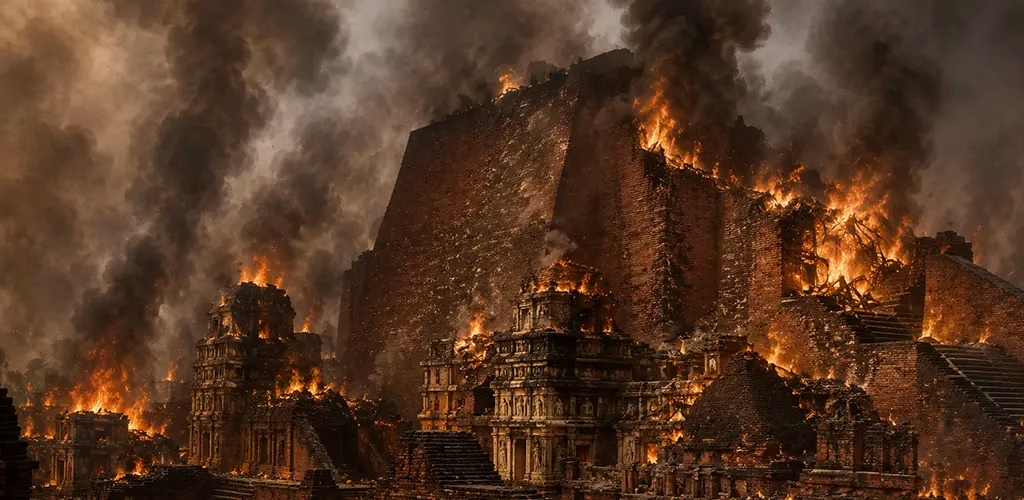
By the time the fire finally settled, centuries of recorded knowledge on medicine, astronomy, mathematics, and philosophy, had turned to ash. Nalanda never fully recovered, and within a few decades, it stood abandoned.
Nalanda Was Gone, But Its Story Wasn’t
Kerala’s literacy rate today is close to one hundred per cent, a number few states have dreamed of achieving.
But the real story is not in the numbers.
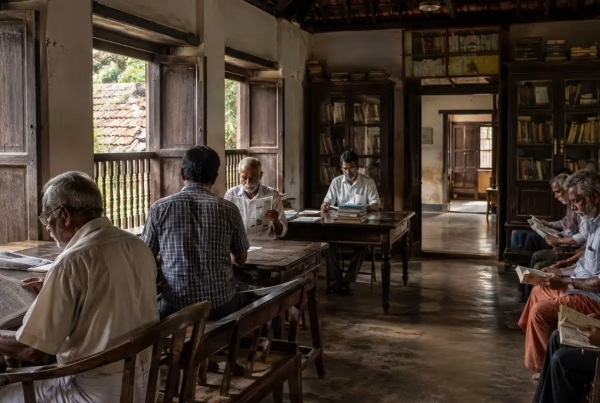
An entire state learned to read not because of one big school system, but because of thousands of small reading rooms and ordinary volunteers who believed that reading should be for everyone, not just those who could sit inside a classroom.

Nalanda’s story reminds us how easily even a great centre of knowledge can disappear if no one protects it. Today, the new Nalanda University stands nearby, carrying the same idea forward.
Because Nalanda may have been reduced to ruins, but what it stood for was never meant to end.