
Bhagwaan Vishnu’s Sleep During Monsoon: The Ancient Secret Hidden Within Chaturmas
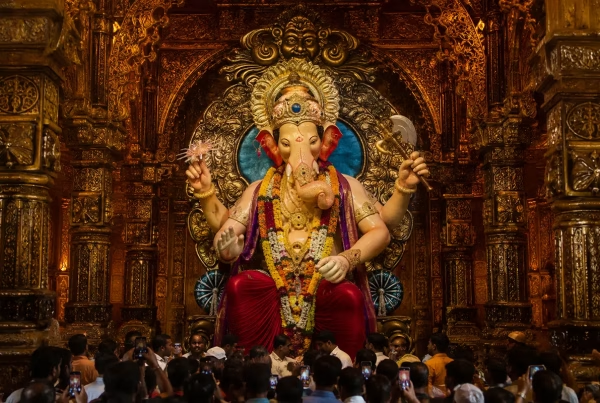
There are only a few ideas in Hindu mythology as intriguing as this one: every year, for four months, the preserver of the universe goes to sleep.
Not a king, not a sage, and not an ordinary deity, but Bhagwaan Vishnu himself.
The very force responsible for maintaining cosmic order, protecting dharma, and preserving existence withdraws from active engagement and enters a state of profound stillness. Across India, this moment marks the beginning of Chaturmas, a sacred four-month period during which weddings are postponed, pilgrimages slow down, monks remain in one place, and millions of devotees turn their attention inward.
At first glance, the idea feels almost paradoxical. Why would the guardian of the cosmos sleep? If Vishnu sustains the universe, what happens when he closes his eyes?
The answer lies within one of Hinduism’s most elegant blends of mythology, philosophy, and environmental wisdom – a story that reveals how ancient India understood not only the divine, but also the rhythms of nature and the human mind.
The Four Months When the Hindu World Slows Down
Chaturmas, which literally translates to four months, begins on Devshayani Ekadashi in the month of Ashadha and concludes on Prabodhini Ekadashi in Kartik. On the Gregorian calendar, this period generally spans from June or July to October or November, aligning almost perfectly with the Indian monsoon.
This alignment is far from accidental.
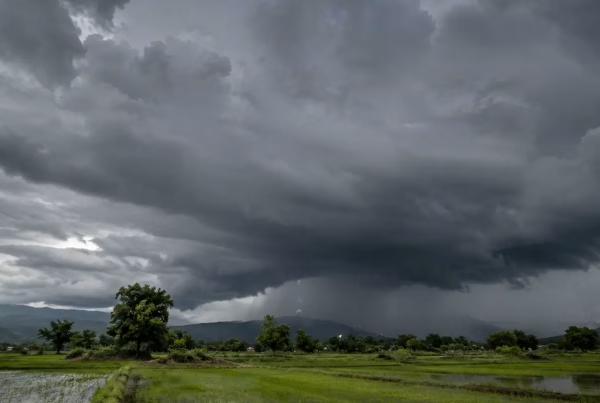
For much of Indian history, the arrival of the rains transforms daily life in a way that roads become muddy, rivers flood, there is extreme humidity in the air, and diseases and germs somehow find their way into the weather. The monsoon demands nothing but extreme caution.
Ancient Indian traditions responded not by resisting these seasonal realities, but by incorporating them into spiritual life. The result was Chaturmas – a time that encouraged restraint over expansion, reflection over movement, and contemplation over ambition.

To explain this shift, mythology offered a powerful image: Vishnu entering Yoga Nidra, a state often translated as cosmic sleep.
Yet Yoga Nidra is not sleep in the ordinary sense. Vishnu does not abandon creation, nor does the universe descend into chaos. The planets continue their journeys, seasons continue their cycles, and life unfolds as it always has. What changes is the cosmic mood.
The King Who Changed the Cosmos
Like many Hindu traditions, the origins of Chaturmas are woven into mythology, and one of its most beloved stories begins with a king.
Mahabali, often known simply as Bali, was among the most powerful rulers in Hindu lore. Unlike many mythological conquerors, however, he was admired not for cruelty but for his generosity. His fame spread across the three worlds, and his kingdom flourished under his rule.
As Bali’s influence grew, Vishnu descended to Earth in the form of Vamana, a dwarf Brahmin. Approaching the king during a sacred ritual, Vamana asked for a seemingly modest gift: three paces of land. Bali agreed without hesitation. In an instant, the dwarf transformed into a colossal cosmic being. With his first step, he covered the earth. With his second, he spanned the heavens. There was nowhere left for the third.

Recognising the divine presence before him, Bali bowed his head and offered himself. Moved by the king’s humility and devotion, Vishnu granted him a boon. Different traditions narrate the boon differently, but many connect it to Vishnu spending part of each year with Bali. Over time, this association became intertwined with the belief that Vishnu withdraws into Yoga Nidra during Chaturmas.
The story survives not merely because of its spectacle, but because of the lesson hidden within it. Power, Hindu mythology repeatedly reminds us, is meaningful only when balanced by humility. Bali loses a kingdom, yet gains immortality in memory.
The Sleep That Isn't Sleep
The deeper one looks at Yoga Nidra, the more fascinating it becomes.
In modern thinking, sleep is often represented as inactivity. Ancient Indian philosophy viewed things differently. It recognised that some of the most important processes in existence occur during periods of apparent stillness.
Seeds lie dormant before they germinate, the earth rests before harvest, and even the human body heals itself most effectively during sleep.
Yoga Nidra reflects this principle on a cosmic scale.

Rather than symbolising absence, Vishnu’s sleep represents a state of perfect awareness beneath perfect stillness. It is a condition where action ceases, but consciousness remains fully awake. The universe, in this view, is not paused. It is held in potential.
Ancient sages understood something modern societies often struggle to remember: constant activity is not the same as meaningful progress. Every cycle of growth requires a corresponding cycle of rest. Vishnu’s cosmic sleep transforms that observation into a sacred truth.
The Serpent Beneath the Universe
No image of Vishnu’s Yoga Nidra is complete without the serpent upon whom he rests.
Known as Ananta Shesha, this multi-headed cosmic serpent is among the most profound symbols in Hindu thought. The name itself reveals his significance. Ananta means endless, and Shesha means that which remains.
Together, they represent infinite time – the eternal reality that survives every cycle of creation and destruction. In Hindu cosmology, universes emerge and dissolve repeatedly. Empires rise and fall. Civilisations flourish and fade. Stars are born and eventually perish. Yet something always remains, and that remainder is Shesha.
By depicting Vishnu resting upon the serpent, Hindu philosophy conveys a remarkable idea: even during periods of apparent inactivity, existence rests upon an enduring foundation. Beneath every change lies continuity. Beneath every ending lies permanence. The image is not one of sleep alone. It is an image of cosmic stability.
Why Humans Follow the Rhythm of the Gods
The symbolism of Chaturmas did not remain confined to mythology. Over centuries, it has shaped everyday life.
Traditionally, major ceremonies such as weddings, housewarmings, and new business ventures were postponed during these months. Monks suspended their travels and stayed in one location, a practice mirrored in Jain and Buddhist traditions as well.
The purpose was not superstition; it was synchronisation.

If nature itself was entering a season of retreat, then human beings were encouraged to do the same. Rather than pursuing external achievements, people focused on spiritual disciplines: fasting, prayer, scripture reading, charity, and self-reflection. Many devotees undertake personal vows during Chaturmas. Some abstain from specific foods. Others dedicate themselves to daily recitation of sacred texts such as the Bhagavad Gita or the Vishnu Sahasranama.
What emerges is a season dedicated not to acquiring more, but to becoming more conscious. In many ways, Chaturmas functions as a civilizational reset button.
The Monsoon Wisdom Hidden Within the Myth
Perhaps the most remarkable aspect of Chaturmas is how seamlessly it blends spiritual symbolism with ecological awareness.
The Indian monsoon is one of the most powerful seasonal events on Earth. It replenishes rivers, nourishes crops, revives forests, and sustains hundreds of millions of lives. Yet it also forces a temporary slowdown in human activity. Ancient India observed this pattern and transformed it into philosophy. Vishnu’s rest became a cosmic reflection of nature’s own rhythm.
The message was subtle but profound: life is not meant to move at the same pace throughout the year. Just as fields require fallow periods and forests undergo cycles of renewal, human beings also need seasons of withdrawal and reflection. In an age obsessed with relentless productivity, this idea feels surprisingly modern. The ancients understood that restoration is not the opposite of progress.
It is what makes progress possible.
When Vishnu Awakens
After four months, the stillness comes to an end. On Prabodhini Ekadashi, Vishnu awakens. Temples celebrate the occasion with special prayers and ceremonies. Wedding season resumes. Pilgrimages regain momentum. Communities prepare for the festivals that define the months ahead. The world begins moving outward once more.
Yet the true significance of Chaturmas lies not in its ending, but in what it teaches during those four quiet months.
The story was never simply about a sleeping god.
It was about rhythm – recognising that existence moves through cycles of action and reflection, expansion and retreat, effort and renewal.
The image of Vishnu resting upon the endless serpent has endured for centuries because it captures a truth far larger than mythology. It reminds us that even the cosmos pauses. Even the preserver withdraws. Even the divine embraces stillness. And perhaps that is the lesson hidden at the heart of Chaturmas: that rest is not an interruption in the journey of life. It is an essential part of it.