The Dead Are Talking: How DNA Is Rewriting India’s History
For centuries, history was taught from what people left behind: inscriptions, ruins of old forts, faded manuscripts.
But there is one witness that historians almost never got to question directly, the dead themselves, but it is changing now.
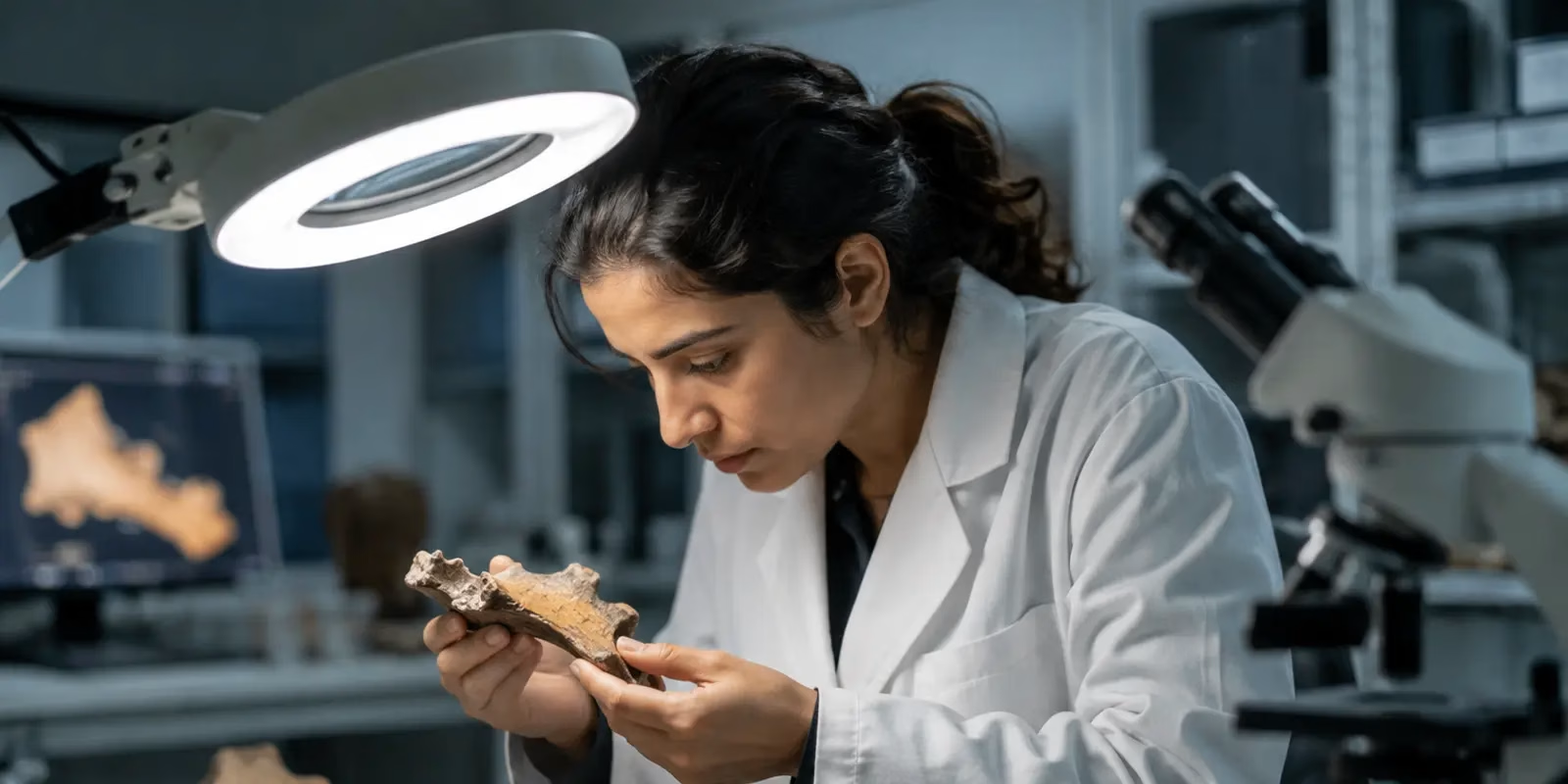
Scientists across India are extracting DNA from centuries-old bones and teeth, and what they’re finding is upending stories that archaeology alone could never fully explain.
A queen presumed lost. A lake full of mysterious skeletons. An entire subcontinent’s tangled ancestry.
It turns out that the dead have quite a lot to say.
A Queen, A Church, and A 400-Year-Old Mystery
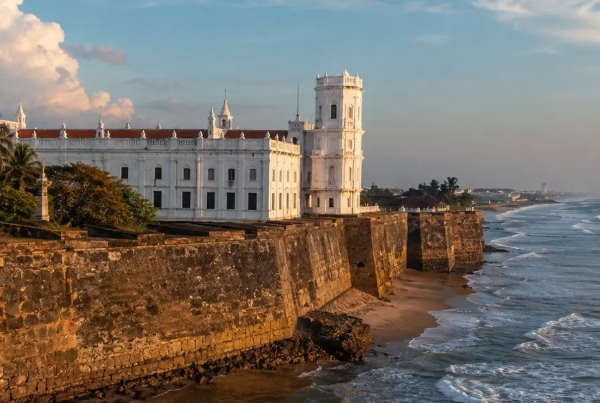
In Goa stand the ruins of the Church of St Augustine, once one of the largest Augustinian churches in the world, abandoned after the Portuguese expelled the Augustinian order in 1835.
According to legends, the remains of a queen are buried somewhere beneath the rubble.
Her name was Ketevan, queen consort of a kingdom in eastern Georgia. Captured by a Persian ruler in the early 17th century, she was executed after refusing to change her religion. According to the ruler’s religion and old records, a friar smuggled part of her remains all the way to Goa, where they were laid to rest in a stone casket.
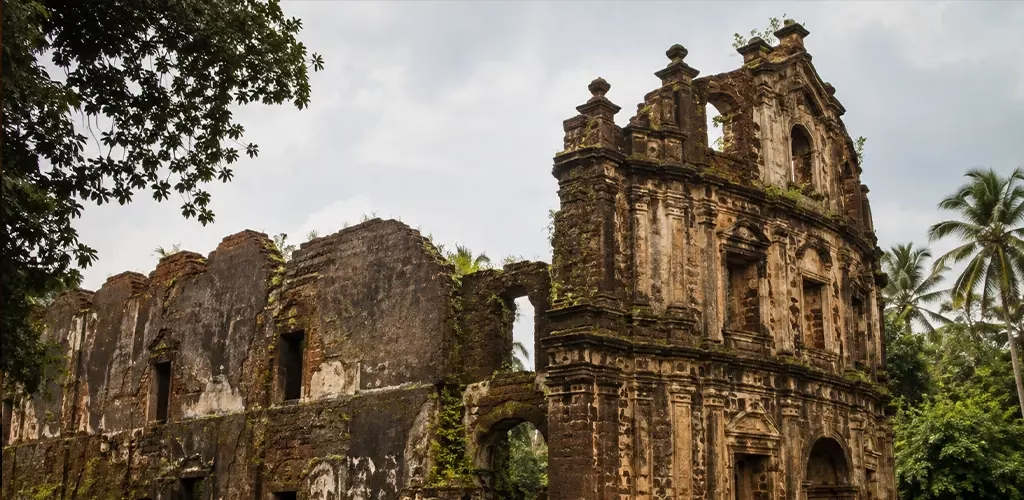
For nearly four centuries, this was nothing more than a table talk. Then in 2005, a team of archaeologists dug up three bone fragments near the old chapel.
Could one belong to a Georgian queen who died thousands of kilometres away?
This is where science stepped in where old texts and folklore could not. Geneticists at a laboratory in Hyderabad ran mitochondrial DNA tests on the fragments and compared them against samples brought from Georgia. One of the three bones lined up as very likely belonging to Ketevan.
The discovery was more than a win for historians; it turned into a meaningful diplomatic moment between India and Georgia. The relic was eventually sent back to Georgia for an exhibition, and years later, India’s External Affairs Minister personally handed it over to Georgian officials.
A centuries-old mystery, closed by a strand of DNA.
The Skeleton Lake That Wasn't What It Seemed
High in the Himalayas, at nearly 5,000 metres, lies Roopkund, a small glacial lake that has both fascinated and unsettled people for decades.
When its ice melts, it reveals hundreds of human skeletons in the lake’s water.
For years, the assumption was simple: everyone here died together in one disaster.
But the DNA testing revealed a very strange story.
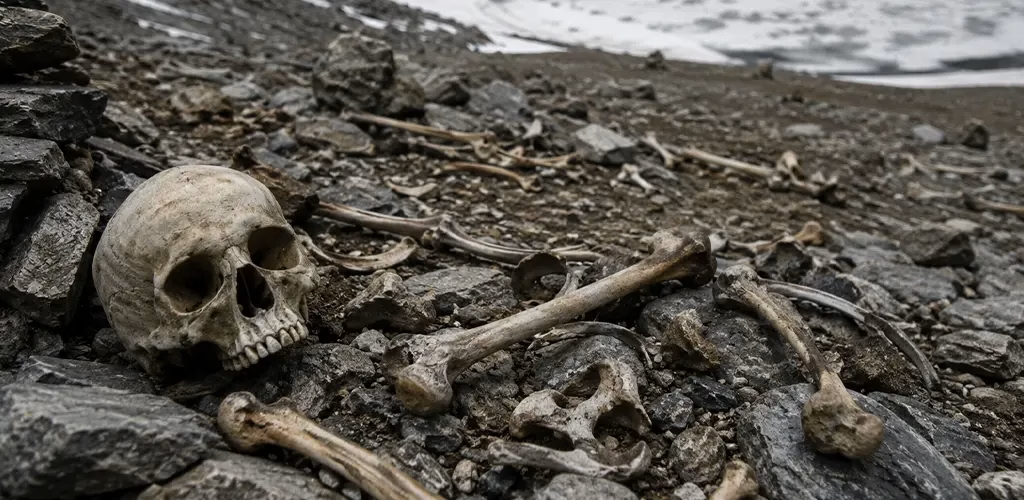
The skeletons didn’t belong to one event at all. One large group, of South Asian ancestry, dated back roughly 1,200 years. A separate group, with ancestry tracing to the eastern Mediterranean, and even one individual linked to Southeast Asia, died around 200 years ago.
Two completely different sets of people, from different parts of the world, died at the same remote lake a thousand years apart.
The leading theory now is that the older group were pilgrims heading toward a mountain temple who lost their way and were caught in a violent hailstorm. While how the second group ended up there remains an open question, one that the researchers are still chasing through further testing of the bones’ teeth and chemistry.
Why This Kind of Science Is So Hard in India
Reading DNA that is hundreds or thousands of years old sounds almost like magic, but it is punishing, painstaking work, especially in India.
Cold, dry climates preserve ancient DNA beautifully. But India’s heat, humidity, and bacteria do the opposite.
A bone sample that gives researchers clear genetic material in Europe may tell them almost nothing in India. The heat, humidity and soil conditions can damage DNA over time, sometimes forcing researchers to repeat the extraction process as many as ten times just to get a usable sample.
Scientists have learned to target two parts of the skeleton that survive best: the teeth and a dense little bone near the inner ear that protects genetic material from decay far longer than the rest of the skeleton. Even the chemical composition of a tooth can reveal where a person grew up, based on what they drank as a child.
It is slow, exacting science, and it is only possible because dedicated ancient-DNA labs have been built in India over the last two decades, staffed by researchers in sterile suits, working under UV lights and controlled air pressure to keep even a single stray skin cell from contaminating a sample.
The Stories Hidden in the Bones
Beyond solving individual mysteries, this research is also changing the way India looks at its own population history.
Genetic studies show that most people across the subcontinent have ancestry from several different groups. These include ancient hunter-gatherers, early farming communities from the Iranian plateau, and pastoral groups that came from Central Asia much later. The mix is different across regions and communities, but the idea of one completely “pure” lineage does not really fit India’s complex history.
Some communities have origin stories tying them to distant lands. When tested, the genetics sometimes agree, and sometimes they don’t. Oral history and DNA are not always telling the same story, and reconciling the two isn’t always comfortable. Some researchers now share findings with communities before publishing, and have quietly shelved studies when communities objected.
IIt’s a reminder that this science is not just about studying ancient remains. It is also about understanding who we are, where we belong, and how the story of our past has been shaped.
The Past Is Still Being Written
Ancient DNA has not given us all the answers about India’s past. There are still very few samples, DNA breaks down over time, and new evidence can change what we think we know. In many cases, finding one answer only leads to two more questions.
But something has genuinely shifted. For most of history, we could only study what people left behind, their tools: their buildings, their words. Now, for the first time, we can study all of that.
The bones were always there. We just didn’t know how to ask them anything.