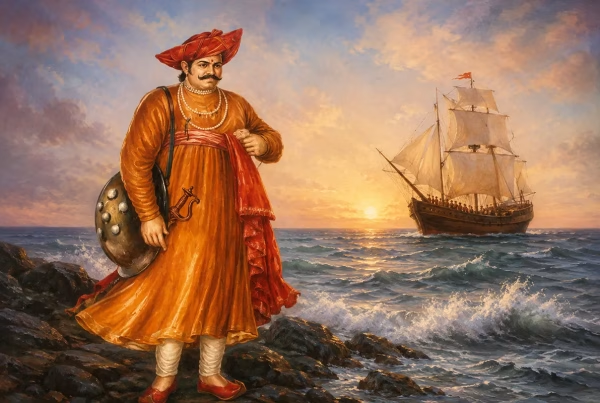

U Tirot Sing: The Young Chief of the Khasi Hills
When we talk about freedom fighters of India, names like Bhagat Singh and Rani Lakshmi Bai are often the first to cross our minds. But hidden in the hills of Meghalaya is the story of a young tribal chief who fought the British long before the Revolt of 1857.
His name was U Tirot Sing Syiem.
He did not have cannons or trained soldiers. Yet, for four years, he kept the powerful British East India Company on edge.
The Khasi Agreement That Changed Everything
The story begins in 1857.
The British had just taken control of the Assam valley. They wanted to build a connecting road from Assam to Sylhet, which had to pass through a region called Nongkhlaw, in the Khasi Hills.
U Tirot Sing, a young chief, was the ruler of the Nongkhlaw region.
In Khasi tradition, a chief could not make decisions alone. So when a British official, David Scott, brought the proposal to him, Tirot Sing called a Durbar, a meeting where village elders discussed matters that affected everyone.
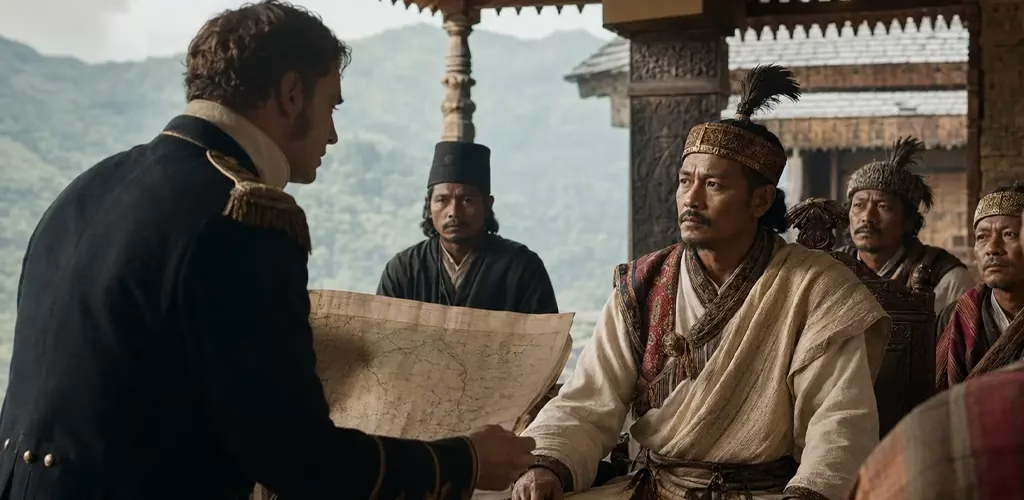
For two days, they debated over this matter.
The British promised that if the Khasis allowed the road, they would get free trade benefits and protection. The council believed these promises and finally agreed. At that moment, it looked like the beginning of a partnership.
But the people of the Khasi Hills were about to learn that the promises they trusted would not last for long.
The Broken Promise Started the Khasi Rebellion
Soon after construction started, everything changed. It did not take long for the Khasis to realise they had been deceived.
The British started bringing more soldiers into the hills, collecting taxes from the local people, and behaved as if the land already belonged to them. Rumours began to spread that once the road was finished, the British would completely take over the hills and strip the Khasis of their freedom. Tirot Sing realised that he had allowed outsiders into his homeland by trusting their words.
He formally asked the British to stop the construction and leave his land. When the British ignored his warning, Tirot Sing knew he had no choice but to fight.
On 4 April 1829, Tirot Sing and his warriors launched a surprise attack on the British camp at Nongkhlaw; this marked the beginning of the Anglo-Khasi War.
How U Tirot Sing Used the Khasi Hills as a Weapon
The battle was never equal.
The British army had modern guns and trained soldiers. The Khasi warriors only had swords, shields, and bows with arrows. This battle would have ended the moment it started, but Tirot Sing fought differently.
Whenever British soldiers entered the hills, Khasi warriors appeared without warning. They attacked from behind dense forests and narrow mountain paths. Before the British could even aim their rifles, the warriors would vanish back into the wilderness.
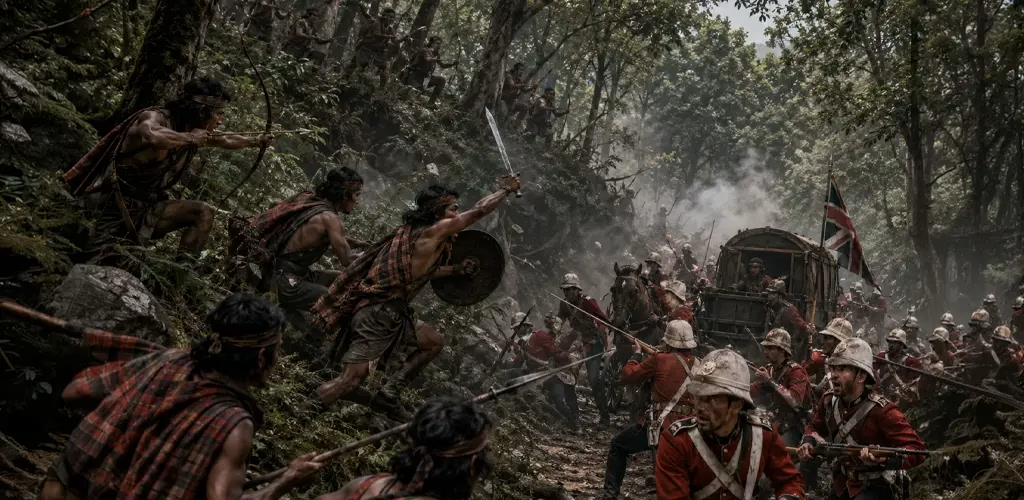
The British never knew where the next attack would come from.
Even after being hit by a bullet, Tirot Sing refused to give up. He hid inside a secret cave and continued leading his people.
For four years, the British struggled to defeat someone they could rarely even see.
But as history often shows, not every battle is lost on the battlefield.
The Betrayal That Led to The Capture of Tirot Sing
By 1832, the British realised that their weapons alone would not win this war. So they changed their plan.
Instead of chasing Tirot Sing through the forests, they began burning down the Khasi villages and destroying crops in the hope that the people would surrender out of hunger.
Even then, the British could not catch Tirot Sing. In the end, it was betrayal that brought him down.
The British bribed a neighbouring chief with gold coins, and in return he gave away the location of the secret cave where Tirot Sing was hiding. On January 13, 1833, Tirot Sing was surrounded and captured.
The British did not execute him right away. They feared that killing such a respected leader would inspire an even bigger rebellion. Instead, they sent him far away to a prison in Dhaka. While in prison, the British offered to release him and restore his wealth if he accepted British rule. Tirot Sing refused, stating that he would rather die as a king in a cell than rule as a slave in a palace.
That decision became the final chapter of his life, but not the end of his story.
The Legacy of Tirot Sing
On July 17, 1835, Tirot Sing passed away in prison, far from the hills he fought so hard to protect and was never able to return to.
He lost his land, his freedom and his life, but never his courage. The story of Tirot Sing reminds us that while a person can be imprisoned, their spirit cannot. So, who was truly defeated in the end, the man in the prison cell or the empire that could never break his spirit?