
A Missed Income Tax Department Clue That Turned Into India's First Stock Market Scandal
If you’ve watched Scam 1992, you probably know the story of Harshad Mehta as one of India’s biggest stock market scams. But it wasn’t India’s first financial scandal.
The LIC scam that shook the country was independent India’s first financial scandal, but there were already warning signs. Among the earliest institutions to raise concerns was the Income Tax Department, which had identified serious financial troubles surrounding businessman Haridas Mundhra.
Yet despite those red flags, public money was used to rescue his failing companies.
What followed became one of the most controversial financial scandals in India’s history – one that changed how public institutions were held accountable.
So, who was the man behind it all?
Haridas Mundhra: The Rise of a Market Mastermind
The entire scandal revolves around a man named Haridas Mundhra.
Haridas Mundhra was from a small trading family in Kolkata, so he grew up around business. Mundhra started his career as a light bulb salesman before slowly making his way into the stock market.
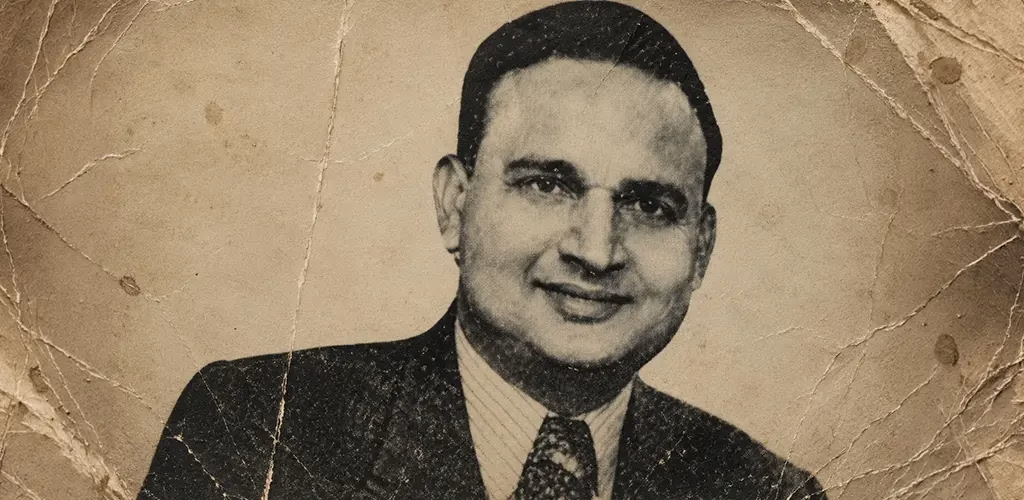
He began his stock market journey by helping investors buy and sell shares and earning commissions from them. Gradually, he started investing in shares himself.
When Haridas Mundhra entered the stock market, he began by buying shares of companies that were struggling to survive. By purchasing enough shares, he gradually gained control over these companies, which meant he could influence many of their major financial decisions.
At first, it looked like a smart business move. But there was something bigger hidden behind the scenes. The companies that Mundhra was buying had one thing in common: they still had a large amount of cash reserves. Once Mundhra gained control, he used the resources of that company to acquire another, and then kept repeating the process again and again.
But buying companies wasn’t enough.
To keep expanding, Haridas Mundhra needed people to believe his companies were becoming more valuable. So, he started spreading rumours that the share prices of his companies would rise in the future. Many investors bought those shares hoping to earn huge returns. He also used forged share certificates to create fake demand in the market.
With every acquisition and rising share price, his business empire grew larger, and to the outside world, Haridas Mundhra was nothing less than a financial genius.
But while investors admired his success, regulators were beginning to notice cracks beneath the surface.
The Fall of a Financial Genius
For a while, everything seemed to be working in Mundhra’s favour. His companies were growing, and investors believed they were worth far more than they actually were.
But every plan built on false promises eventually falls apart.
By late 1956, Mundhra’s luck ran out. Stock exchanges discovered that some of the share certificates linked to Mundhra were fake. This news shook investors’ confidence. Eventually, the share prices crashed, creditors came asking for their money, and Mundhra found himself buried under massive debts.
His entire business empire was on the verge of collapse, and he needed a huge amount of money to save it.
As his financial position weakened, the Income Tax Department had also begun taking notice. Mundhra reportedly owed substantial unpaid income taxes, and the department was preparing to recover the dues. It was one of the earliest official signs that all was not well within his business empire.
The Sunday Nobody Knew About
It was 1956 when the Government of India had recently created the Life Insurance Corporation of India (LIC) by nationalising private life insurance companies. Almost everybody in India trusted LIC with their savings, believing the government would invest their money carefully and responsibly.
For Haridas Mundhra, however, LIC looked like the perfect way out.
Mundhra knew LIC had plenty of money, so he used his connections and reached out to senior officials in the Finance Ministry. He claimed that if his companies failed, it could create panic in the stock market and hurt the country’s economy. According to him, saving his businesses was in the national interest, so the officials agreed.
In June 1957, LIC bought over ₹1.24 crore worth of shares in six of Mundhra’s failing companies.
But this was beyond an ordinary investment. The deal was carried out on Sunday, when the stock market was closed. Even more surprising, they skipped the mandatory committee that was supposed to review and approve all LIC investments.
With this, Mundhra received the money he desperately needed within a single day. His companies got a lifeline, while LIC was left holding shares that were already losing their value. They believed that the deal would remain hidden forever.
But secrets rarely stay hidden for long.
A few months later, one man stood up in Parliament and asked a question that changed everything.
The Man Who Exposed the Scam
The truth came out from a place the government least expected.
Rumours had started spreading about a suspicious investment made by LIC. While most people ignored them, one Member of Parliament decided to dig deeper.
He was Feroze Gandhi. Instead of protecting his party, he gathered evidence and stood up against this scandal.
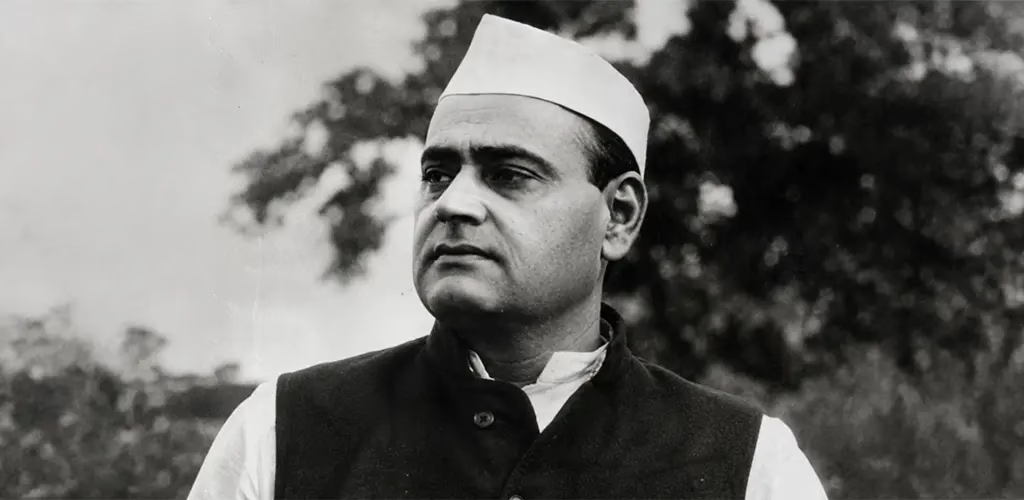
On December 16, 1957, he showed clear proof in Parliament of how public money was secretly used to save the companies of Haridas Mundhra.
His speech created a political storm.
People across the country wanted answers. Newspapers covered the story, and the government could no longer ignore the allegations.
To find out what really happened, Prime Minister Nehru appointed Justice M. C. Chagla to lead an independent inquiry. The inquiry was held in public with thousands of people gathered outside the courtroom to listen to the proceedings every day.
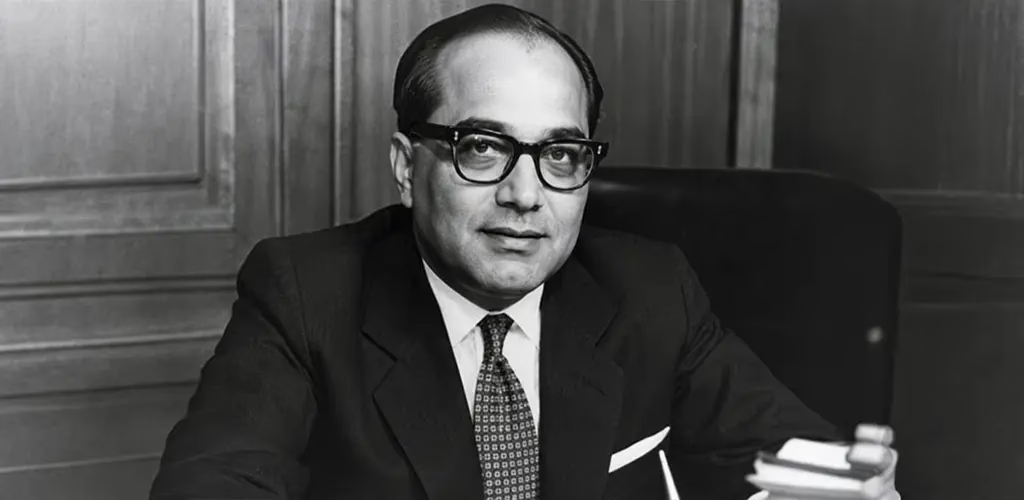
After 24 days of investigation, Justice Chagla submitted his report.
He clearly stated in his findings that the deal was completely improper and the LIC investment should never have happened. With that, he also declared that the proper rules were ignored, and the Finance Ministry was held responsible for allowing the deal to go through.
This led to the resignation of Finance Minister T. T. Krishnamachari from his post. Several senior officials were investigated and suspended. Haridas Mundhra was arrested, convicted, and sentenced to prison for 22 years.
The scam was finally over. Or was it?
The Forgotten Tax Clue
There was one part of the story that most people overlooked.
Long before LIC gave him even a single rupee, the Income Tax Department was actually chasing Haridas Mundhra. He owed a huge sum of money in unpaid income taxes. The tax department was getting ready to freeze his bank accounts and seize his assets to recover the dues.
Then, around the same time, LIC bought shares in his struggling companies; the action against him suddenly slowed down. Some believed he was given time to repay his dues using the LIC money, while others suspected political influence. There was no final conclusion to this.
Looking back today, one question still lingers: if the early warning signs had been acted upon more decisively, could independent India’s first major financial scandal have been prevented?